Belform and Alfred Hendrickx: a story of post-war Belgian furniture
Home ” Newspaper ” Belform and Alfred Hendrickx: a story of post-war Belgian furniture
In the history of post-war Belgian furniture, Alfred Hendrickx holds a singular place. Today, his name is mainly associated with Belform, its sideboards and credenzas with taut lines, its tables, seating and modular storage systems. Developed between the 1950s and 1960s, this production coincides with a moment when Belgian furniture gradually moved away from traditional models to adopt a lighter modernist language better suited to new interiors.
The relationship between Alfred Hendrickx and Belform is, however, more complex than a simple collaboration between a designer and a publisher. Belform originated within the Van Fleteren family business, and Hendrickx was directly involved in its development. A period Belform catalogue kept by Vintage Addict, undated but explicitly bearing the trilingual mention “ontwerp / création / entwurf : Alfred Hendrickx”, now makes it possible to view this production through its own commercial documents: materials, compositions, dimensions and, above all, model numbers.
Several pieces illustrated in this catalogue have also passed through Vintage Addict. Comparing them with the period photographs therefore makes it possible to complement historical sources through direct observation of the pieces.
From Van Fleteren to Belform
Born in Mechelen in 1931, Alfred Hendrickx grew up in an environment directly connected to furniture making. His grandfather, master cabinetmaker Eugène Van Fleteren, designed and carved himself the two Eisteddfod chairs (Welsh cultural festivals) for the national events in Wales in 1917 and 1918. These chairs are considered export masterpieces of the famous Mechelen furniture tradition. During the interwar period, the Mechelen master founded the Van Fleteren company. After the Second World War, the business first specialised in ship interior fittings before turning, around 1950, to a highly mechanised production of furniture for the home.
A 1964 invoice in which Vanfleteren and Belform appear together.
Hendrickx thus came into contact with industrial manufacturing very early on. He notably associated with Jan Kuper, one of the figures of modern Mechelen furniture in the interwar period, and also completed an internship at Pirelli in Italy. This Italian experience aligns with the evolution of his early creations: supple lines, light structures, volumes lifted off the floor and particular attention to proportions.
Alfred Hendrickx sideboard, Italian influence from the 1950s.
The distinction between Van Fleteren and Belform also deserves clarification. Contrary to what is sometimes written, Van Fleteren does not seem to have simply changed its name to become Belform. Around 1953, the new furniture designed by Hendrickx was brought together in the company’s first catalogue—a leaflet—under the promotional name Belform. It was then a new line of light, flexible, easily combinable furniture, which, according to the authors of the study Het Mechelse meubel 1500-2000, had a distinctly modern character shaped by Italian influence.
The name Belform then became inseparable from Alfred Hendrickx’s creations.
New furniture for a new way of living
As early as 1953, Hendrickx presented a model apartment at the Beter Wonen exhibition in Luchtbal, Antwerp. This furniture corresponded to the profound transformations of post-war housing: interiors became more open, homes evolved, and massive, fixed furniture sets gradually gave way to lighter elements that were easier to combine.
In Belgium, this thinking echoes that of modern social furniture, particularly visible at the national salons held in Ghent during the 1950s. Hendrickx occupied a distinctive position there. His creations responded to the functional concerns of mass-produced furniture while retaining a refinement that set them apart from strictly economical furnishings.
Period “Social Design” catalogue by Alfred Hendrickx, bearing witness to the development of Belgian modernist modular furniture.
Belform already emphasised modularity. The furniture could be combined according to the function of the room: living room, office or retail. A single construction principle made it possible to create different compositions from storage elements, drawers, doors or shelves.
This logic appears very clearly in the catalogue kept by Vintage Addict. One photograph, for example, shows a Belform wall shelving unit made up of several uprights and numbered elements, combining open bookcase, closed storage, drawers and a work shelf. It is therefore not just a wall unit designed as a definitive composition, but a true system that can be configured according to the available space.
Alfred Hendrickx, Belform and Expo 58
The 1958 Brussels World’s Fair was an important milestone in the dissemination of Alfred Hendrickx’s work.
Expo 58 became the great showcase of Belgian modernisation. Architecture, furniture, graphic design, new materials and domestic equipment all contributed to the representation of a forward-looking lifestyle. In this context, Hendrickx’s light lines and modernist vocabulary naturally found their place.
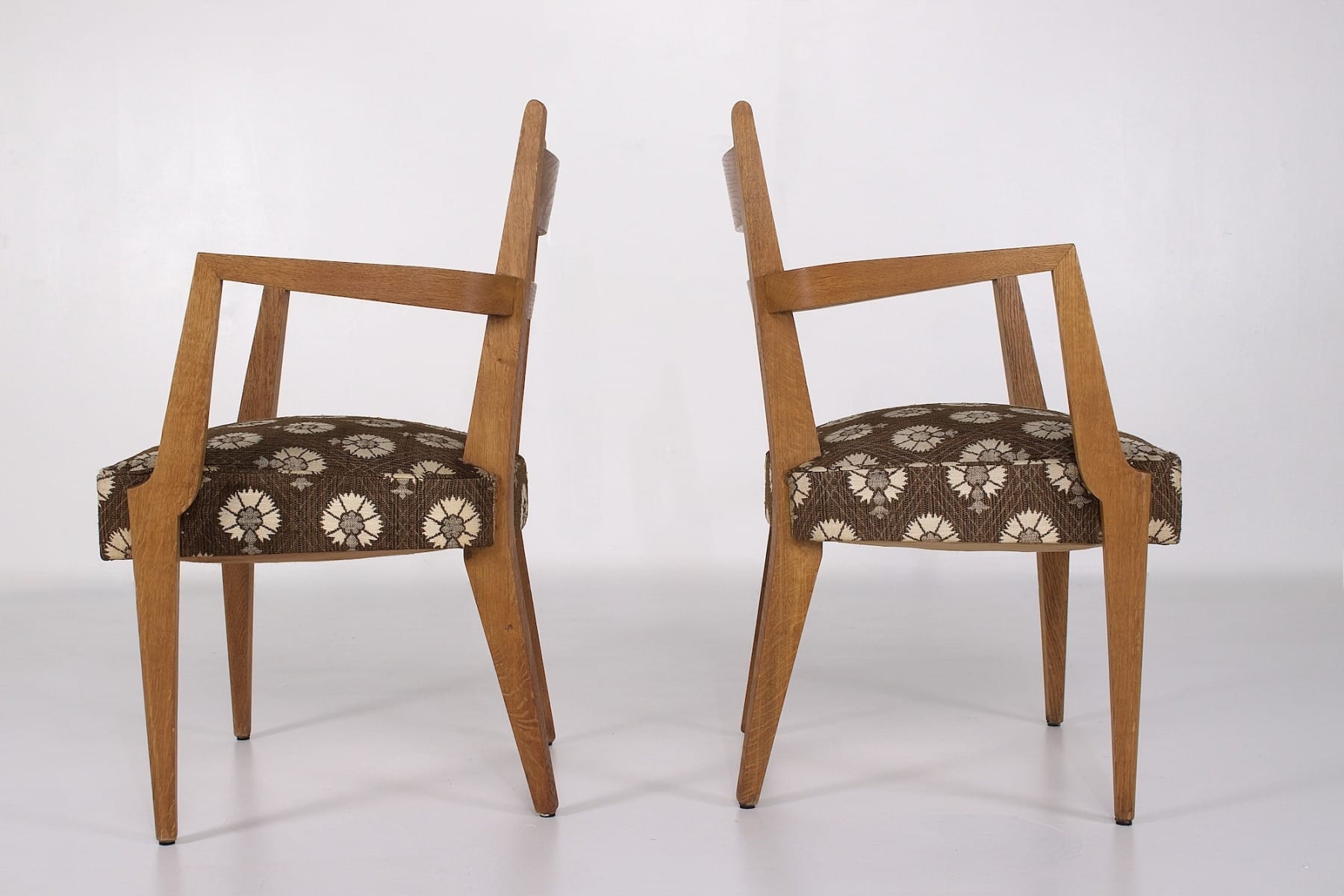
Newlyweds settled into their new Alfred Hendrickx dining room, late 1950s.
His S3 armchair, produced by Belform, remains one of the best-documented examples from this period. Hendrickx designed it as part of the fit-out of the Skyhall at Zaventem Airport for Sabena. Around 150 armchairs were made in three tweed versions—blue, mustard and red—intended to welcome travellers arriving notably for Expo 58. A copy acquired by the Fonds Marie-Jeanne Dauchy has joined the Design Museum Brussels.
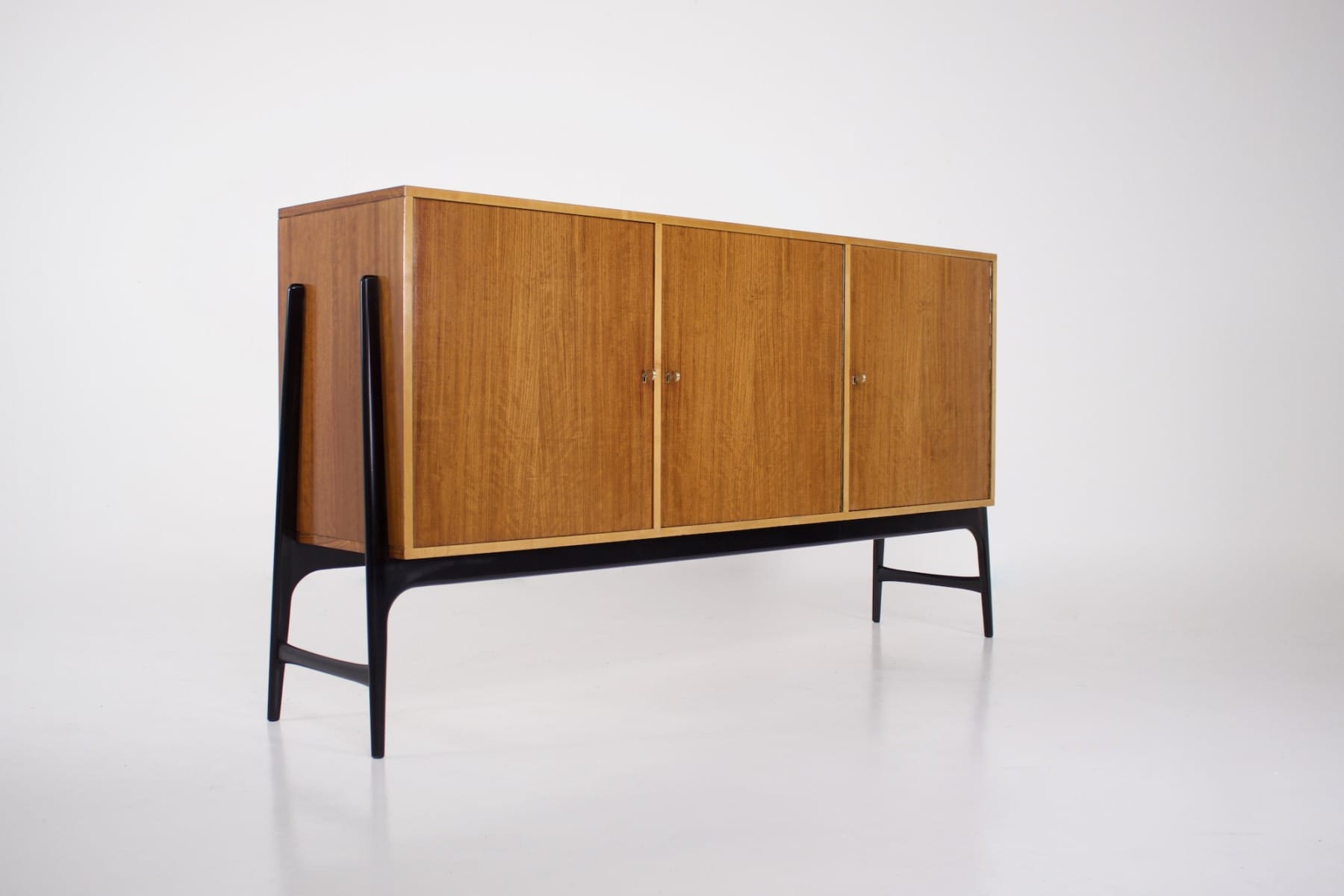
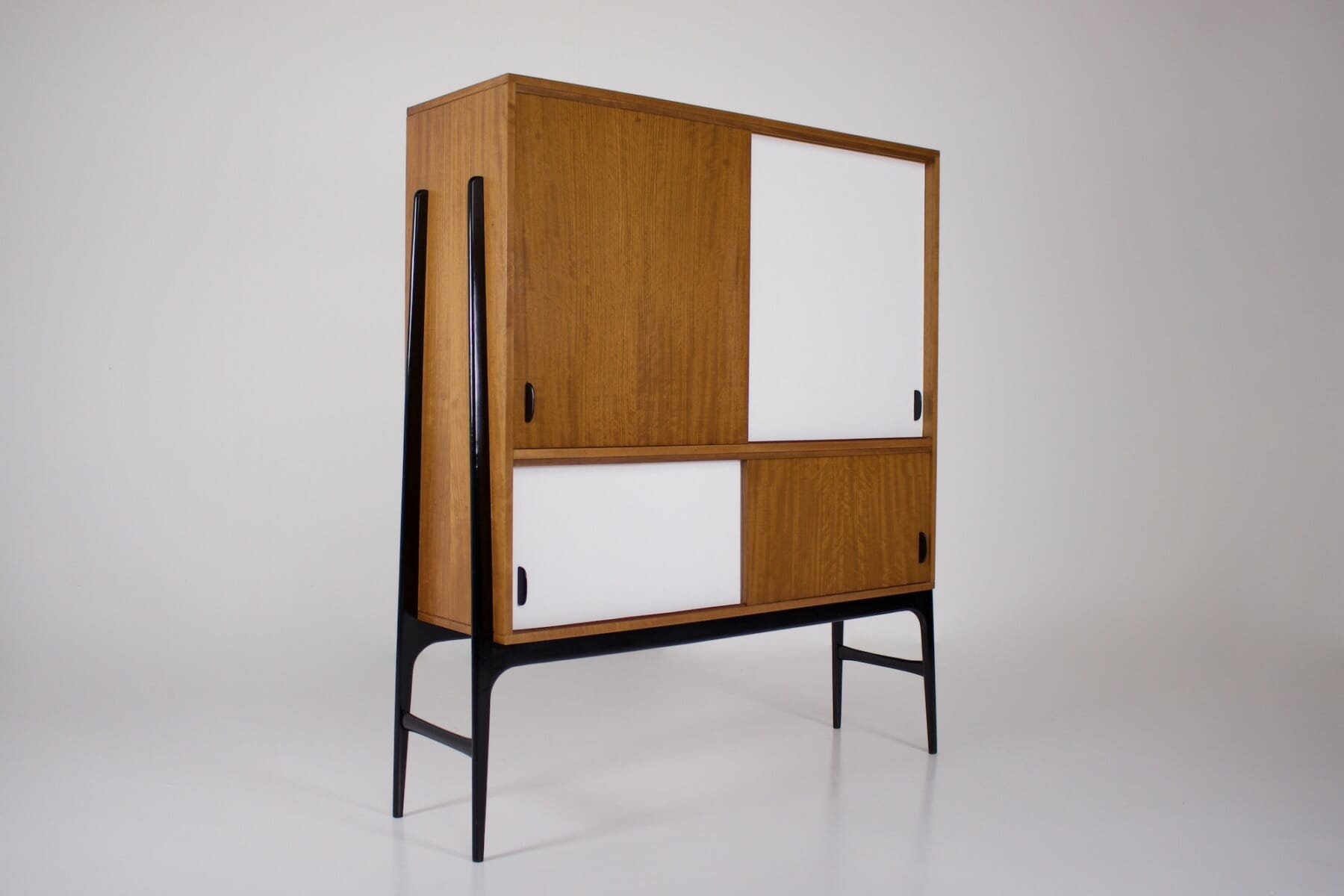
Tall sideboard or bar cabinet by Alfred Hendrickx for Belform, around 1958
Hendrickx also presented his furniture within the exhibition itself. The contacts developed on the occasion of Expo later contributed to the export of Van Fleteren production to the Netherlands, Germany, Italy and France.
From the organic lines of the 1950s to the geometry of the 1960s
Alfred Hendrickx’s furniture evolved noticeably over this period.
His creations from the early and mid-1950s often stand out for particularly fluid lines: tapered or worked wooden legs, slightly off-centre structures, curves and variations in section give the furniture an impression of movement. This research allowed Hendrickx to visually lighten volumes that were sometimes substantial.
Wood remained central, but it was combined with thick glass, marble, metal, synthetic panels and even ceramics. The Mechelen designer Willy Meysmans notably supplied ceramic elements integrated into certain Belform pieces.
At the end of the decade, the language changed. A Belform document dated 1959 shows, according to historical sources, an evolution towards much more rigorous forms: rectangles, squares, regular-section legs and metal structures gradually replaced the more expressive lines of the early 1950s. Tables, seating, desks and storage adopted a more architectural appearance.
It is precisely within this evolution that the original catalogue now kept by Vintage Addict belongs.
A period Belform catalogue
Unfortunately, the catalogue bears no visible print date. Its cover is dominated by the Belform logo, accompanied by the mention “création : Alfred Hendrickx”. An interior architect’s stamp and handwritten notes also show that this copy circulated as professional documentation.
The Belform catalogue, 1960s.
The furniture presented—large rectangular volumes, very pared-back fronts, regular-section metal bases and modular wall compositions—corresponds to the evolution begun at the end of the 1950s and widely developed during the 1960s. Some archives also list several wardrobes, secretaries, sideboards and Belform pieces that are stylistically comparable as productions from the 1960s.
This document is especially interesting because the furniture is not anonymous: Belform uses a nomenclature based on model numbers.
The Belform models documented in the catalogue
Among the references currently identified are, in particular:
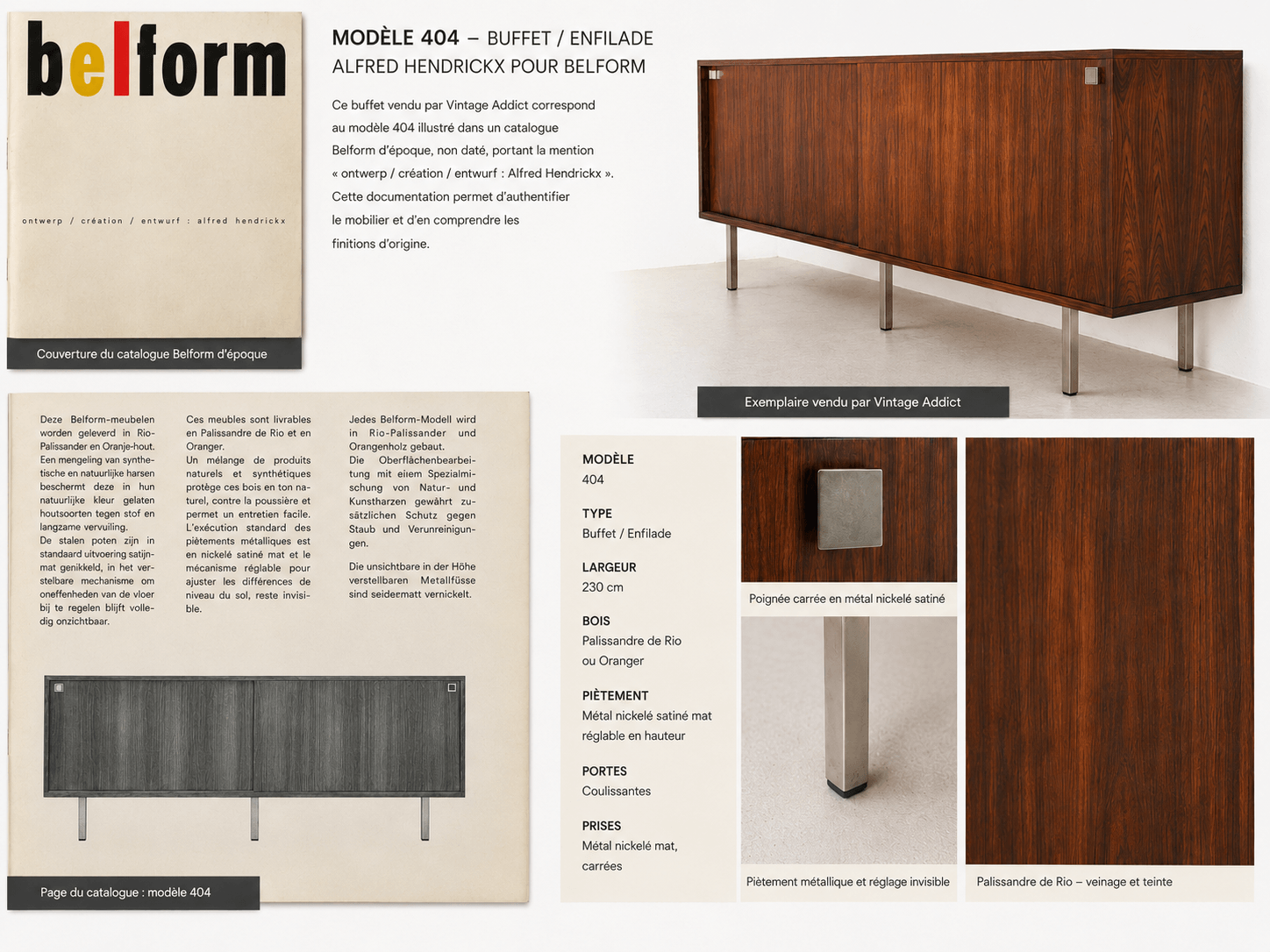
Sliding-door credenza, model 404 by Alfred Hendrickx
The 404 sideboard in the Belform catalogue
A large low sideboard with an extremely pared-back design, made up of a long rectangular case resting on slender metal legs and closed by sliding panels. The small square pulls placed in the upper part of the doors further reinforce the geometry of the front.
This numbering is particularly important for identifying Alfred Hendrickx furniture. It makes it possible to move beyond contemporary descriptions that are sometimes vague—“Hendrickx sideboard”, “Belform credenza” or “Belgian 1960s furniture”—and return to the nomenclature used by the manufacturer itself.
This match between model 404 reproduced in the catalogue and the example that passed through Vintage Addict makes it possible to document its attribution on the basis of a period commercial source explicitly bearing the mention “création : Alfred Hendrickx”.
It also illustrates very well the designer’s evolution at this time. The graphic effects and sculptural bases characteristic of certain 1950s creations have practically disappeared. The line becomes horizontal, rigorous and almost architectural, while the metal helps to visually lift the volume off the floor.
Observing several Hendrickx pieces that have passed through Vintage Addict and our restoration workshop also makes it possible to compare these commercial photographs with the manufacturing details actually used.
Rio rosewood, orange wood and nickel-plated metal
A page in the catalogue provides particularly interesting details on materials and finishes: Belform indicates that the furniture in this series can be made in Rio rosewood or orange wood. The wood receives a treatment combining natural products and synthetic resins in order to preserve its natural tone while making it easier to maintain.
The catalogue also specifies the finish of the base: the metal legs are offered in satin matte nickel plating. Their height adjustment, intended to compensate for differences in floor level, is integrated so as to remain invisible.
This information is important, because current descriptions of Hendrickx furniture frequently use generic terms such as “chrome”, “steel” or simply “metal”. Belform documentation makes it possible here to restore the terminology used by the manufacturer for this specific production.
It also helps to better understand the intended effect. The pronounced grain of the rosewood contrasts with an almost understated metal structure. The richness of the material does not result in a heavy piece: it is contained within a particularly sober geometry.
Wall units and Belform’s modular logic
One of the most interesting aspects of the catalogue concerns Belform wall shelves and storage systems.
One photographed composition combines several vertical uprights with open shelves, a closed cabinet, drawers and a work element that can serve as a small desk. The visible references—notably 411, 413 and 414—show that the composition results from assembling different elements.
Modular Belform wall bookcase-shelving unit, composite model 413 and 414
This wall bookcase can also be seen in our archives.
This design directly extends the research undertaken from the very first Belform collections. Historical sources describe Hendrickx’s furniture as elements that can be combined according to the user’s needs.
The Alfred Hendrickx bookcase or wall shelving unit should therefore not be considered only as a standalone object. It belongs to a broader reflection on interior design: storing, working, displaying and concealing can be brought together within a single structure.
This principle brings Belform closer to the major European explorations of post-war modular furniture, while retaining a distinct identity based on the quality of the woods, proportions and the sobriety of the structures.
Tables, chairs, sideboards: a broader production than a single silhouette
Today, the market strongly associates Alfred Hendrickx with sideboards and credenzas, notably the rosewood models resting on metal bases.
Yet the catalogue reminds us of the much broader scope of Belform production. Tables and coffee tables, chairs, desks, storage, furniture and complete wall compositions are conceived as different parts of the same interior.
One page thus presents table 601 accompanied by chairs 501, while other historical documents identify models such as the extendable table T4, the S6L seat or the K4 living-room unit.
Table model 601
This diversity is important for understanding Hendrickx: his work does not consist of endlessly reworking a successful credenza. He is interested in the interior space as a whole and in the way different pieces of furniture can dialogue with one another.
How can you recognise an Alfred Hendrickx piece for Belform?
Production evolved greatly between the early 1950s and the 1960s, which explains the sometimes significant differences between two creations nevertheless designed by the same designer.
Several elements nevertheless recur regularly: attention to the wood grain, volumes visually lifted off the floor, small geometric handles or pulls, the combination of wood and metal, the search for lightness and, in later productions, an increasingly rectilinear construction.
The presence of a model number, or its correspondence with Belform documentation, remains far more convincing than a simple stylistic resemblance—and that is precisely the value of an original catalogue: an identified model can then become a point of comparison for other examples.
Alfred Hendrickx in the history of Belgian design
Alfred Hendrickx belongs to the generation that profoundly renewed Belgian design in the 1950s, alongside creators such as Jules Wabbes, Willy Van Der Meeren, Jos De Mey and Lucien Engels.
His career remains distinctive, however, because of the constant proximity between the designer and the company that produced his furniture. Hendrickx did not only design prototypes or one-off pieces: his work developed in direct contact with the constraints of manufacturing, marketing and mass production.
This relationship likely explains part of Belform’s coherence. Design, materials, modular systems and technical details cannot be completely separated from one another.
The study devoted to Mechelen furniture even considers Hendrickx one of the major figures in the renewal of post-war Belgian furniture and highlights the particular place of his fluid, playful line in the 1950s before his evolution towards greater sobriety.
Today, this production is enjoying renewed visibility. The archives of specialised dealers list a wide variety of Hendrickx/Belform furniture—wardrobes, desks, credenzas, tables, seating or secretaries—while certain creations such as the S3 have entered public collections.
But this rediscovery also makes a return to period documents necessary.
The Belform catalogue kept by Vintage Addict is, in this respect, a particularly useful source: it does not replace the historical research devoted to Alfred Hendrickx, but makes it possible to add original commercial documentation, model references, materials and period photographs. As the pieces documented in this catalogue are identified among those that have passed through Vintage Addict, this documentation can be enriched and gradually form a corpus devoted to Alfred Hendrickx’s furniture for Belform, between the history of Belgian design and direct observation of the furniture.
Joseph-André Motte holds a unique place in the renewal of post-war French furniture. However, his career was not limited to furniture design: he was also active in interior architecture, the layout of public facilities, teaching,...
René-Jean Caillette (1919–2004) belongs to that generation of designers who, in the 1950s and 60s, profoundly transformed French furniture. At a time when furnishing still hesitated between decorative tradition and industrial production, he resolutely chose...
Are you wondering how to choose a wall sconce? The answer depends on the room to be lit, the desired light, the materials, the mounting height, and the style of your interior. A wall sconce...
×
1
Product selection
2
Contact information
3
Review information
error: Content is protected !!
Gérer le consentement
Pour offrir les meilleures expériences, nous utilisons des technologies telles que les cookies pour stocker et/ou accéder aux informations des appareils. Le fait de consentir à ces technologies nous permettra de traiter des données telles que le comportement de navigation ou les ID uniques sur ce site. Le fait de ne pas consentir ou de retirer son consentement peut avoir un effet négatif sur certaines caractéristiques et fonctions.
Fonctionnel
Always active
L’accès ou le stockage technique est strictement nécessaire dans la finalité d’intérêt légitime de permettre l’utilisation d’un service spécifique explicitement demandé par l’abonné ou l’utilisateur, ou dans le seul but d’effectuer la transmission d’une communication sur un réseau de communications électroniques.
Préférences
L’accès ou le stockage technique est nécessaire dans la finalité d’intérêt légitime de stocker des préférences qui ne sont pas demandées par l’abonné ou l’internaute.
Statistiques
Le stockage ou l’accès technique qui est utilisé exclusivement à des fins statistiques.Le stockage ou l’accès technique qui est utilisé exclusivement dans des finalités statistiques anonymes. En l’absence d’une assignation à comparaître, d’une conformité volontaire de la part de votre fournisseur d’accès à internet ou d’enregistrements supplémentaires provenant d’une tierce partie, les informations stockées ou extraites à cette seule fin ne peuvent généralement pas être utilisées pour vous identifier.
Marketing
L’accès ou le stockage technique est nécessaire pour créer des profils d’internautes afin d’envoyer des publicités, ou pour suivre l’utilisateur sur un site web ou sur plusieurs sites web ayant des finalités marketing similaires.