Home ” Newspaper ” How to choose a wall sconce? The complete guide
Are you wondering how to choose a wall sconce? The answer depends on the room to be lit, the desired light, the materials, the mounting height, and the style of your interior. A wall sconce is much more than a simple light fixture fixed to the wall. It contributes to the atmosphere of a room, highlights the architecture of an interior, lights up a living space, or serves as an excellent alternative to a bedside lamp. Depending on its design, it diffuses direct, indirect, or decorative light, creating a very different atmosphere from a ceiling light or a floor lamp.
Choosing a wall sconce is therefore not just a matter of style. The room to be lit, the light output, the color temperature, the mounting height, and the material all play a decisive role. A wall lamp intended for a living room will not meet the same needs as an indoor wall lamp installed in a bedroom or a hallway.
The possibilities today are almost endless: designer wall sconces from the ’60s, vintage wall sconces from the ’70s, adjustable models, reading lights, Murano glass, crystal, brass, chrome-plated steel, ceramic. Each has its advantages and naturally finds its place in a contemporary interior as well as in a more classic decor.
In this guide, discover how to choose a wall sconce adapted to your project, which criteria to prioritize, what power to select, and how to harmoniously integrate this type of light fixture into every room of the house.
Why choose a wall sconce instead of a ceiling light or a floor lamp?
The wall sconce offers layout possibilities that other types of light fixtures do not always allow. Fixed directly to the wall, it frees up floor space, declutters furniture, and allows for precise lighting of an area without multiplying light sources.
Unlike a ceiling light, which generally diffuses uniform light from the center of the room, a wall lamp creates more targeted or more diffused lighting depending on its orientation. It can highlight a painting, a bookcase or a wall shelf, a niche, a mirror, or even emphasize the volumes of a wall thanks to a beam directed upwards, downwards, or in both directions.
Compared to a floor lamp, the wall sconce also has the advantage of not encroaching on traffic flow. In a hallway, a stairwell, a bedroom, or a small living room, it is often the most elegant solution to save space while improving visual comfort.
Designer wall sconces also play a major decorative role. Some become true light sculptures, like the “Ice Glass” series in frosted glass, while others prioritize discretion by diffusing a particularly pleasant indirect light. Vintage wall sconces, for their part, appeal through their noble materials — brass, opaline glass, ceramic, or lacquered metal — and bring an authentic character that a contemporary fixture does not always possess.
Finally, a wall sconce easily integrates into a global lighting project. Combined with a ceiling light, a pendant, or a floor lamp, it allows for the creation of several levels of lighting adapted to different times of day, while reinforcing the warm atmosphere of an interior.
Where, how, and at what height to place a wall sconce?
Choosing a wall sconce according to the room
Not all wall sconces meet the same needs. Depending on the room in which they are installed, they can serve as main lighting, accent lighting, or simply highlight an architectural or decorative element. The choice of model, light output, and type of diffusion therefore depends primarily on their use.
The living room
The living room is generally the room where we spend the most time. A living room wall sconce should diffuse a pleasant light without glaring. Indirect lighting models or those directed upwards create a warm atmosphere ideal for moments of relaxation. Installed on either side of a fireplace, a sofa, a wall bookcase, a sideboard, or even a work of art, they also structure the space and provide a true decorative signature.
The bedroom
In a bedroom, a bedroom wall sconce advantageously replaces a bedside lamp while freeing up space on nightstands. Models equipped with an adjustable wall-mounted bedside lamp or an integrated reading light are particularly suitable for reading. A warm light between 2700 and 3000 Kelvin promotes an atmosphere conducive to rest.
The hallway
Often narrow and lacking natural light, the hallway particularly benefits from wall lighting. Several indoor wall lamps installed at regular intervals help guide movement while giving an impression of depth. Models diffusing light upwards and downwards also highlight the volumes and textures of the walls.
The stairs
In a staircase, lighting must above all guarantee safety. Wall sconces installed at regular heights allow each step to be lit without creating glare. LED models offer excellent visual comfort while limiting electricity consumption. They can also emphasize the architecture of the staircase and create an elegant decorative effect.
The bathroom
A bathroom wall sconce must be chosen based on its location and comply with the protection ratings (IP) adapted to humidity. Placed on either side of a mirror, it provides uniform lighting that is particularly pleasant for makeup, shaving, or daily care. A color temperature close to daylight is often recommended.
The exterior
Outdoor wall sconces ensure both safety and the enhancement of the facade. They light up an entrance, a terrace, a garage, or a driveway while contributing to the architectural character of the house. Models diffusing a double beam, upwards and downwards, are particularly appreciated for their graphic rendering. Outdoors, it is essential to choose a fixture with a protection rating adapted to the weather.
How to choose the right lighting?
The choice of lighting is just as important as that of the wall sconce. Depending on how the light is diffused, the same fixture can create a warm atmosphere, highlight a decorative element, or offer optimal visual comfort for reading or working. Before choosing a wall lamp, it is therefore essential to determine the type of lighting desired.
Direct light
A direct light wall sconce concentrates its beam on a specific area. It is perfect for lighting a reading chair, a work surface, a headboard, a desk, or a painting. Adjustable models allow the light to be directed exactly where it is needed while limiting light loss.
Indirect light
An indoor wall lamp diffusing indirect light projects the light flow towards the ceiling, the wall, or through a glass, fabric, or opaline diffuser. This solution provides soft, uniform, and restful lighting, particularly appreciated in a living room, bedroom, or dining room. It reduces contrasts and helps create a warm atmosphere.
The double beam
The double beam diffuses light simultaneously upwards and downwards. Highly appreciated by interior designers, this lighting principle emphasizes the volumes of the wall rather than just lighting the room. The two light halos visually enlarge the space and highlight the materials as much as the furniture that accompanies them: a vintage sideboard, a bookcase, or a wall shelf.
A simple stroke of light is enough to reveal the lines of a storage unit, to emphasize the presence of a vintage armchair, and to create a harmonious dialogue between the different light fixtures in the room — floor lamp, ceiling light, chandelier, pendant or table lamp— to compose a coherent, balanced, and particularly warm lighting scheme. The wall sconce no longer just provides light: it becomes a true element of interior architecture, capable of structuring the space and staging the entire decor.
What power in lumens and what color temperature to choose?
To choose the right wall sconce, you must consider two essential criteria: the light output, expressed in lumens, and the color temperature, expressed in Kelvin. These two elements determine the quality of the lighting, the atmosphere of the room, and daily visual comfort.
What power in lumens for a wall sconce?
Lumens indicate the amount of light actually diffused by a light fixture. For simple ambient lighting, a wall lamp of 300 to 700 lumens is generally sufficient. This power is perfectly suitable for a living room, bedroom, or hallway when the goal is to create a soft and pleasant light.
For a reading area, a desk, or a headboard, it is preferable to choose a more powerful or adjustable wall sconce. A wall-mounted bedside lamp with a directed beam allows for comfortable reading without lighting the entire room. In a staircase or hallway, several medium-power wall sconces will often offer a better result than a single light point that is too strong.
Brightness (Lumens)
Old incandescent bulb
LED bulb
Recommended use
200 to 250 lm
25 W
3 W
Bedside lamp, reading light, or small wall sconce.
400 to 470 lm
40 W
5 to 6 W
Desk, hallway, or ambient wall sconce.
700 to 810 lm
60 W
8 to 10 W
General lighting for a living room, bedroom, or kitchen.
920 to 1,060 lm
75 W
11 to 12 W
Large room, ceiling light, or pair of wall sconces.
1,300 to 1,500 lm
100 W
14 to 18 W
Large living room, open kitchen, or room requiring a high level of lighting.
Good to know: Watts only indicate the electrical consumption of the bulb, while lumens measure the amount of light actually produced. To compare LED bulbs, it is therefore better to refer to lumens rather than watts.
What color temperature to choose?
Color temperature directly influences the atmosphere of an interior. A warm light, located between 2700K and 3000K, creates a soft, intimate, and relaxing atmosphere. It is particularly suitable for a living room wall sconce, a bedroom, or a dining room.
A neutral light, around 4000K, is closer to natural light. It is suitable for functional areas like a bathroom, a desk, an entrance, or a transition space. For an indoor wall lamp, it is better to avoid temperatures that are too cold, often above 5000K, which can give a clinical or impersonal impression.
In a vintage or contemporary interior, vintage wall sconces are generally enhanced by a warm light. Brass, opaline glass, ceramic, gilded metal, or colored lampshades gain depth with a well-chosen warm LED bulb.
To simplify installation, all light fixtures sold on Vintage Addict are delivered with their E14 or E27 LED bulb adapted to the model. Your wall sconce is thus ready to be installed and used upon receipt.
At what height should a wall lamp be installed?
The installation height of a pair of wall sconces directly influences visual comfort and lighting efficiency. Lighting placed too low risks glaring, while a model installed too high will lose part of its effectiveness. The ideal height therefore depends on the room, the function of the light fixture, and its type of diffusion.
In a living room or hallway
In living areas, a pair of wall sconces is generally installed between 1.60 m and 1.80 m from the floor, which is approximately at eye level. This position allows the light to be diffused uniformly while avoiding glare thanks to the frosted glass of an Ice Glass wall sconce for example. The ideal placement in a dining room will naturally be above a sideboard. In a living room, they are easily imagined highlighting a Scandinavian sideboard, but facing or behind a sofa can prove to be a very practical and aesthetic solution. If several wall sconces are aligned in a hallway, be sure to maintain regular spacing to obtain harmonious lighting.
Above a nightstand
In a bedroom, a wall-mounted bedside lamp is generally placed between 60 and 90 cm above the mattress, depending on the height of the bed and the chosen model. An adjustable sconce or one equipped with a reading light will offer excellent reading comfort while freeing up space on the nightstand, which a floor lamp or a small table lamp does not allow.
In a staircase
Wall sconces intended for a staircase are generally installed between 1.8 m and 2.20 m from the step or at the height of the landings in order to effectively light the steps without creating glare. The goal is to ensure safety while highlighting the architecture of the staircase.
In a bathroom
Around a mirror, an indoor wall lamp must be placed at a height that allows the face to be lit uniformly. Two sconces installed on each side of the mirror often offer a better result than a single fixture placed above. The Ice Glass series produced by Kaiser Leuchten, Kalmar, and many others allow for very good light diffusion, thanks to their thick layer of frosted glass while avoiding the glare of direct lighting. Of course, the bulb’s power and its temperature also play a decisive role; we will look at this point further down.
It is also necessary to respect the distances imposed by regulations according to the proximity of water points.
Finally, the ideal height also depends on the design of the wall sconce. Models diffusing indirect light towards the ceiling can be installed slightly higher, while Ice Glass or Murano glass sconces require more precise positioning to achieve the desired lighting effect.
What materials should be prioritized for a wall sconce?
The material of a wall sconce influences its aesthetics as much as the quality of its lighting. Each material has its own characteristics and integrates more or less easily into a decor style. Beyond design, the choice also depends on the room to be lit, the desired atmosphere, and ease of maintenance.
Brass lamps
Highly appreciated in vintage wall sconces, brass brings warmth and elegance. Polished, brushed, or patinated with its golden reflections, it fits as well with a contemporary interior as with a classic decor. It pleasantly reflects daylight and particularly enhances warm light bulbs as well as glass or crystal. Hollywood Regency models sometimes incorporate chrome, which on its own tempers the brilliance of bronze and brass while highlighting the design of the wall lamps.
Wall sconce in brass from the ’70s, brutalist style.
Glass and crystal
Opaline, blown glass, textured or colored crystal diffuse soft and uniform lighting. Murano glass globes sometimes contain fine air bubbles trapped in the mass. Depending on their arrangement and the technique used by the master glassmakers, we speak notably of bullicante, when the bubbles are regular and distributed throughout the glass, or pulegoso, when countless micro-bubbles give it a frothy and diffusing appearance. Finally, molded glasses offer a remarkable decorative rendering. A glass or crystal wall lamp often constitutes an excellent compromise between light efficiency and elegance.
Authentic antique Murano glass plates, thick and deeply textured, the secret to quality interior lighting.
Metal
Brushed steel, polished or painted aluminum, lacquered metal, or chrome are widely used in designer wall sconces. They allow for clean lines, geometric shapes, and excellent durability. Black, white, or chrome finishes easily integrate into contemporary or industrial interiors.
Vintage wall sconce, chrome-plated metal. Italian design, ’70s.
Wood
Wood brings a natural and warm touch. Combined with a warm light, it naturally finds its place in Scandinavian, contemporary, or rustic interiors. An indoor wall lamp in wood pairs easily with materials like black metal, brass, or glass.
Whatever material is chosen, always prioritize a quality wall sconce, made with durable materials and careful finishes. A beautiful light fixture lasts through the years without losing its elegance and fully participates in the identity of an interior; this is characteristic of lamps from the ’50s.
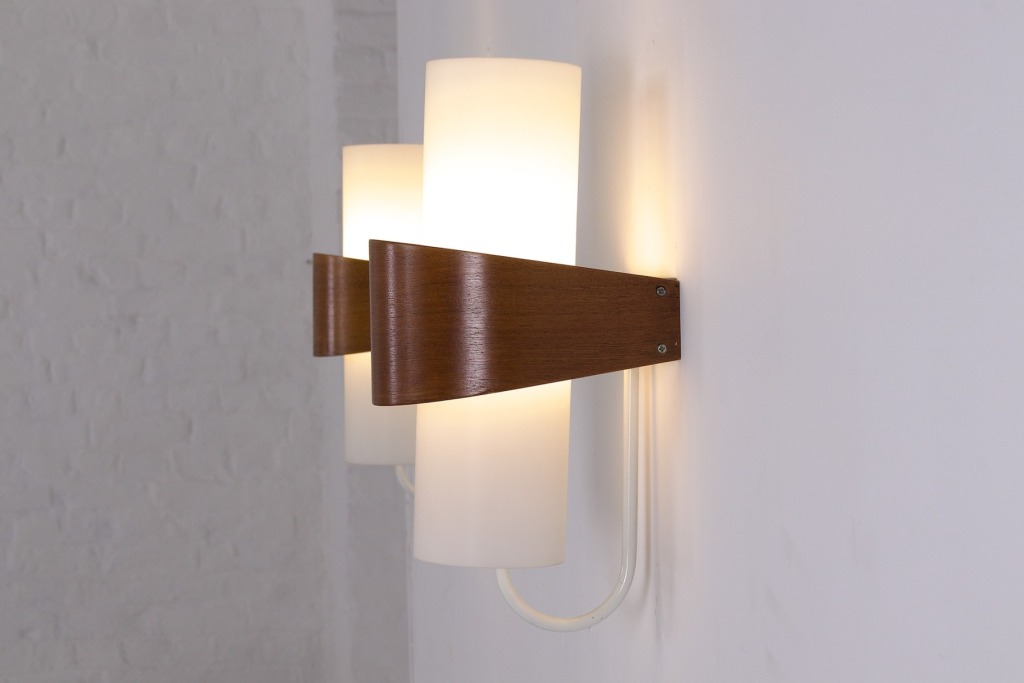
Wall sconce in wood and opaline glass from the ’50s.
Mistakes to avoid when choosing a wall sconce
Choosing a wall sconce is not just about selecting an aesthetic model. Certain mistakes, common when furnishing an interior, can harm visual comfort or the harmony of the decor. Avoiding them allows you to fully enjoy your lighting for many years.
Choosing an unsuitable power
A wall lamp that is too powerful can cause unpleasant glare, while a fixture that is not bright enough will not fulfill its function. It is better to adapt the power in lumens to the use of the room and to supplement the lighting with other light sources if necessary: floor lamps, chandeliers or ceiling lights, and even table lamps are excellent complements to interior lighting.
Neglecting color temperature
A light that is too cold in a living room or bedroom or even on a desk often creates an unwelcoming atmosphere. Conversely, a light that is too warm may lack precision in a bathroom or workspace. Choosing the right color temperature is essential for obtaining pleasant lighting.
Color temperature
Light appearance
Recommended use
2200 to 2700 K
Very warm white, close to the light of a candle or an incandescent bulb.
Living room, bedroom, relaxation areas, restaurants, and ambient lighting.
2700 to 3000 K
Warm white.
The ideal temperature for most wall sconces, living rooms, bedrooms, dining rooms, and living areas.
3000 to 3500 K
Neutral warm white.
Kitchen, desk, entrance, spaces requiring more visual comfort.
4000 K
Neutral white.
Bathroom, workshop, desk, or professional premises.
5000 to 6500 K
Cold white, close to daylight.
Garages, workshops, cellars, technical rooms, or environments requiring excellent visibility.
Our advice: For the majority of interior light fixtures and vintage wall sconces, a 2700 K LED bulb offers the best compromise. It provides a warm light, close to old incandescent bulbs, while particularly enhancing brass, Murano glass, opaline, ceramic, or wood.
Installing the sconce at the wrong height
A wall sconce placed too high or too low loses part of its effectiveness and can become uncomfortable to use. Respecting the recommended installation heights allows the light to be diffused uniformly while avoiding glare.
Choosing a model solely for its aesthetics
A designer wall sconce or vintage wall sconces can be magnificent without necessarily being suitable for all uses. Before prioritizing style, it is advisable to check the type of light diffusion, compatibility with the room, and ease of maintenance.
Forgetting harmony with other light fixtures
A wall sconce is rarely integrated alone in a room. It must dialogue with other light fixtures, whether it is a pendant, a ceiling light, a table lamp, or a floor lamp. Consistency in materials, proportions, and color temperature contributes to creating a harmonious interior.
Finally, always prioritize manufacturing quality over fashion trends. A beautiful wall sconce, made with durable materials and a timeless design, will retain its elegance for many years while durably enhancing your interior.
Why is a wall sconce from the ’50s, ’60s, and ’70s still so sought after?
If vintage wall sconces still appeal to decor enthusiasts and interior designers, it is not only for their aesthetics. The light fixtures manufactured during the ’50s, ’60s, and ’70s bear witness to an era where manufacturing quality was a priority. This period, often referred to as the Trente Glorieuses, was marked by a formidable industrial boom and high design standards. Materials were selected for their durability, assemblies were carried out with care, and each model was designed to be maintained, repaired, and kept for several decades.
Solid brass, steel, aluminum, blown glass, and crystal such as opaline were widely used by major European manufacturers. Many called upon renowned designers to create designer wall sconces capable of outlasting trends without losing their modernity. Even today, these creations retain all their relevance in a contemporary interior.
Unlike many mass-produced light fixtures, an antique wall lamp can generally be restored, rewired, and equipped with a modern LED bulb. It thus offers the comfort of current lighting while retaining its authenticity and original character.
For over twenty years, Vintage Addict has been selecting vintage wall sconces and antique light fixtures for their quality, authenticity, and decorative interest. Carefully restored and delivered ready to be installed, they demonstrate that a well-designed object can span several generations without losing its functionality or elegance.
Joseph-André Motte holds a unique place in the renewal of post-war French furniture. However, his career was not limited to furniture design: he was also active in interior architecture, the layout of public facilities, teaching,...
René-Jean Caillette (1919–2004) belongs to that generation of designers who, in the 1950s and 60s, profoundly transformed French furniture. At a time when furnishing still hesitated between decorative tradition and industrial production, he resolutely chose...
In the history of post-war Belgian furniture, Alfred Hendrickx holds a singular place. Today, his name is mainly associated with Belform, its sideboards and credenzas with taut lines, its tables, seating and modular storage systems....
×
1
Product selection
2
Contact information
3
Review information
error: Content is protected !!
Gérer le consentement
Pour offrir les meilleures expériences, nous utilisons des technologies telles que les cookies pour stocker et/ou accéder aux informations des appareils. Le fait de consentir à ces technologies nous permettra de traiter des données telles que le comportement de navigation ou les ID uniques sur ce site. Le fait de ne pas consentir ou de retirer son consentement peut avoir un effet négatif sur certaines caractéristiques et fonctions.
Fonctionnel
Always active
L’accès ou le stockage technique est strictement nécessaire dans la finalité d’intérêt légitime de permettre l’utilisation d’un service spécifique explicitement demandé par l’abonné ou l’utilisateur, ou dans le seul but d’effectuer la transmission d’une communication sur un réseau de communications électroniques.
Préférences
L’accès ou le stockage technique est nécessaire dans la finalité d’intérêt légitime de stocker des préférences qui ne sont pas demandées par l’abonné ou l’internaute.
Statistiques
Le stockage ou l’accès technique qui est utilisé exclusivement à des fins statistiques.Le stockage ou l’accès technique qui est utilisé exclusivement dans des finalités statistiques anonymes. En l’absence d’une assignation à comparaître, d’une conformité volontaire de la part de votre fournisseur d’accès à internet ou d’enregistrements supplémentaires provenant d’une tierce partie, les informations stockées ou extraites à cette seule fin ne peuvent généralement pas être utilisées pour vous identifier.
Marketing
L’accès ou le stockage technique est nécessaire pour créer des profils d’internautes afin d’envoyer des publicités, ou pour suivre l’utilisateur sur un site web ou sur plusieurs sites web ayant des finalités marketing similaires.