Joseph-André Motte, French designer and interior architect
Home ” Newspaper ” Joseph-André Motte, French designer and interior architect
Joseph-André Motte holds a unique place in the renewal of post-war French furniture. However, his career was not limited to furniture design: he was also active in interior architecture, the layout of public facilities, teaching, and reflections on mass-produced furniture. From his initial research in the early 1950s to the Paris metro stations, his work accompanied several decades of transformation in French interiors.
Training focused on modern furniture
His interest in drawing emerged during his high school years in Gap. He then pursued his training at the École des Arts Appliqués in Paris, where his teachers included René Gabriel, Louis Sognot, and Albert Guénot. In 1948, he completed his studies at the top of his class.
He immediately joined Pomone, the art studio of Le Bon Marché, then under the direction of Albert Guénot. He worked there as a decorator, while carrying out his first commissions for private individuals and already taking an interest in the possibilities offered by mass-produced furniture.
A new stage began when he joined the agency of Marcel Gascoin. This environment served as an important meeting point for a young generation of creators. It was there that Joseph-André Motte met Pierre Guariche and Michel Mortier, with whom he would soon pursue a decisive collective experience.
The A.R.P. with Pierre Guariche and Michel Mortier
In 1954, Motte, Guariche, and Mortier together founded the Atelier de Recherches Plastiques, better known by the initials A.R.P. Their objective was to develop new models suitable for production by French manufacturers and publishers.
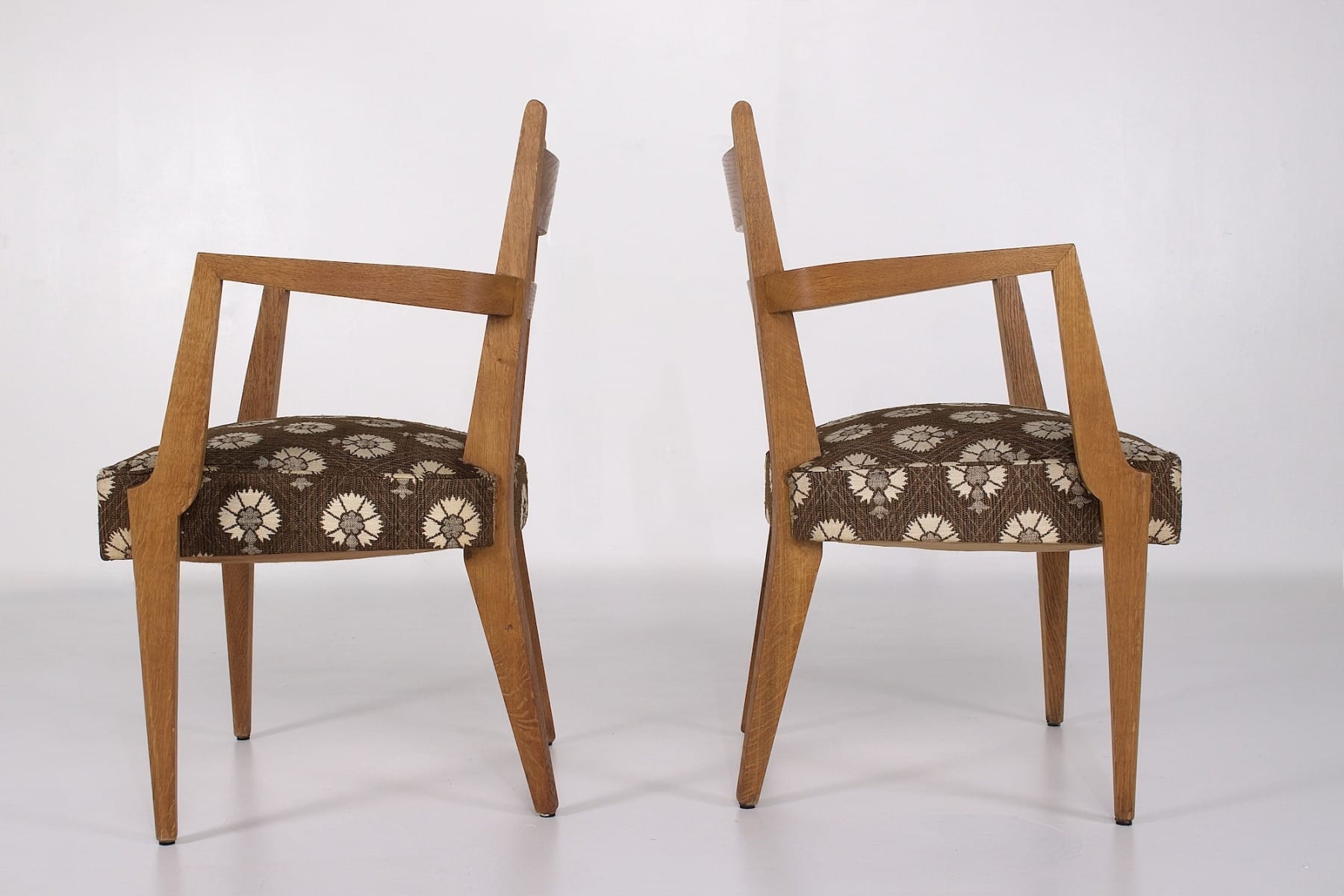
Two Coquetier armchairs designed by the Atelier de Recherches Plastiques.
During the three years of the studio’s existence, the group worked in several areas of furniture and interior equipment. Steiner and Airborne manufactured their seating, Disderot their lighting, and Minvielle their furniture.
For Minvielle, the three designers imagined the “Minvielle elements,” a modular furniture system capable of fulfilling several functions. The collection achieved significant commercial success and participated in the first French experiments with furniture sold as components for assembly.
Sideboard by the Atelier de Recherches Plastiques for Les Huchers Minvielle: Motte, Mortier, Guariche.
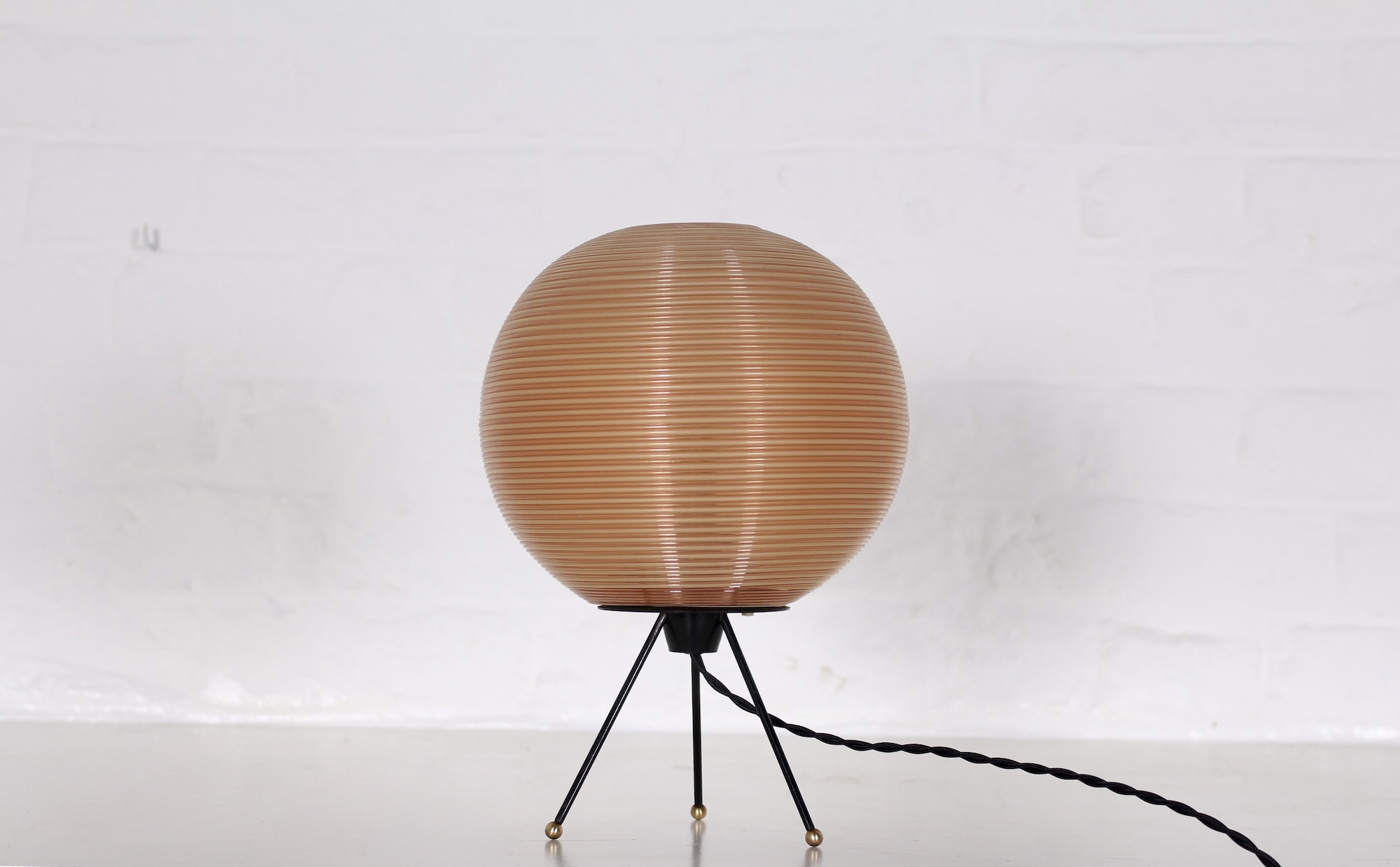
Their collaboration with Steiner notably gave birth to the 640 seating series. Using a single structure, the A.R.P. developed several solutions for bases and armrests. Lighting also served as a field for experimentation. For Disderot, the studio notably used Rotaflex, a plastic material that was new at the time.
The tripod lamp manufactured by Rotaflex in the 1950s, model R1.
Based on the Rue du Faubourg-Saint-Antoine in Paris, their office also participated in major furniture events. The A.R.P. notably designed a stand at the 1955 Salon des Arts Ménagers and won the first two prizes in a competition organized by the Centre Technique du Bois that same year.
The experience ended in 1957, as the individual careers of Motte, Guariche, and Mortier each gained greater momentum.
Joseph-André Motte and Groupe 4
The A.R.P. was not the only collective adventure in which Joseph-André Motte participated. As early as 1952, he also joined Groupe 4, an initiative launched by the publisher Georges Charron with René-Jean Caillette and encouraged by Louis Bruillard, editor-in-chief of the magazine Meubles et décors.
René-Jean Caillette, drop-front secretary desk. Produced by Groupe 4 Charron, circa 1952.
Alongside René-Jean Caillette, Geneviève Dangles, and Alain Richard, Motte participated in the design of contemporary furniture intended for mass production. This simultaneous participation in Groupe 4 and the A.R.P. placed Motte at the heart of the research that was then renewing French modernist furniture.
Steiner, Disderot, and the personal creations of Joseph-André Motte
Joseph-André Motte worked with various materials, including wood, rattan, and stainless steel. His models were produced by several major manufacturers of the period, notably Steiner, Minvielle, Charron, and Disderot, and were regularly presented at the Salon des Arts Ménagers as well as the Salon des Artistes Décorateurs.
The year 1957 was a major milestone as he received the René-Gabriel Prize. At the Salon des Arts Ménagers that same year, the 740 armchair manufactured by Steiner made its appearance. The model combined generous volumes with a stainless steel base and was marketed as a flat-pack seat. It met with significant commercial success.
For Disderot, Motte simultaneously developed several lighting fixtures. The J13 lamp, dating from 1959, notably combined a double-layered white glass diffuser with a silhouette whose design evokes a Japanese influence.
His participation in the 1958 Brussels World’s Fair brought him new recognition. In the low-cost apartment designed by architect André Hermant, he took charge of the parents’ bedroom and received the Grand Prix for this layout.
From furniture to major interior architecture programs
Joseph-André Motte’s career gradually developed far beyond furniture design alone. In the late 1950s and during the following decades, he worked on several large-scale public programs.
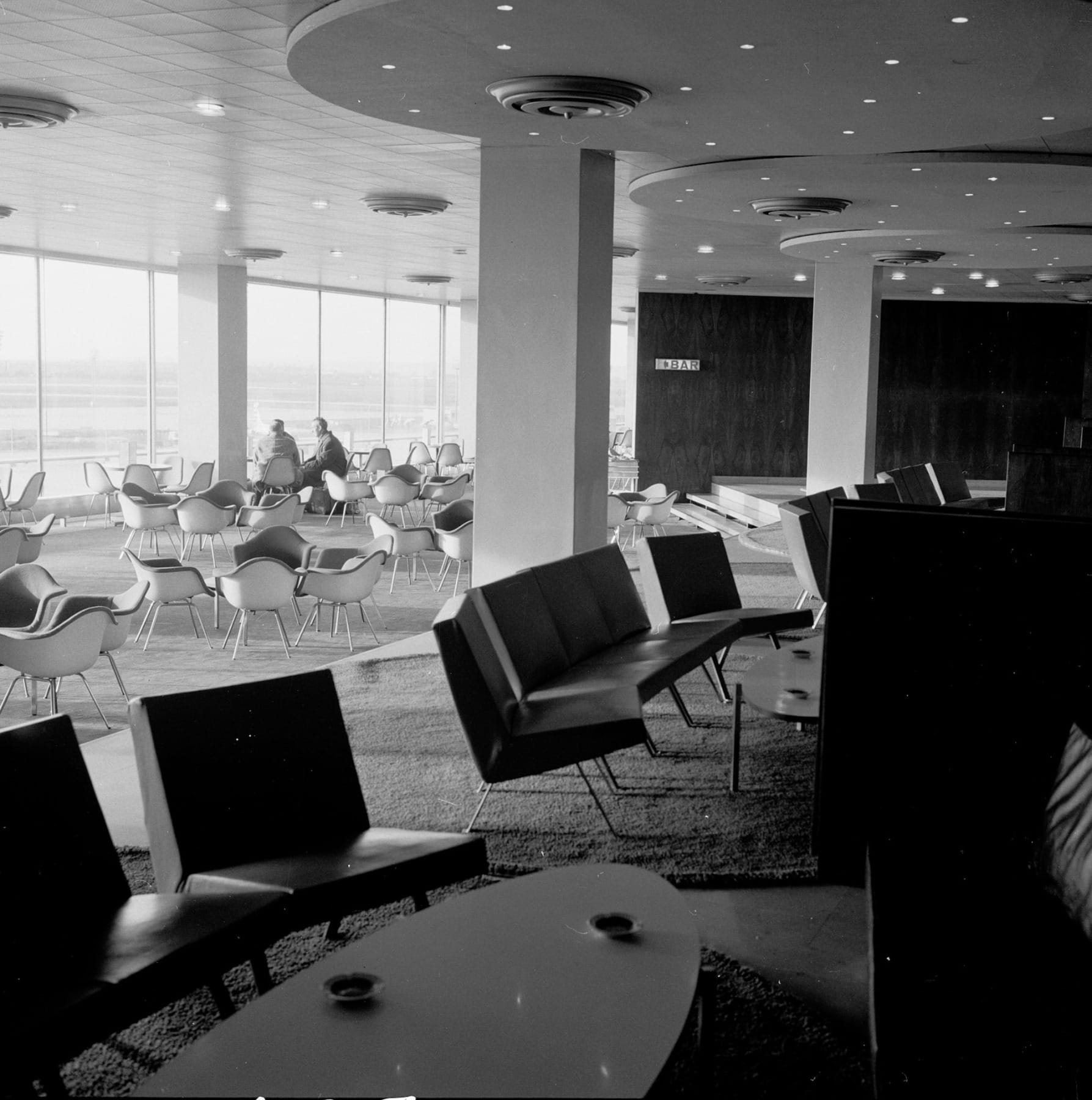
Between 1958 and 1961, he worked on the layout of Orly Airport. His interventions concerned the terminal facilities and the transit zone, but also various spaces and services associated with the site, including an oratory, a hotel, a tea room, and several shops.
Motte’s 740 armchairs alongside Eames Shell chairs at Orly in the 1960s (Source: Inventaire Ile de France)
In 1962, he designed the executive offices and conference rooms for the Maison de la Radio.
He also collaborated with the Mobilier National. In 1967, as part of the furnishing of national palaces, he notably designed a desk for a high-ranking official. Stainless steel, Macassar ebony, and leather occupied a predominant place in the design.
These achievements demonstrate how his work evolved across several scales: individual furniture, interior space, and institutional programs.
The Andreu-Motte style in the Paris metro
In the early 1970s, Joseph-André Motte undertook one of his most visible projects. He signed a contract with the R.A.T.P. aesthetics committee for the modernization of old Paris metro stations.
The program, carried out until 1983 under the direction of architect Paul Andreu, gave birth to what is now known as the Andreu-Motte style.
The principle was based on an environment largely dominated by white, with which Motte associated colored elements. Color was used notably in the light coves and in the seating specific to each station.
The Porte de Charenton Metro station, designed in the “Motte” style (Source: Wikipedia)
The so-called “bucket” seat adopted a deliberately elementary construction: an enameled metal shell installed on a masonry bench. It became one of the immediately recognizable elements of these layouts.
In total, Joseph-André Motte worked on approximately one hundred Parisian stations.
Transmission, teaching, and reflection on design
Motte did not limit himself to the practice of the profession. He also wrote on issues related to mass-produced furniture and the organization of space, and collaborated on several publications dedicated to decoration. He notably participated in the magazine Arts Ménagers, where he contributed, along with other professionals, to content dedicated to furnishing and decoration.
His experience was also transmitted through teaching. He served as a professor or lecturer in several institutions, including the École Nationale Supérieure des Arts Décoratifs, the École Nissim de Camondo, and the École Boulle.
Joseph-André Motte, a major figure in post-war French design
From his first mass-produced furniture to the layouts of the Paris metro, Joseph-André Motte thus built a particularly extensive career. The A.R.P., Groupe 4, his collaborations with Steiner and Disderot, his interventions for major French institutions, and his teaching activity illustrate the different dimensions of his work.
His career testifies above all to a single will applied to very different fields: adapting creation to new uses, whether designing a mass-produced seat, organizing an administrative space, or rethinking the daily environment of metro travelers.
Joseph-André Motte was named Commandeur des Arts et des Lettres, a recognition that crowned this long career as a designer and interior architect.
René-Jean Caillette (1919–2004) belongs to that generation of designers who, in the 1950s and 60s, profoundly transformed French furniture. At a time when furnishing still hesitated between decorative tradition and industrial production, he resolutely chose...
In the history of post-war Belgian furniture, Alfred Hendrickx holds a singular place. Today, his name is mainly associated with Belform, its sideboards and credenzas with taut lines, its tables, seating and modular storage systems....
Are you wondering how to choose a wall sconce? The answer depends on the room to be lit, the desired light, the materials, the mounting height, and the style of your interior. A wall sconce...
×
1
Product selection
2
Contact information
3
Review information
error: Content is protected !!
Gérer le consentement
Pour offrir les meilleures expériences, nous utilisons des technologies telles que les cookies pour stocker et/ou accéder aux informations des appareils. Le fait de consentir à ces technologies nous permettra de traiter des données telles que le comportement de navigation ou les ID uniques sur ce site. Le fait de ne pas consentir ou de retirer son consentement peut avoir un effet négatif sur certaines caractéristiques et fonctions.
Fonctionnel
Always active
L’accès ou le stockage technique est strictement nécessaire dans la finalité d’intérêt légitime de permettre l’utilisation d’un service spécifique explicitement demandé par l’abonné ou l’utilisateur, ou dans le seul but d’effectuer la transmission d’une communication sur un réseau de communications électroniques.
Préférences
L’accès ou le stockage technique est nécessaire dans la finalité d’intérêt légitime de stocker des préférences qui ne sont pas demandées par l’abonné ou l’internaute.
Statistiques
Le stockage ou l’accès technique qui est utilisé exclusivement à des fins statistiques.Le stockage ou l’accès technique qui est utilisé exclusivement dans des finalités statistiques anonymes. En l’absence d’une assignation à comparaître, d’une conformité volontaire de la part de votre fournisseur d’accès à internet ou d’enregistrements supplémentaires provenant d’une tierce partie, les informations stockées ou extraites à cette seule fin ne peuvent généralement pas être utilisées pour vous identifier.
Marketing
L’accès ou le stockage technique est nécessaire pour créer des profils d’internautes afin d’envoyer des publicités, ou pour suivre l’utilisateur sur un site web ou sur plusieurs sites web ayant des finalités marketing similaires.