René-Jean Caillette and the Birth of French Serial-Production Furniture
Home ” Newspaper ” René-Jean Caillette and the Birth of French Serial-Production Furniture
René-Jean Caillette (1919–2004) belongs to that generation of designers who, in the 1950s and 60s, profoundly transformed French furniture. At a time when furnishing still hesitated between decorative tradition and industrial production, he resolutely chose a new path: that of modern, functional, accessible furniture designed for mass production.
His career, however, is deeply rooted in the furniture trade. Born in 1919, he grew up in the world of cabinetmaking, his father having established his workshop in Paris. From a very young age, he discovered woodworking, traditional techniques, and the particularly active milieu of the Faubourg Saint-Antoine. There he encountered a world of craftsmen, decorators, and manufacturers among whom figures such as Louis Sognot and Paul Dupré-Lafon were then active.
Drawn to design, René-Jean Caillette entered the École des Arts Appliqués à l’Industrie in 1933 and graduated four years later at the top of the furniture section. In parallel, he attended evening classes in art history at the École du Louvre. This dual training is revealing of what would characterize his work: a genuine culture of decorative arts combined with a constant curiosity for techniques, materials, and new production methods. His early professional experiences led him, among other places, to the art workshop of Le Bon Marché.
Reconstruction and the Invention of New Furniture
In the aftermath of the Second World War, France entered a vast period of Reconstruction. It was necessary to rebuild damaged cities, but also to address a chronic housing shortage and accompany a rapid transformation of lifestyles.
Thousands of new apartments were built. Their sizes, layouts, and uses often differed from those of prewar bourgeois interiors. The kitchen became rationalized, rooms became multipurpose, and available space had to be used more efficiently. Furnishing had to be done differently.
The beginnings of René-Jean Caillette’s career are already perceptible in this pair of armchairs, with the appearance of the “Compas” movement in the legs. Circa 1948.
For young designers, this situation constituted both a constraint and a formidable field of experimentation. Heavy furniture, made individually and intended to remain in the same family for several generations, corresponded less and less to these new dwellings. Furniture had to be lighter, less bulky, sometimes modular or transformable, while being manufacturable at a reasonable cost.
It is in this context that the notion of “serial-production furniture” takes on its full meaning, of which René-Jean Caillette becomes one of the champions.
Producing in series does not yet necessarily mean manufacturing thousands of identical pieces of furniture according to a massive industrial logic. It is above all about breaking with the principle of the unique piece or one made specially for a client. The designer now conceives a reproducible model, whose dimensions, assemblies, and materials are determined so that a manufacturer can produce several examples in a rational manner.
Furniture thus becomes the result of a new creation chain: it is conceived by a designer, manufactured by a company, published or commercially distributed, and then offered to multiple clients.
For Caillette and the designers of his generation, this evolution is in no way synonymous with abandoning quality. Quite the contrary. It must make it possible to bring contemporary design, good materials, and intelligent conception within reach of a wider public.
René-Jean Caillette therefore never opposes creation and industry. Manufacturing constraints become for him a source of invention.
In 1949, he created with his friend Roger Landault the Saint-Honoré group, soon joined by Bernard Durussel, Jacques Hauville… Their approach notably attracted the attention of Marcel Gascoin and Michel Mortier (Atelier de Recherche Plastique), two important figures in the renewal of French furniture.
From these encounters was born in 1953 the ACMS, the Association des Créateurs de Modèles en Série. Its ambition was then particularly modern: to promote furniture designed by creators, offered at identical prices in different points of sale and identifiable by a common brand.
Behind this initiative lies a genuine cultural battle: to have serial-production furniture recognized as a domain of creation in its own right.
The Salon des Arts Ménagers and the Meeting with Georges Charron
In 1950, René-Jean Caillette exhibited at the Salon des Arts Ménagers. He presented a living room comprising notably juxtaposable furniture, a wheeled serving cart with a removable tray, and a bookcase-secretary.
The catalogue of the Salon de l’Art Ménager Français of 1952
These early creations already contain several concerns that would run through his entire body of work: mobility, space-saving, versatility, and simplicity of use. The gamble is convincing enough to enable him to sell several pieces and, above all, to get noticed.
In the wake of this, he met Georges Charron, who had just launched into the furniture trade and was looking for a decorator capable of designing contemporary furniture. A collaboration of more than twenty years began between the two men.
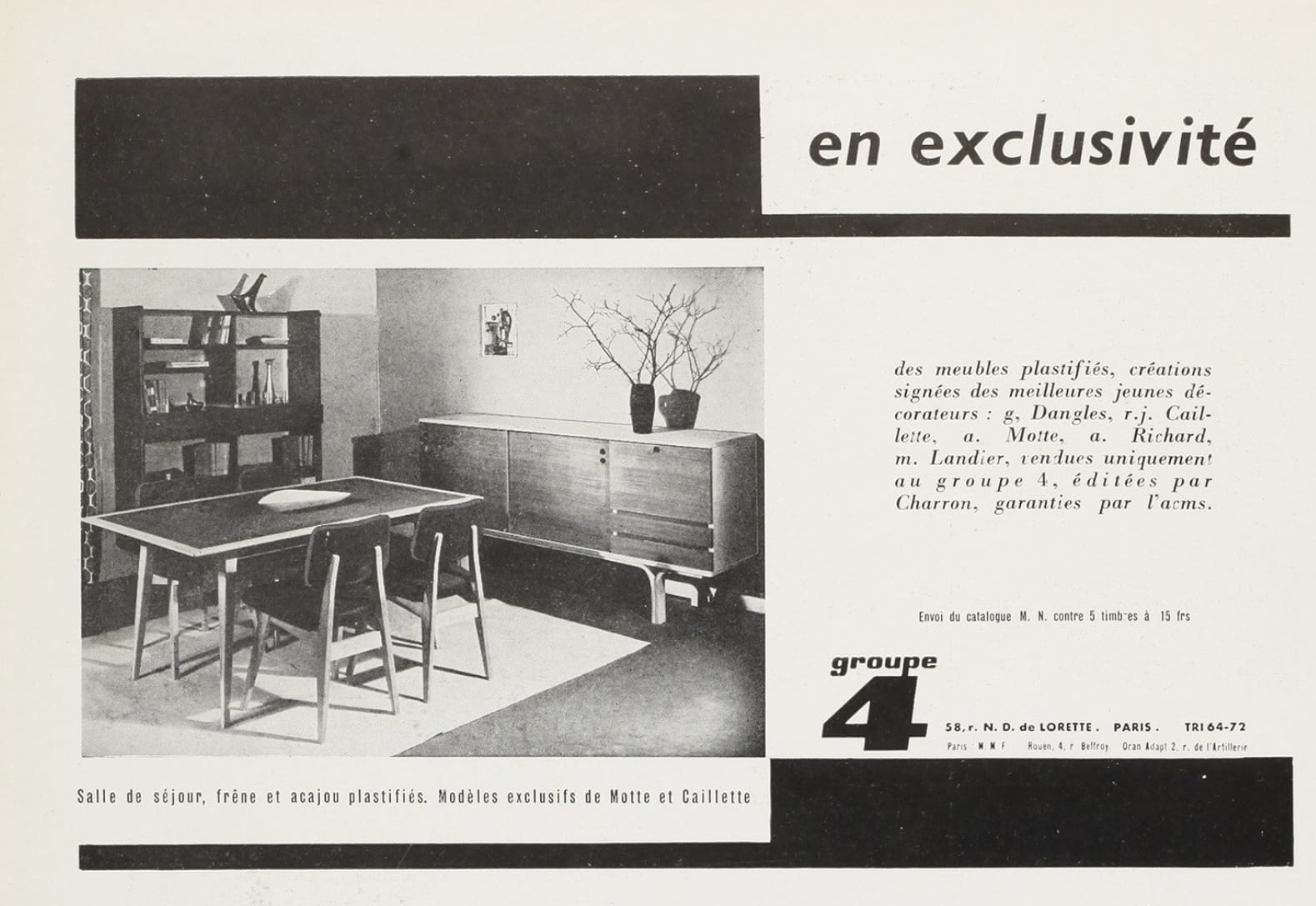
Advertisement for Groupe 4 Charron and the ACMS with mention of Geneviève Dangles, R-J Caillette, J-A Motte, Alain Richard…
Caillette worked for Charron but also maintained great independence. He designed certain models that he had produced himself in small series, an approach still relatively rare in French design of the early 1950s.
In 1952, on the advice of Louis Bruillard, editor-in-chief of the magazine Meubles et Décors, and at Caillette’s instigation, Georges Charron created Groupe 4, which brought together four young designers: Geneviève Dangles, Joseph-André Motte, Alain Richard, and René-Jean Caillette.
Groupe 4 championed resolutely contemporary furniture, stripped of superfluous ornament but never austere. Precious woods, metal, glass, and new assembly methods made it possible to imagine more open and luminous interiors. This search for balance between structure, function, and elegance constitutes one of the signatures of the designer’s work.
Steiner, the Coccinelle Chair, and the Diamant Chair
While Georges Charron occupies a central place in his career, René-Jean Caillette also worked for several major publishers of his era, among them Steiner, Airborne, Disderot, and even Fermob. This diversity allowed him to explore storage furniture as well as tables, lighting, and especially seating.
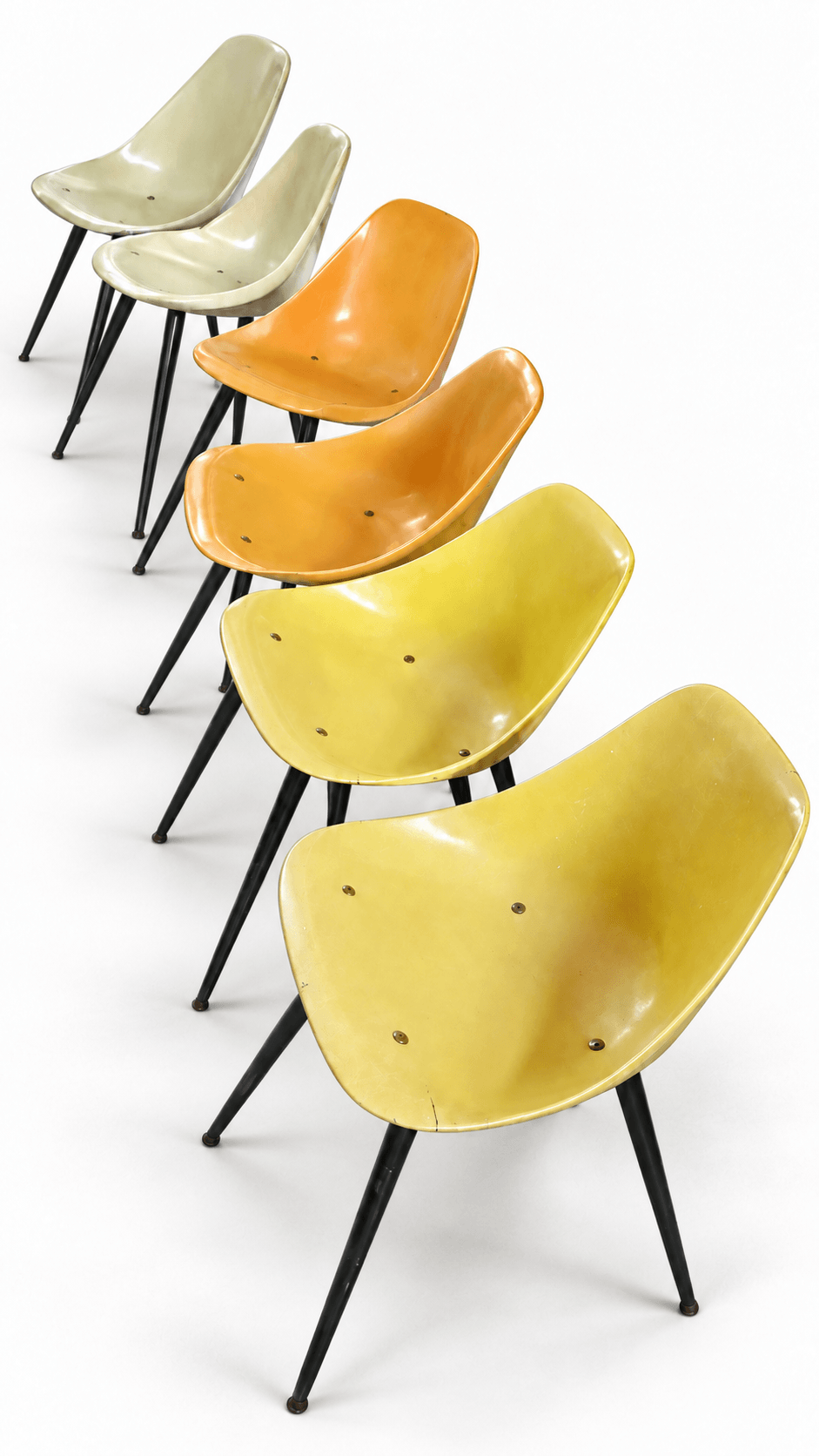
For Steiner, he designed the Coccinelle chair in 1957. With its colored fiberglass shell, the model demonstrates his interest in new materials and the very broad possibilities offered by molding.
Coccinelle chairs by R-J Caillette, available soon.
The chair received significant coverage in the specialized press, which highlighted the originality of its design, but its production remained relatively limited. A year later appeared the Diamant chair, a first prototype of which was designed for the HLM apartment of the French section of the 1958 Brussels World’s Fair, for which Caillette was responsible for the furnishing.
The principle of the chair is of remarkable simplicity. Its seat is conceived from the folding of a flat surface, almost like a sheet of paper or origami. Made of molded thermoformed wood in a single piece, it forms a shell with taut lines whose geometry constitutes both the structure and the decoration.
The model was taken up by Steiner with a particularly slender metal base, lacquered or chrome-plated, which further accentuates this impression of lightness. Little material, few elements, and practically no added decorative effect: all the personality of the chair comes from its construction. The Diamant became one of the emblematic creations of French furniture of the late 1950s and received significant recognition at the Brussels World’s Fair.
From the Functionalism of the 1950s to the Elegance of the 1960s
Caillette’s work, however, never remained fixed in the aesthetic of Reconstruction. In the early 1960s, his furniture accompanied the evolution of French taste toward more refined interiors. Functional rigor remained, but it was now combined with more precious materials and a new elegance.
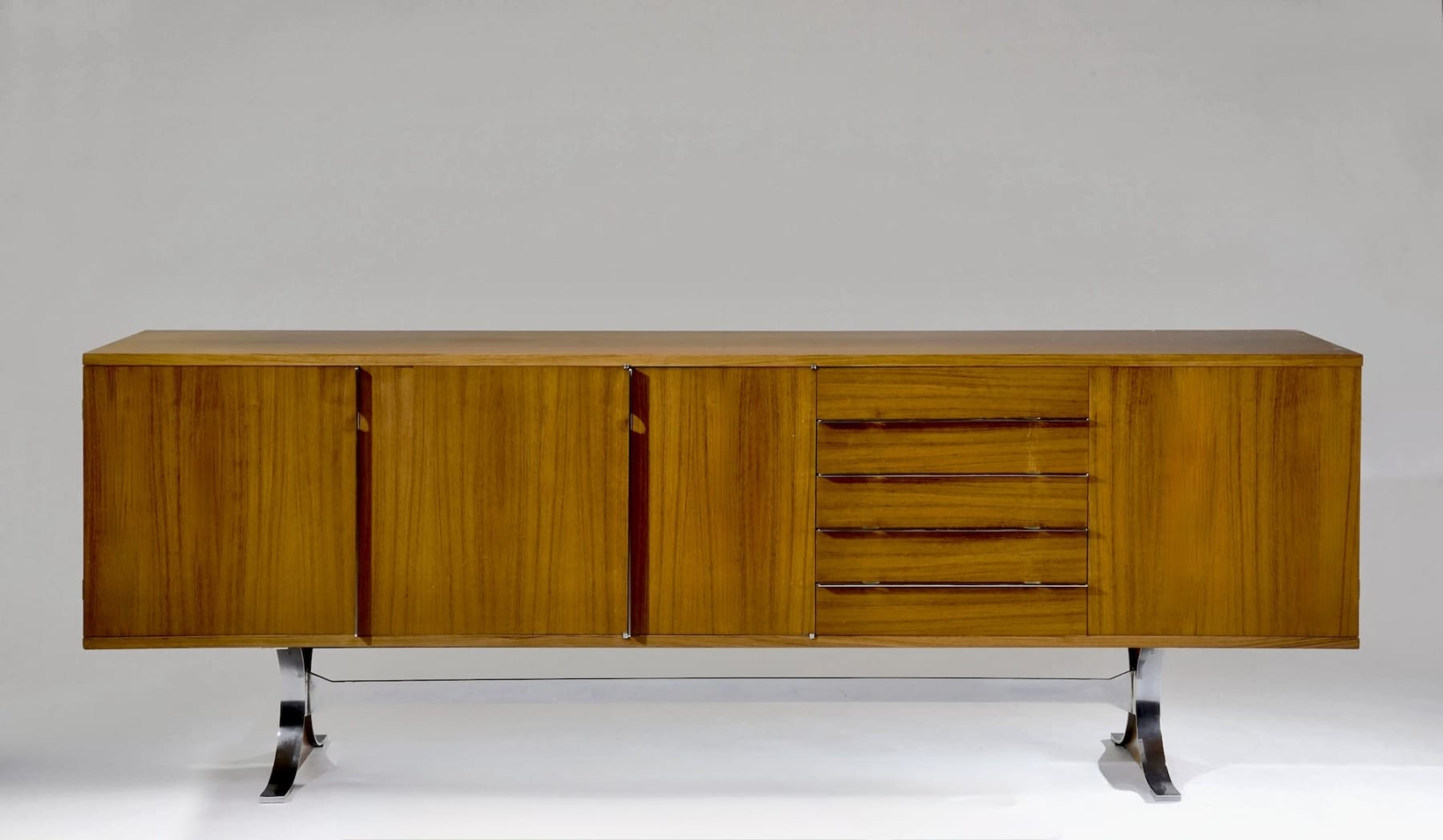
The Sylvie collection constitutes a very fine example. Presented at Charron around 1961, it notably combined Rio rosewood and stainless steel in a dining table and several coordinated pieces of furniture. The result is particularly representative of Caillette: precious without ostentation, geometric without coldness, elegant without sacrificing function.
“Sylvie” sideboard by René Jean Caillette
This capacity to evolve partly explains the longevity of his collaboration with Charron. Caillette does not seek to impose a recognizable form on all his furniture. He prefers to solve each problem according to its use.
A Designer Who Also Thinks Like an Inventor
René-Jean Caillette is indeed as much a technician as a draftsman. He is interested in mechanisms, opening systems, transformable furniture, and different ways of occupying space. Several of his research projects resulted in patents, notably for secretaries or sofa-bed systems developed for Steiner.
Molded plywood, laminate, stainless steel, rattan, or fiberglass are never employed as mere signs of modernity. What interests him above all are the new structural possibilities they allow.
This technical curiosity quickly earned him the recognition of his peers, and he received the Prix René Gabriel in 1952.
His creations appeared regularly at the Salon des Arts Ménagers, the Salon des Artistes Décorateurs, the Milan Triennials, and in major international exhibitions devoted to modern housing.
From the Chair to Interior Architecture
In 1957, Saint-Gobain entrusted him, along with André Craquelin, with the design of the Maison du Soleil presented at the Salon des Arts Ménagers. The project notably aimed to show how the use of glass could transform housing and promote the entry of natural light into modern interiors. Caillette notably presented a bench with a reclining back made by Charron as well as a seat composed of a piece of leather resting on a metal structure.
A few years later, he intervened in a project of an entirely different scale: the new Maison de la Radio in Paris. René-Jean Caillette was entrusted with the music foyer, while Pierre Paulin furnished the artists’ foyer.
Faced with the immense semicircular space of the building, Caillette conceived different modules making it possible to create rest areas and more intimate spaces within a largely open architecture.
The intervention shows how much his conception of design goes beyond the isolated object. A seat, a table, a partition, or a light fixture are part of the same problem: organizing space and making its use more evident.
Creating, but Also Transmitting
This reflection on the profession of designer naturally led René-Jean Caillette toward teaching. From 1954, he taught at the École Nationale Supérieure des Arts Décoratifs, where he remained until 1972. He also contributed to several decoration magazines and wrote numerous texts devoted to serial-production furniture, furnishing, and the organization of space. In the 1970s, he published several books intended for the general public. Here again, his approach remained consistent with that of his beginnings: design only has meaning if it concretely improves the way of living.
René-Jean Caillette Today
René-Jean Caillette sometimes remains less immediately identified by the general public than some of his contemporaries such as Pierre Guariche and other young lions of his generation. He nevertheless occupies an essential place in the history of postwar French furniture.
His career above all makes it possible to understand that particular moment when the decorator progressively became a designer, when the workshop dialogued with industry, and when furniture ceased to be thought of solely as an individual piece to become a model intended to be reproduced and distributed. He also embodies a generation capable of being simultaneously draftsman, technician, decorator, inventor, and theorist of furniture.
His creations rarely seek spectacular effect. Their intelligence is often revealed in a detail: a base that seems to disappear, a sliding door that avoids cluttering the space, a transformable top, a shell reduced to a few folds, or a structure stripped of any unnecessary element. It is perhaps precisely this that makes his furniture still so current.
More than sixty years after their creation, his best models retain that particularly French combination of rationality, elegance, and lightness that characterizes a part of the great design of the 1950s and 1960s.
In René-Jean Caillette’s work, modernity is never a style added to the furniture; it is born from its construction.
Joseph-André Motte holds a unique place in the renewal of post-war French furniture. However, his career was not limited to furniture design: he was also active in interior architecture, the layout of public facilities, teaching,...
In the history of post-war Belgian furniture, Alfred Hendrickx holds a singular place. Today, his name is mainly associated with Belform, its sideboards and credenzas with taut lines, its tables, seating and modular storage systems....
Are you wondering how to choose a wall sconce? The answer depends on the room to be lit, the desired light, the materials, the mounting height, and the style of your interior. A wall sconce...
×
1
Product selection
2
Contact information
3
Review information
error: Content is protected !!
Gérer le consentement
Pour offrir les meilleures expériences, nous utilisons des technologies telles que les cookies pour stocker et/ou accéder aux informations des appareils. Le fait de consentir à ces technologies nous permettra de traiter des données telles que le comportement de navigation ou les ID uniques sur ce site. Le fait de ne pas consentir ou de retirer son consentement peut avoir un effet négatif sur certaines caractéristiques et fonctions.
Fonctionnel
Always active
L’accès ou le stockage technique est strictement nécessaire dans la finalité d’intérêt légitime de permettre l’utilisation d’un service spécifique explicitement demandé par l’abonné ou l’utilisateur, ou dans le seul but d’effectuer la transmission d’une communication sur un réseau de communications électroniques.
Préférences
L’accès ou le stockage technique est nécessaire dans la finalité d’intérêt légitime de stocker des préférences qui ne sont pas demandées par l’abonné ou l’internaute.
Statistiques
Le stockage ou l’accès technique qui est utilisé exclusivement à des fins statistiques.Le stockage ou l’accès technique qui est utilisé exclusivement dans des finalités statistiques anonymes. En l’absence d’une assignation à comparaître, d’une conformité volontaire de la part de votre fournisseur d’accès à internet ou d’enregistrements supplémentaires provenant d’une tierce partie, les informations stockées ou extraites à cette seule fin ne peuvent généralement pas être utilisées pour vous identifier.
Marketing
L’accès ou le stockage technique est nécessaire pour créer des profils d’internautes afin d’envoyer des publicités, ou pour suivre l’utilisateur sur un site web ou sur plusieurs sites web ayant des finalités marketing similaires.