





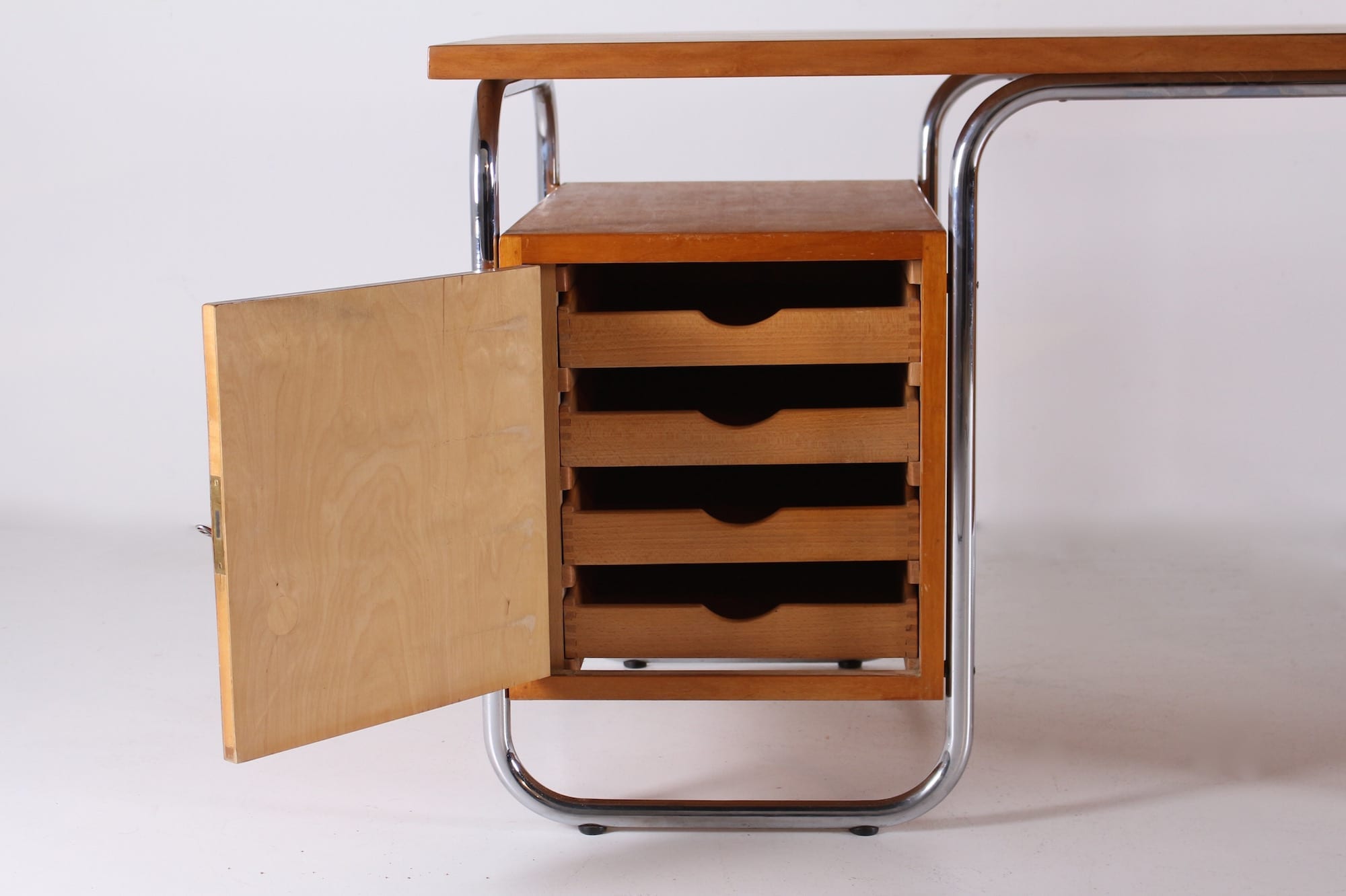


Tubular steel desk in Bauhaus style
Large executive desk, tubular steel and ash, in the style of Marcel Breuer. Production to be situated between the late 1930s and early 1950s, Manubelge publisher.
- Very good condition, the chrome is not pitted, woodwork restored by our conservator.
- W 175 CM X D 75 CM X H 79 CM
- Chair passage: 72 CM X 72 CM
- H useful drawers 10 CM
Sold

Manubelge: From Medical Furniture to Belgian Modernism
This large modernist desk bears its Manubelge label, the brand of the Manufacture Belge de Gembloux. The company is now primarily known for its medical and hospital furniture, particularly its steel and glass display cases and cabinets, but its history reveals a much broader production, closely linked to the development of modern furniture in Belgium.
The Manubelge label with its 1930s typography
Surgical furniture production began in Gembloux as early as 1905. In 1923, several workshops were brought together to form the Manufacture belge d’Instruments de Chirurgie et de Mobilier chirurgical de Gembloux, a company that already employed around 300 people by the end of the 1920s. This mastery of metal, acquired in the manufacture of technical and medical furniture, naturally became one of the foundations of its modernist productions.
As early as 1933, Manubelge announced in the magazine Bâtir the existence of a “Modern Metal Furniture Department.” The manufacturer explicitly mentioned office furniture, smoking room and patio furniture, as well as creations in chrome-plated or nickel-plated tubes. It also specified that it manufactured furniture based on architects’ sketches, with sales houses in Brussels, Liège, and Paris. The desk presented here thus finds a particularly coherent place in the documented production of the manufacturer.
Bauhaus style desk, produced by Manubelge in Gembloux, chrome-plated tubular steel and wood, circa 1930-1950.
During the 1930s, Manubelge also participated in the furnishing of schools and public buildings. It notably supplied desks, chairs, tables, cabinets, and lecterns. In 1938, the metal and wood furniture for the Léonie de Waha high school in Liège, designed by Jean Moutschen, was specially studied by the Manufacture Belge de Gembloux.
Jean Moutschen is the brother of Joseph Moutschen, a major figure in Liège modernism, notably the author of the Institutes of Mechanics and Civil Engineering at Val-Benoît, where the influence of principles advocated by Walter Gropius is particularly perceptible.
The combination of wood and chrome-plated tubular steel in this desk fully aligns with this context. Its light structure, geometric volumes, and the visual dissociation between the metal base and the storage elements echo contemporary Bauhaus research and the wood and steel tube desks developed in the 1930s, notably by Marcel Breuer for Thonet. This linguistic proximity places Manubelge within a broader European movement.
This desk thus constitutes both a functional piece of furniture and a testament to Belgian industrial heritage and modernism, revealing a lesser-known facet of Manubelge, beyond its famous steel and glass medical furniture.
Presented here with a Louis Kalff Philips lamp, this desk could just as easily have been paired with a Christian Dell lamp, to reinforce its dialogue with the Bauhaus vocabulary, or with a contemporary creation. This ability to transcend eras highlights the timelessness of its lines and its balance between wood and metal.
Belgium, Manufacture Belge de Gembloux – Manubelge, probably 1930s-50s.
You might also like…
Discover also...



Delivery to Belgium

Delivery to France

Delivery to Luxembourg
