Christian Dell, a major figure in Bauhaus lighting design
Home ” Newspaper ” Christian Dell, a major figure in Bauhaus lighting design
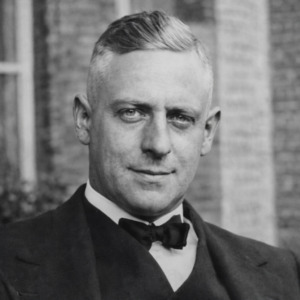
Christian Dell (1893–1974)
An iconic 20th-century designer, Christian Dell is now primarily associated with floor lamps and the Bauhaus desk and task lamps that have become benchmarks of functional design. Yet behind these now-iconic objects lies a more complex career, deeply rooted in silversmithing and the metal arts.
Christian Dell (1893–1974)
Goldsmith training in the heart of German tradition
Dell was born in 1893 in Offenbach am Main, Hesse, in a region shaped by a strong craft tradition. From adolescence, he trained in metalworking: between 1907 and 1911, he studied silver forging at the Königlich Preußische Zeichenakademie in Hanau, while also completing, from 1907 to 1912, an in-depth apprenticeship as a silversmith at the Schleissner & Söhne manufactory.
This dual training, both academic and industrial, forms the technical foundation on which all his subsequent production is based: mastery of alloys, understanding of manufacturing constraints, and a keen sense of precision.
From applied art to the Bauhaus
In 1913, he worked as a silversmith in Dresden before joining the Großherzoglich-Sächsische Kunstgewerbeschule in Weimar. There he met Henry van de Velde, a central figure in the reform of applied arts in Europe, whose influence bridged Art Nouveau and functional modernity.
After the First World War, a period of transition led him to work in various manual trades between 1918 and 1920. He then found a stable position as a master silversmith in Munich with Hestermann & Ernst, before moving to Berlin to work with silversmith Emil Lettré.
The Bauhaus and the birth of modern lighting
Between 1922 and 1925, he became foreman of the Bauhaus metal workshop in Weimar. This period was decisive. In close collaboration with László Moholy-Nagy, he helped define a new formal language in which lighting was no longer decorative but functional, rational, and suited to modern workspaces.
It was against this backdrop that he developed metal lamp models intended for offices, workshops and industrial environments, laying the foundations for the modern luminaire as we know it today.
Frankfurt, industrialization and recognition
From 1926, Christian Dell joined the Frankfurter Kunstschule. There he developed several series of luminaires that marked a decisive turning point in his career. The brass and nickel table lamps “Rondella-Polo” (1928–1929) brought him his first major recognition, while the “Idell” range fully embodies the synthesis of formal rigor, functionality, and industrial production. Distributed on a large scale by Kaiser Leuchten, the latter helped establish Bauhaus lighting on a lasting international footing.
These models were then mass-produced by various German publishers, contributing to their widespread distribution. In 1928, several of his creations were shown at the Kunsthalle Mannheim in an exhibition devoted to craftsmanship in the industrial age, confirming his central role in the transition from craftsmanship to industrial design.
Last years and legacy
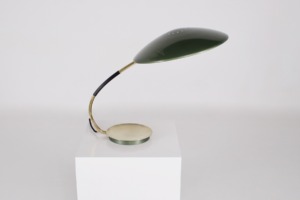
Idell lamp, design by Christian Dell, edition circa 1960
In 1933, the Nazi regime brought his teaching activity in Frankfurt to an end. Although Walter Gropius offered him a position in the United States, he chose to remain in Germany. After the Second World War, he returned to silversmithing and opened a jewelry shop in Wiesbaden in 1948, which he ran until 1955.
He died in Wiesbaden in 1974.
Even today, several desk lamps designed by him are still in production, proof of the enduring nature of his approach: a rigorous aesthetic, born of silversmithing, placed at the service of function and everyday use.
Christian Dell’s influence extends far beyond the Bauhaus period. His luminaires continued to accompany the evolution of modern design throughout the 1950s, a period during which the functionalism inherited from the interwar period retained an important place in the furnishing of offices and contemporary interiors. Their refined aesthetic also found a natural echo in the design of the 1960s, marked by the search for simple forms and rational production. Although tastes evolved during the 1970s, the Idell models remain a major reference in the history of modern lighting and continue to inspire collectors, interior designers, and 20th-century design enthusiasts.
Joseph-André Motte holds a unique place in the renewal of post-war French furniture. However, his career was not limited to furniture design: he was also active in interior architecture, the layout of public facilities, teaching,...
René-Jean Caillette (1919–2004) belongs to that generation of designers who, in the 1950s and 60s, profoundly transformed French furniture. At a time when furnishing still hesitated between decorative tradition and industrial production, he resolutely chose...
In the history of post-war Belgian furniture, Alfred Hendrickx holds a singular place. Today, his name is mainly associated with Belform, its sideboards and credenzas with taut lines, its tables, seating and modular storage systems....
×
1
Product selection
2
Contact information
3
Review information
error: Content is protected !!
Gérer le consentement
Pour offrir les meilleures expériences, nous utilisons des technologies telles que les cookies pour stocker et/ou accéder aux informations des appareils. Le fait de consentir à ces technologies nous permettra de traiter des données telles que le comportement de navigation ou les ID uniques sur ce site. Le fait de ne pas consentir ou de retirer son consentement peut avoir un effet négatif sur certaines caractéristiques et fonctions.
Fonctionnel
Always active
L’accès ou le stockage technique est strictement nécessaire dans la finalité d’intérêt légitime de permettre l’utilisation d’un service spécifique explicitement demandé par l’abonné ou l’utilisateur, ou dans le seul but d’effectuer la transmission d’une communication sur un réseau de communications électroniques.
Préférences
L’accès ou le stockage technique est nécessaire dans la finalité d’intérêt légitime de stocker des préférences qui ne sont pas demandées par l’abonné ou l’internaute.
Statistiques
Le stockage ou l’accès technique qui est utilisé exclusivement à des fins statistiques.Le stockage ou l’accès technique qui est utilisé exclusivement dans des finalités statistiques anonymes. En l’absence d’une assignation à comparaître, d’une conformité volontaire de la part de votre fournisseur d’accès à internet ou d’enregistrements supplémentaires provenant d’une tierce partie, les informations stockées ou extraites à cette seule fin ne peuvent généralement pas être utilisées pour vous identifier.
Marketing
L’accès ou le stockage technique est nécessaire pour créer des profils d’internautes afin d’envoyer des publicités, ou pour suivre l’utilisateur sur un site web ou sur plusieurs sites web ayant des finalités marketing similaires.