Arne Vodder (1926–2009)
A major Danish designer of the XXᵉ century, Arne Vodder is today mainly associated with the tables, sideboards, desks and seating of the Scandinavian modernism of the 1950s–1960s. Behind this seemingly discreet production lies a rigorous body of work, based on a mastery of proportions, constructive intelligence and a deep understanding of everyday use.
What strikes one about Arne Vodder, in retrospect, is not stylistic effect. It is precision.
Born in Copenhagen in 1926, Arne Vodder studied architecture at the Royal Danish Academy of Fine Arts. There, he acquired a culture of drawing, structure and space that would have a lasting influence on his approach to furniture. This architectural training explains the coherence of his formal language, as well as his ability to think of furniture as an element within a larger whole.
From an early age, he was interested in the relationship between form, material and function, in a Danish context where high-level craftsmanship and reasoned production occupy a central place.
In the 1950s, Arne Vodder developed a practice that oscillated between architecture and furniture design. He collaborated with several Danish manufacturers and gradually refined a recognizable vocabulary: long lines, softened edges, balanced volumes, and the absence of any gratuitous effect. His early tables and storage pieces already demonstrated this formal restraint. Nothing is demonstrative. Proportions assert themselves effortlessly, technical solutions remain invisible, serving the whole.
Round or oval extension tables occupy a central place in his work. Models such as the round extension table known as Model 204 perfectly illustrate this pursuit of balance: closed or extended, the table maintains remarkable visual and physical stability. The top does not sag, the base remains discreet yet secure, and the extension mechanism never disrupts the overall line. These qualities become fully apparent with time, or when comparing these pieces to other, more demonstrative contemporary productions. Vodder’s tables do not seek to impress. They are designed to endure.
Rosewood occupies an essential place in his furniture, but never as a mere decorative element. It structures the piece. On sideboards and tall cabinets, particularly on iconic models such as the tall cabinet OS-63, the design respects the grain of the wood. The broad expanses of figuring follow the form without abrupt interruption and, even on large-scale pieces, the whole remains balanced, without heaviness. With time, these surfaces gain in density and nuance. They do not become heavier. They acquire depth.
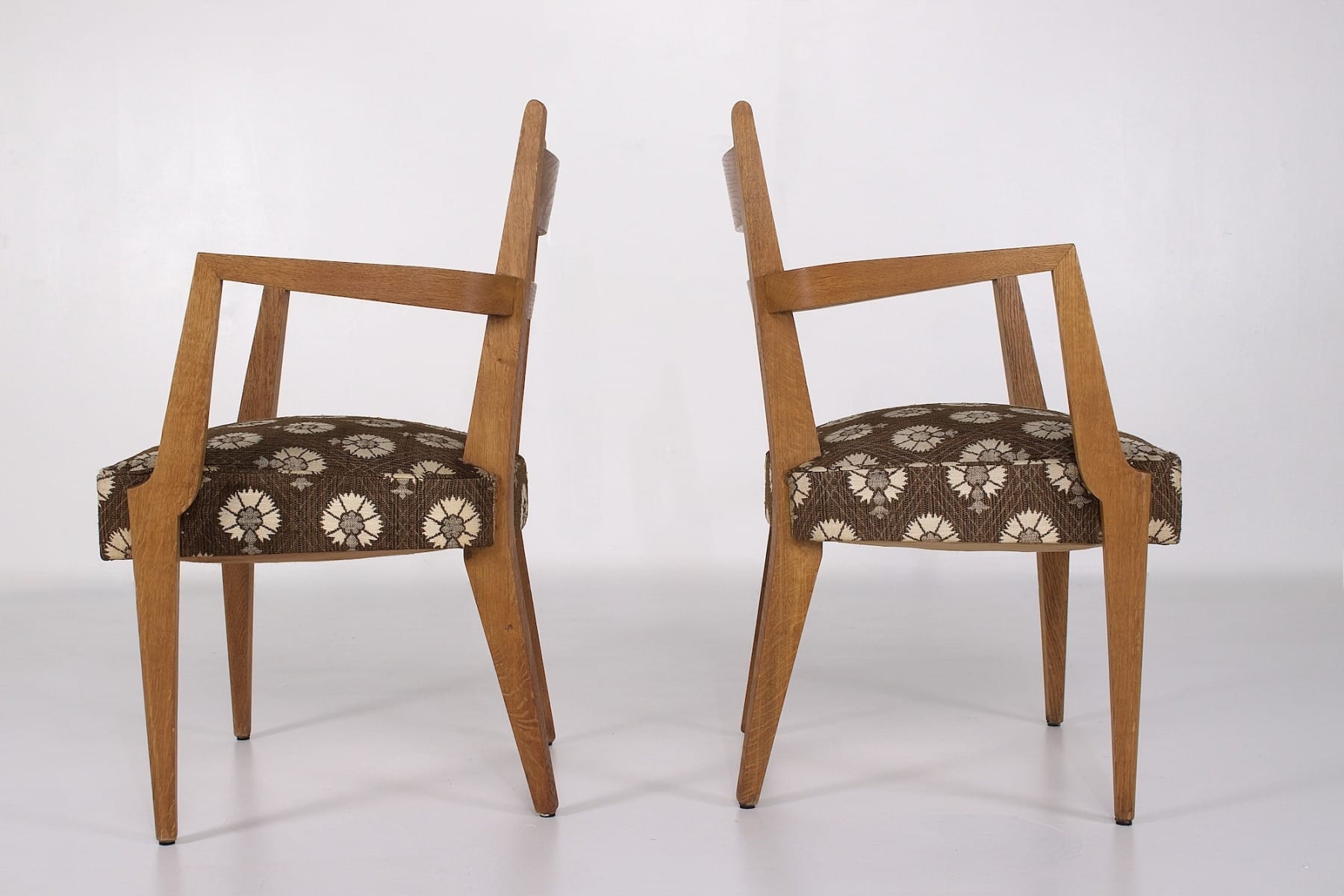
Seating continues this logic. Chairs like the 418 stand out for their sober design, balanced seating and discreet presence around a table, without ever saturating the space. Desks are particularly revealing of Vodder’s approach. Many are designed to be placed in the center of a room, with an elaborate back and autonomous volumes. Storage units are seamlessly integrated, and function never takes precedence over overall balance.
Arne Vodder’s work goes beyond isolated pieces of furniture. His collaboration with architect Anton Borg on standardized house projects sheds light on an essential dimension of his approach: thinking in systems, in modules, in coherent ensembles. This logic is directly reflected in his furniture. The proportions are reproducible, the elements interact, the solutions are simple without being simplistic. It’s not a question of theoretical minimalism, but of controlled economy, based on a real understanding of use.
With experience, certain signs come back systematically: an immediate sensation of stability, clean assemblies without unnecessary effects, clean edges that are never aggressive, a balance that holds even on large pieces. But above all, an impression that’s harder to formulate: the furniture doesn’t demand attention. It’s there. It works. It is part of everyday life, without invading it.
These parts stand the test of time. They age without deforming, either visually or in use. Proportions remain legible. Materials take on a patina without losing their balance. Over time, what remains is not a style, but a transmission.
Furniture by Arne Vodder