Claude de Marteau (1935-2016), Asian art dealer and collector
Home ” Newspaper ” Claude de Marteau (1935-2016), Asian art dealer and collector
Claude de Marteau (1935-2016)
Asian art dealer and collector
Claude de Marteau, Asian art collector and internationally recognized dealer, was primarily celebrated for the scope and quality of his collection of ancient Asian art. His largely self-taught career led him to play a central role in the circulation and recognition of major works from the Himalayas, Tibet, Nepal, India, and Southeast Asia.
From an early age, his attention was drawn to Asia. At the age of nineteen, he embarked on a solo round-the-world voyage. The discovery of the Asian continent left a lasting impression on him, and led to a definitive commitment to the religious and spiritual arts.
A collection built over decades
Over several decades, Claude de Marteau assembled an exceptional collection of religious and artistic objects: Buddhist sculptures, Himalayan works, Tibetan artifacts and pieces spanning almost 1,500 years of history. His approach is distinguished by a constant focus on the intrinsic quality of the works, their iconographic power and stylistic coherence.
In Brussels, he ran two boutiques, notably around the Place du Grand Sablon, from which he presented and traded works from the Himalayas as well as Southeast Asia, particularly Thailand and Burma. From the 1970s onwards, these galleries were an important point of passage for collectors and institutions.
Claude de Marteau’s shop, Place du Grand Sablon in Brussels, in the 1970s
Over time, Claude de Marteau deliberately reduced his public activity to focus on a select circle of discerning collectors and major institutions. Many works remained preserved in his residence, originating both from his past activity as a dealer and from his personal collection.
Major works and international recognition
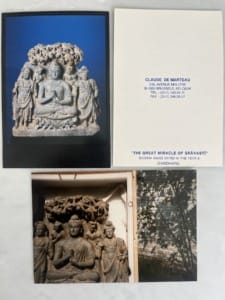
Among the most emblematic pieces associated with Claude de Marteau is the Brussels Buddha, a representation of the Miracle of Śrāvastī, a masterpiece of Greco-Buddhist art from Gandhara. This sculpture represents one of his most celebrated discoveries.
Claude de Marteau’s business card featuring the Brussels Buddha
Claude de Marteau was also the intermediary through whom the Cleveland Museum of Art acquired his Buddha from the Yuan period. In 1965, John D. Rockefeller III purchased his Shiva Nataraja, confirming the position he then held in the international networks of the Asian art market.
The Cleveland Museum of Art awarded him an honorary title, signed by E. Lee Sherman, director of the institution between 1958 and 1983, in recognition of his gifts and commitment.
Posterity and transmission
Following his death in 2016, part of Claude de Marteau’s collection was auctioned by Bonhams, attracting international attention. Several exhibitions were organized in Brussels, London, New York, Hong Kong and Paris, underlining the enduring importance of his contribution to the knowledge and dissemination of early Asian art.
The vast majority of pieces from Southeast Asia—particularly from Burma and Thailand—as well as from India and the Himalayas were acquired by Vintage Addict Gallery, which now ensures their preservation, study, and transmission.
Joseph-André Motte holds a unique place in the renewal of post-war French furniture. However, his career was not limited to furniture design: he was also active in interior architecture, the layout of public facilities, teaching,...
René-Jean Caillette (1919–2004) belongs to that generation of designers who, in the 1950s and 60s, profoundly transformed French furniture. At a time when furnishing still hesitated between decorative tradition and industrial production, he resolutely chose...
In the history of post-war Belgian furniture, Alfred Hendrickx holds a singular place. Today, his name is mainly associated with Belform, its sideboards and credenzas with taut lines, its tables, seating and modular storage systems....
×
1
Product selection
2
Contact information
3
Review information
error: Content is protected !!
Gérer le consentement
Pour offrir les meilleures expériences, nous utilisons des technologies telles que les cookies pour stocker et/ou accéder aux informations des appareils. Le fait de consentir à ces technologies nous permettra de traiter des données telles que le comportement de navigation ou les ID uniques sur ce site. Le fait de ne pas consentir ou de retirer son consentement peut avoir un effet négatif sur certaines caractéristiques et fonctions.
Fonctionnel
Always active
L’accès ou le stockage technique est strictement nécessaire dans la finalité d’intérêt légitime de permettre l’utilisation d’un service spécifique explicitement demandé par l’abonné ou l’utilisateur, ou dans le seul but d’effectuer la transmission d’une communication sur un réseau de communications électroniques.
Préférences
L’accès ou le stockage technique est nécessaire dans la finalité d’intérêt légitime de stocker des préférences qui ne sont pas demandées par l’abonné ou l’internaute.
Statistiques
Le stockage ou l’accès technique qui est utilisé exclusivement à des fins statistiques.Le stockage ou l’accès technique qui est utilisé exclusivement dans des finalités statistiques anonymes. En l’absence d’une assignation à comparaître, d’une conformité volontaire de la part de votre fournisseur d’accès à internet ou d’enregistrements supplémentaires provenant d’une tierce partie, les informations stockées ou extraites à cette seule fin ne peuvent généralement pas être utilisées pour vous identifier.
Marketing
L’accès ou le stockage technique est nécessaire pour créer des profils d’internautes afin d’envoyer des publicités, ou pour suivre l’utilisateur sur un site web ou sur plusieurs sites web ayant des finalités marketing similaires.