





Alfred Hendrickx Freestanding Desk for Belform – Model B5
€3200,00
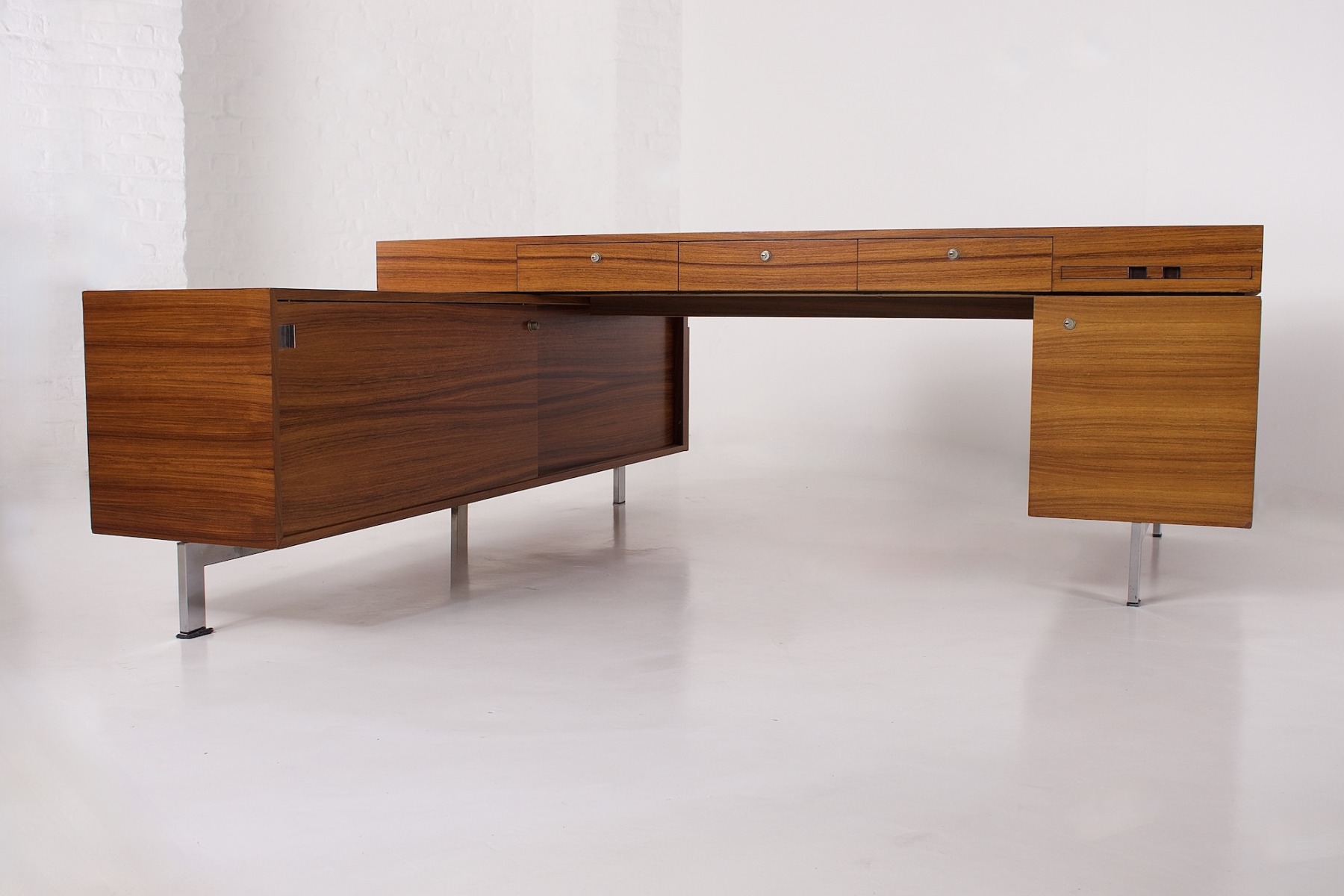
Alfred Hendrickx for Belform, freestanding desk model B5 with its two pedestals B6 and B7, in Zebrano (Zingana) veneer. Base and handles in nickel-plated steel, mid-1960s.
- Excellent condition, surfaces restored by our conservator.
- No key for a drawer
- W 180 cm × D 85 cm × H 73 cm.
- Drawers P 51.5 CM X P 9.5 CM.
- Large drawer P 52 CM X H 29 CM.
- Delivery by national or international carrier.
1 available in store

Large 1960s Desk, 180 cm – Belgian Design
Measuring 180 cm in width, this large 1960s vintage desk, featuring a top and Zebrano pedestals suspended on a brushed steel base, embodies the sought-after characteristics of a design desk: an elegant and practical workspace with a visually light structure, serving as a true three-dimensional calling card.
B5 desk with B6 and B7 pedestals by Alfred Hendrickx for Belform
Designed by Alfred Hendrickx for Belform, this piece anticipates what is now almost a prerequisite: flexibility. While this executive desk can be placed against a wall, its design primarily allows for free placement within a room. The design of the base, the elevated pedestals, and the contrast between the strongly veined wood and the metal also position it as an alternative to the more massive executive desks of the same period.
This design is part of the development of 1960s design furniture, a period when many European designers sought to visually lighten office furniture.
An Alfred Hendrickx Desk Documented by the Belform Catalogue
The attribution of this desk to Alfred Hendrickx for Belform is not based solely on stylistic comparison. An original catalogue preserved in our archives presents the furniture in situ, as well as in the form of a technical drawing. The documentation explicitly bears the trilingual mention « ontwerp / création / entwurf : Alfred Hendrickx ».

“Social Design” catalogue documenting furniture designed by Alfred Hendrickx for Belform.
The drawing identifies the main structure under the reference B5, accompanied by two suspended elements: the B6 drawer pedestal and the B7 closed storage unit. The dimensions indicated in the catalogue, 73 × 180 × 85 cm, correspond to those of the example presented here.

The Alfred Hendrickx desk and its various elements in the Belform catalogue.
The catalogue also provides insight into the designer’s functional research: a drawer is compartmentalized for writing accessories, and the two pedestals can be arranged differently. This modularity is also found in other Hendrickx creations, notably his modular bookcases and wall shelves.
Alfred Hendrickx, Belform, and Belgian modernism
The collaboration between Alfred Hendrickx and Belform occupies an important place in the renewal of post-war Belgian furniture. Emerging from the family firm Van Fleteren in Mechelen, Belform, under Hendrickx’s impetus, developed furniture radically different from traditional Mechelen production: lightened volumes, geometric lines, slender bases, and a rational organization of functions.
By the late 1950s, his design progressively became more architectural. A Belform document dated 1959 is notably described by historical sources as marking this evolution toward stricter rectangular forms and the use of metal legs with a regular section.
The catalogue in which references B5, B6, and B7 appear is not dated itself. Its design, however, clearly fits into this evolution of Belform’s production from the early 1960s.
To situate this modernist desk within the broader scope of this production, our article dedicated to the history of Belform and Alfred Hendrickx compares historical sources with a period catalogue and several numbered pieces that have passed through our restoration workshop.
You might also like…
Discover also...


Delivery to Belgium

Delivery to France

Delivery to Luxembourg
