Danish mid-century teak desk
€1650,00

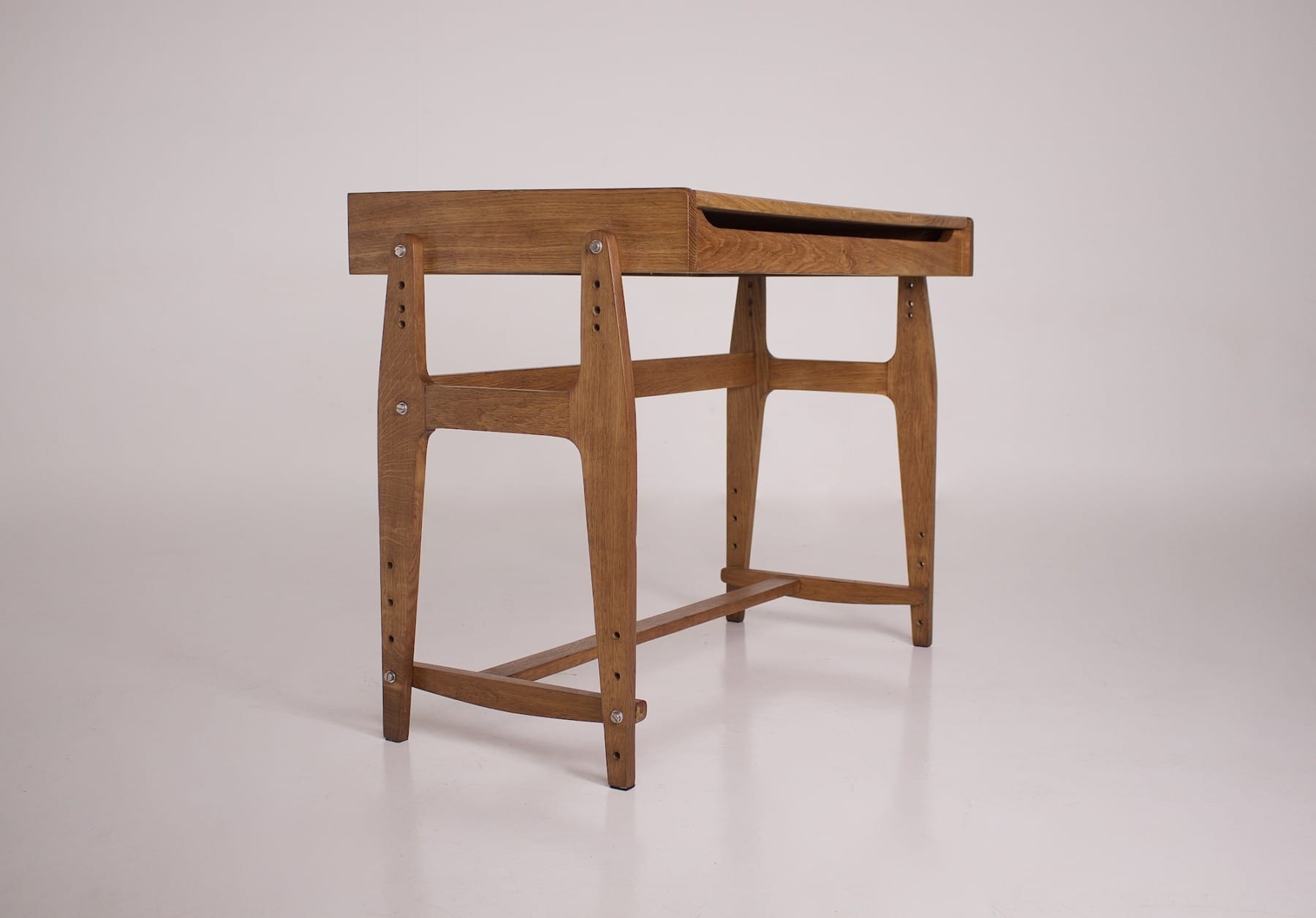
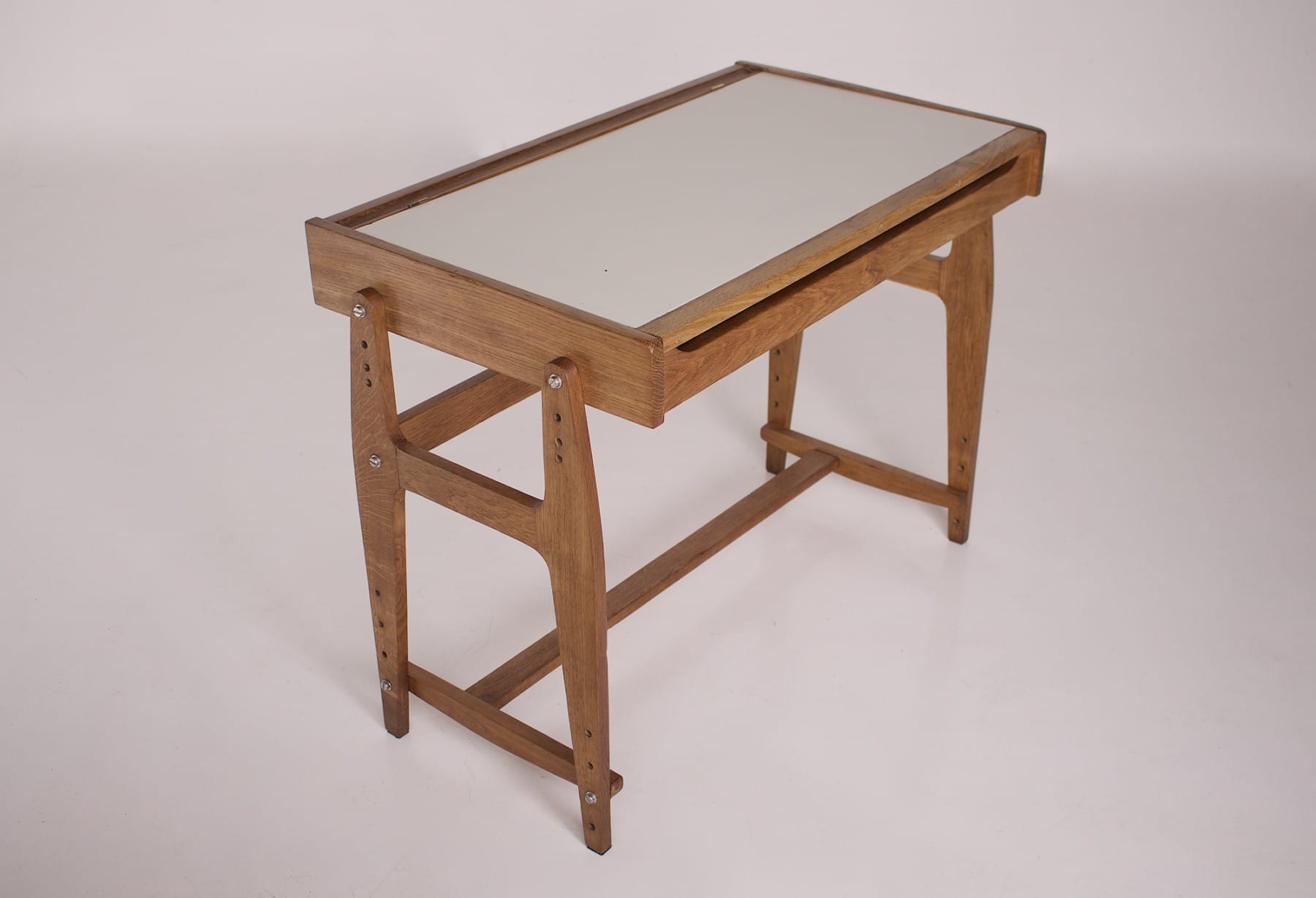
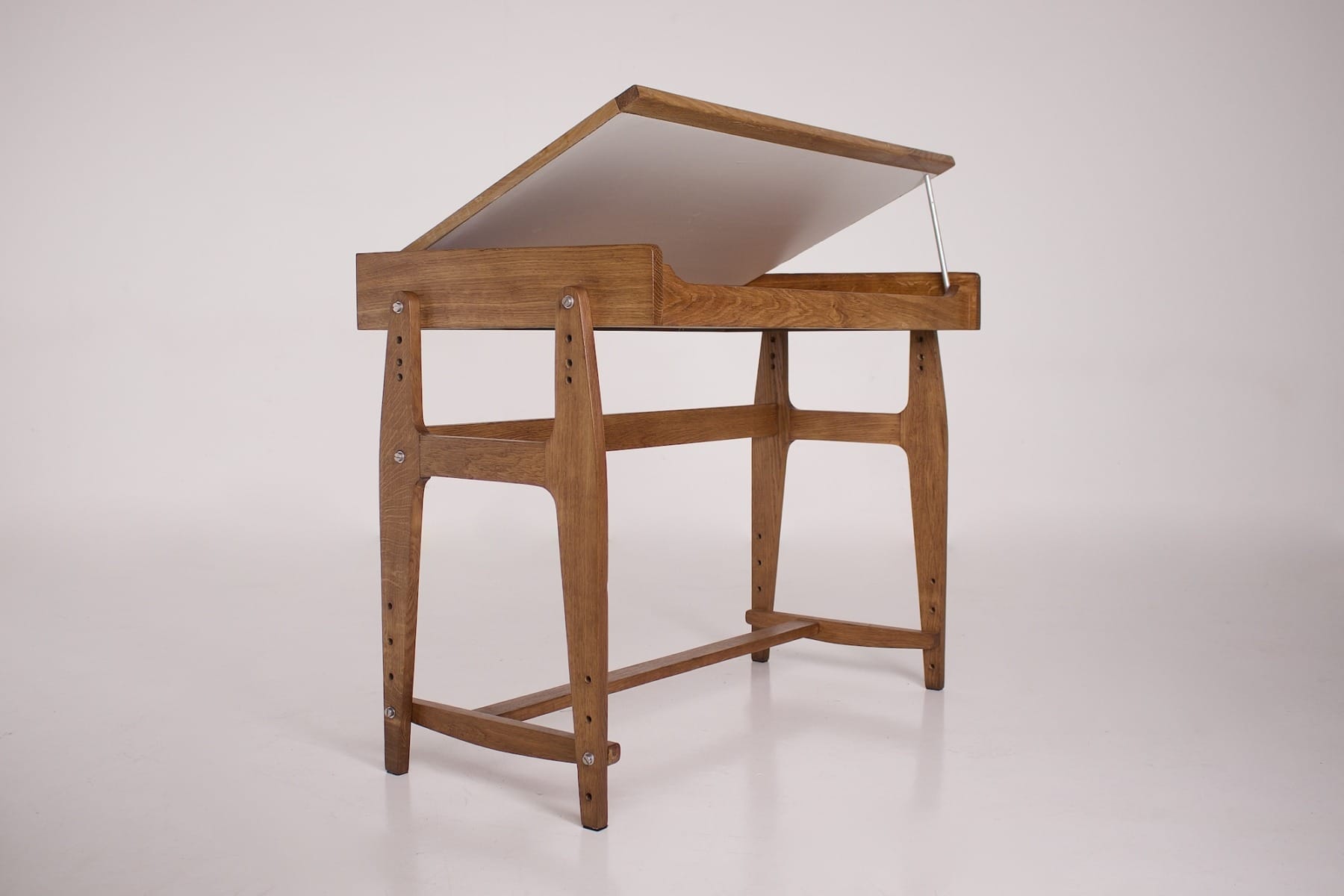


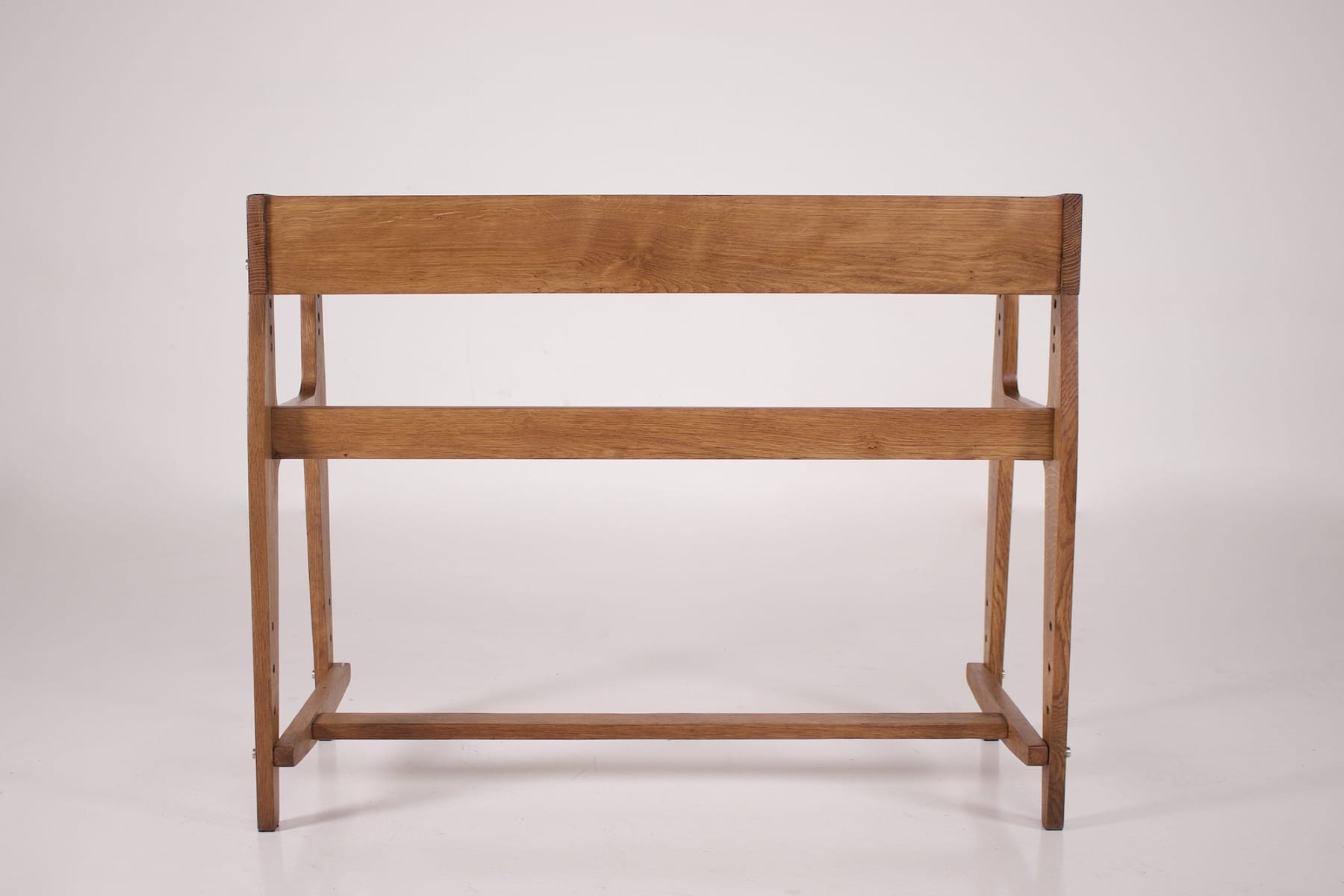


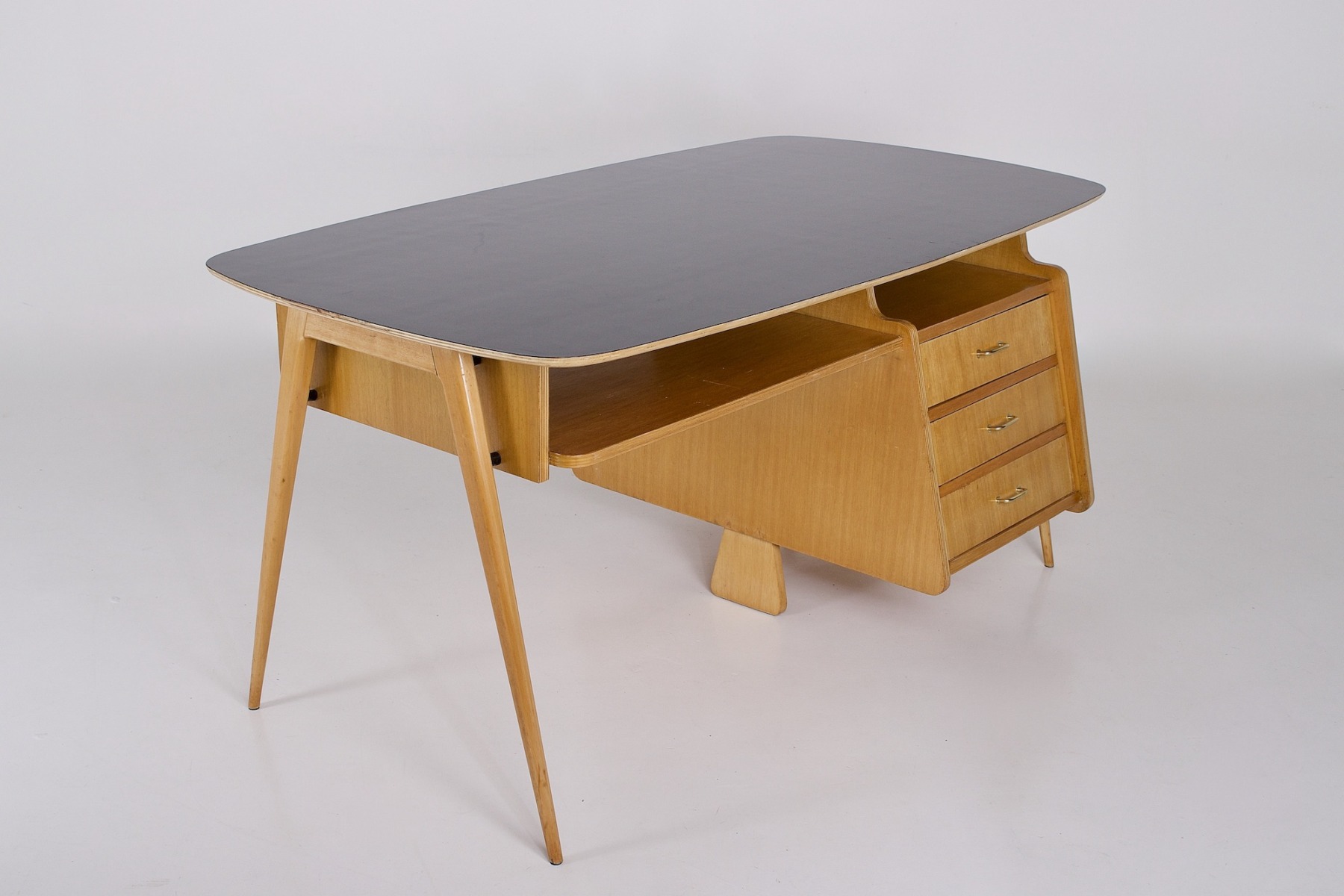
Height-adjustable desk in blond oak, with a hinged compartment beneath the white laminate shelf. Designed by Pierre Gautier Delaye for Vergnères, publisher, mid-1950s.
Sold

This height-adjustable desk is the work of Pierre Gautier-Delaye, an interior architect and French furniture designer who, during the 1950s, took part in the profound renewal of post-war furnishings. His approach rests on a great economy of means: simple lines, clearly constructed volumes, and particular attention to proportions and joinery details. This economy of means is pushed to an extreme: a very simple adjustment device integrated into the base allows the height of the shelf and stretcher to be adapted to the child’s size, extending the desk’s use as they grow. A form of sustainability ahead of its time.
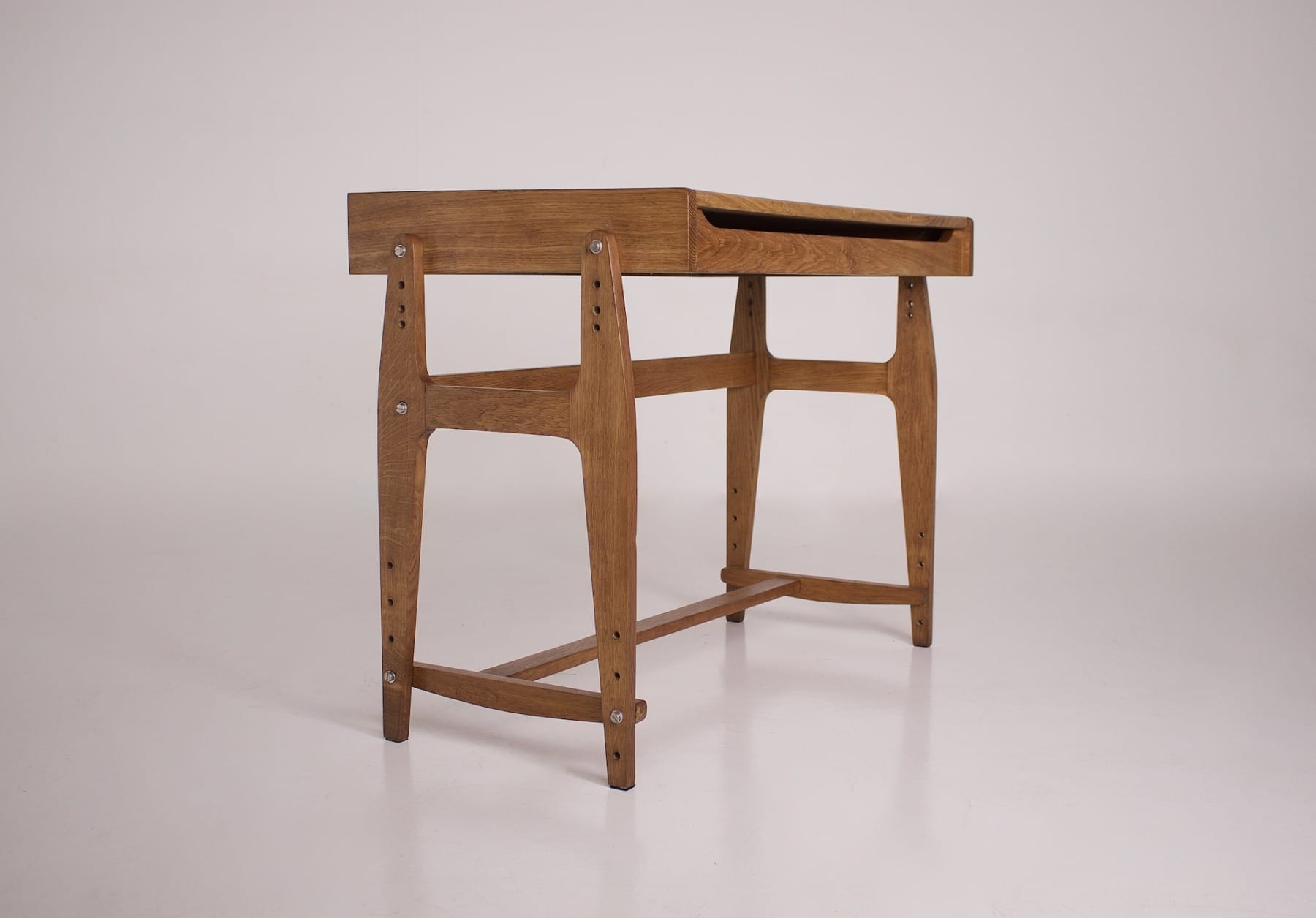
On Pierre Gautier-Delaye’s desk, the shelf and stretcher are adjustable—an economy of means in the fullest sense of the term. Vergnères edition, c. 1954.
Alongside his work as an interior architect—notably for Air France, for which he fitted out numerous agencies—Gautier-Delaye developed an important body of work devoted to serially produced furniture. In 1956, he received the René-Gabriel Prize for a mahogany suite shown at the Salon des arts ménagers on the stand of his publisher Vergnères. The award specifically recognized a conception of modern furniture intended to combine quality of design, functionality, and accessible production.
That same year, Gautier-Delaye presented at the Salon des arts ménagers a suite in Landes pine, including in particular a box-compartment bookcase. This presentation was one of the first manifestations of the Week-End furniture, which would become among the most characteristic achievements of his work.
Pierre Gautier-Delaye’s designs stand out for a simplicity that never excludes refinement. The lightness of the drawing is found as much in the junction of a base with a top as in the slight offset of a chair back. Behind the apparent obviousness of these pieces lies a very precise attention to proportions, joints, and quality of execution.
This approach extends the functional furniture developed after the war around designers such as Marcel Gascoin, while retaining a distinct identity. The literature devoted to Gautier-Delaye even refers, with regard to certain of his designs, to an “economical Gascoin”: furniture reduced to essentials, rational, and intended for relatively wide distribution.
A significant part of this success lies in his collaboration with cabinetmaker Lucien Vergnères. Gautier-Delaye met him through Gilbert Poillerat. Vergnères, whose Paris workshop also worked for decorators such as Jacques Adnet, Jean Pascaud, or André Arbus, brought to the project a solid command of traditional cabinetmaking.
This encounter between modern design and artisanal know-how finds a particularly accomplished expression in the Week-End furniture. Inspired by mountain furniture traditions and by the use of simple woods, Gautier-Delaye conceived a complete range including, in particular, tables, chairs, sideboards, beds, wardrobes, and bedside tables. Inexpensive and designed for everyday use, these ensembles quickly met with considerable success.
The interest of the Week-End furniture lies precisely in this ability to reconcile modernity and tradition. Gautier-Delaye does not seek to erase the character of the material behind an industrial aesthetic. On the contrary, he simplifies constructive principles drawn from vernacular furniture in order to adapt them to the new post-war ways of living.
This approach echoes certain research carried out at the same time by Charlotte Perriand, Gio Ponti, or Hans J. Wegner: using familiar materials and proven techniques to create modern, functional furniture suitable for serial production.
The success of the Week-End furniture was such that it was widely copied. Their use of simple woods and their refusal of any superfluous decorative effect also foreshadow certain directions in 1970s furniture, when the oil crisis and the retreat from all-plastic would help to revalue natural materials and more elementary constructions.
This piece thus bears witness to a particularly fertile period of French modernist furniture, during which designers such as Pierre Gautier-Delaye sought to reconcile contemporary design, serial production, and artisanal tradition.