









Bronze Hayagriva, Tibet
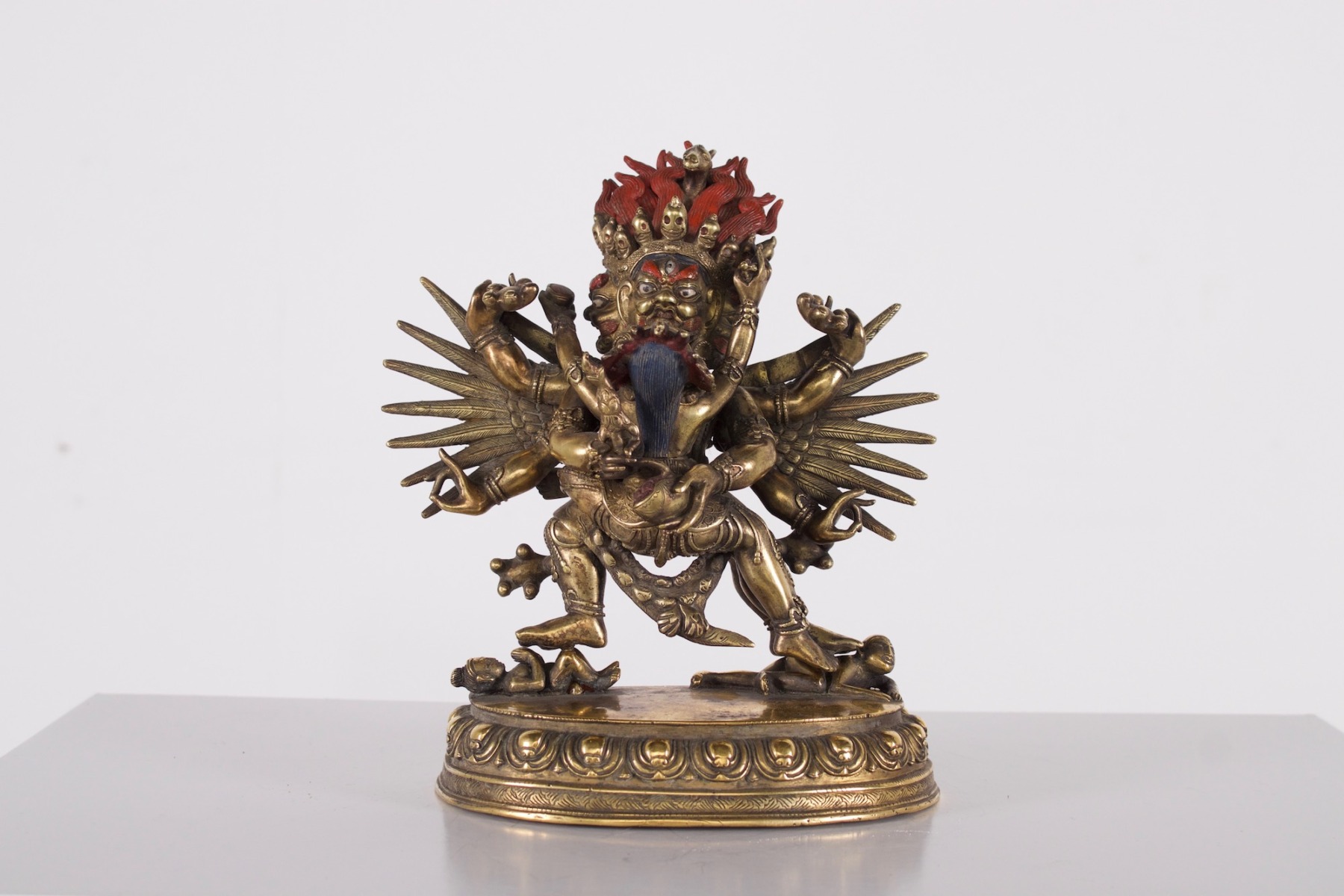
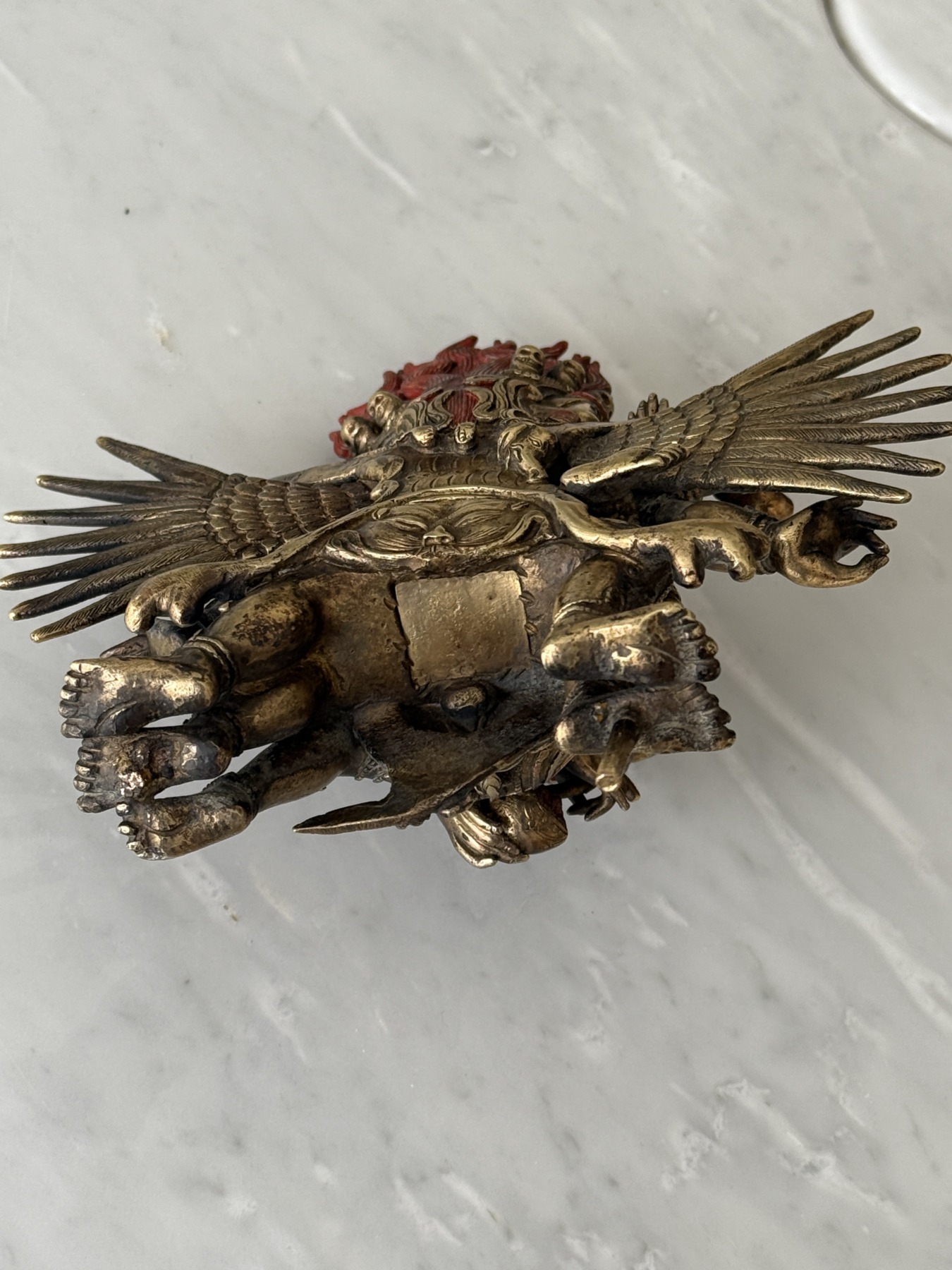
This bronze sculpture represents Hayagrīva in yab-yum with his consort Nairātmyā, deities of Vajrayāna tantric Buddhism.
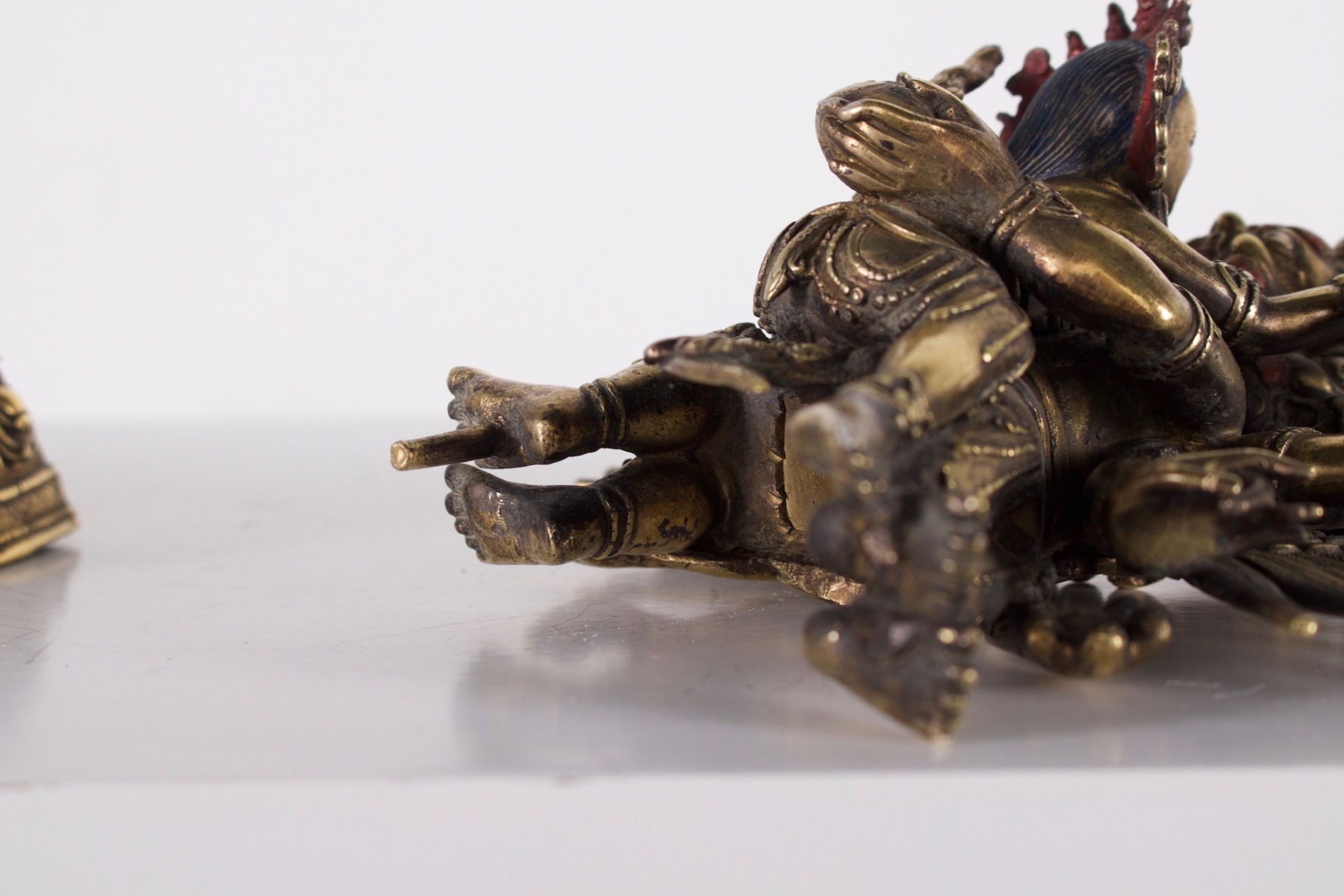
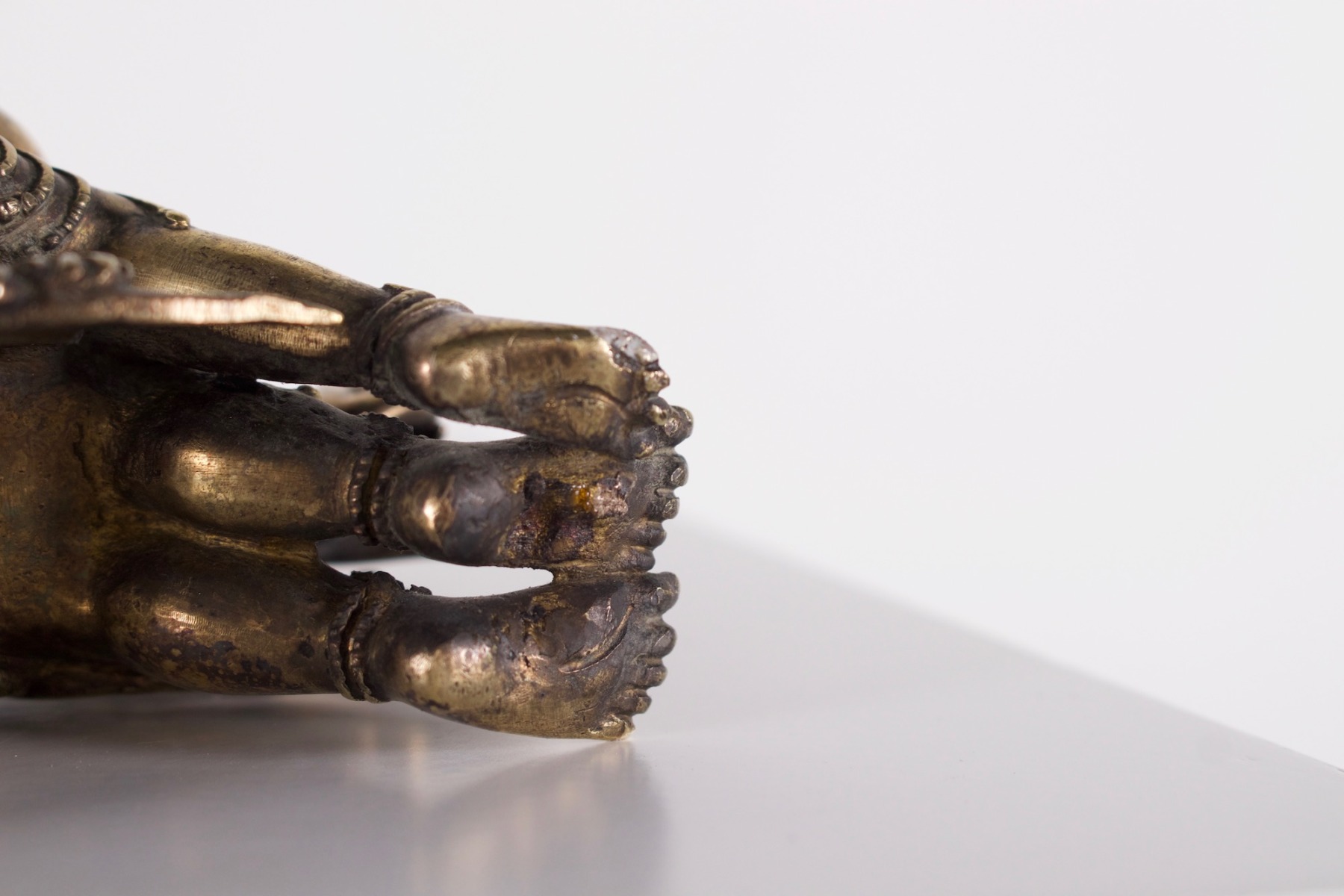
- Very good condition. One anchoring tenon is missing under the left leg, without affecting the overall stability.
- Dimensions: H 20.5 × W 17 × D 9 cm.
- Weight: 2.19 kg.
- Tibet, 19th century or earlier.
- Provenance: Claude de Marteau collection.
- Sold with certificate of origin.
Sold

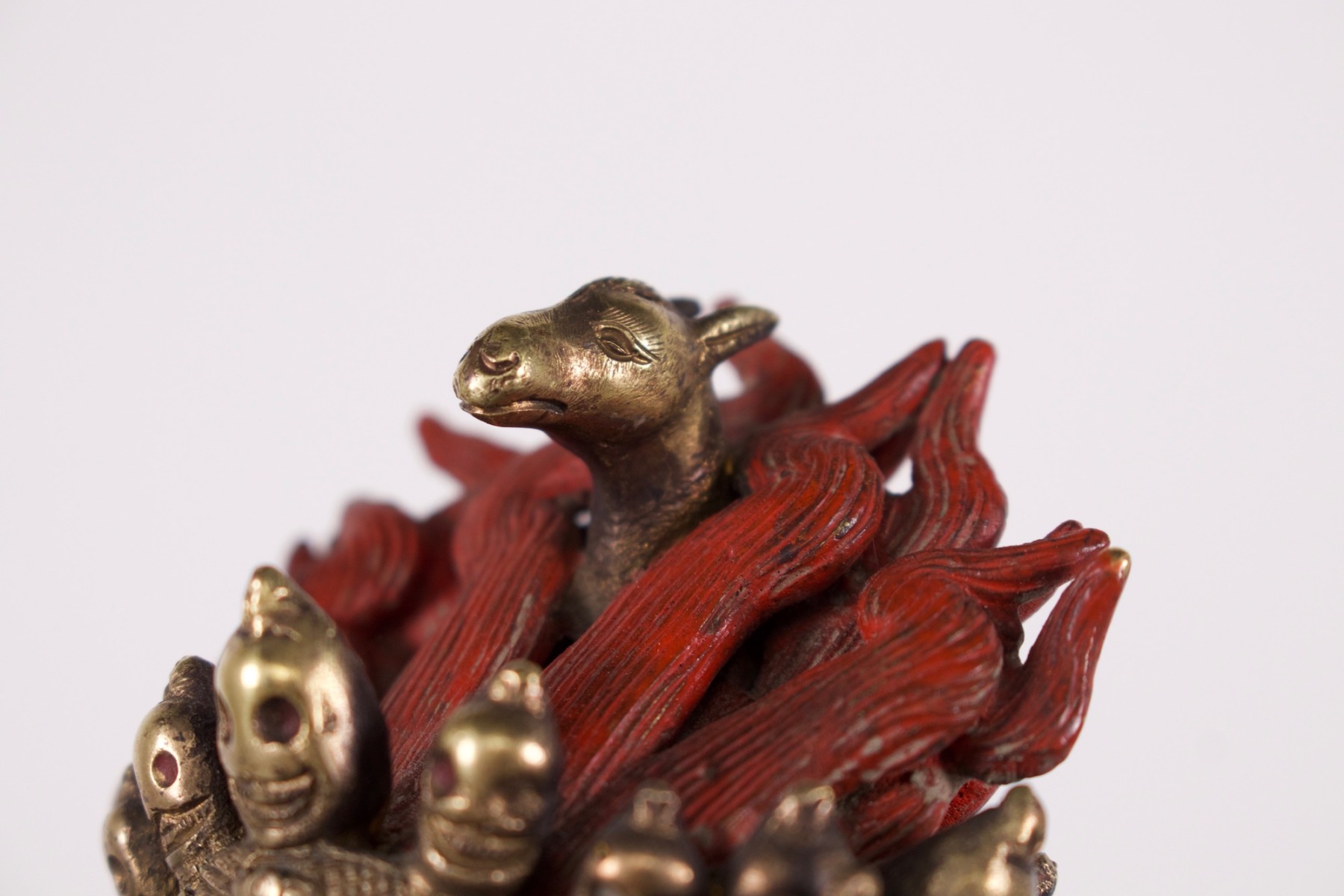
This Tibetan gilt-bronze sculpture depicts Hayagrīva, one of the great wrathful deities of Vajrayāna Buddhism. Its Sanskrit name literally means “he who possesses a horse’s neck”; in Tibet, the deity is known as Tamdrin (rTa-mgrin). Its identification here is immediate due to the small horse head emerging from his flaming hair, an iconographic characteristic specific to Hayagrīva.
The fierce aspect of the deity should not be understood as a malevolent representation. In Tibetan Buddhism, Hayagrīva belongs to the register of protective deities whose wrath expresses, on the contrary, a particularly energetic form of compassion. He is both a tutelary deity or yidam and a protector of the Buddhist teachings. Attached to the Lotus family of the buddha Amitābha, he is also presented as a wrathful manifestation of Avalokiteśvara, the bodhisattva of compassion.
A complex form of Hayagrīva in yab-yum
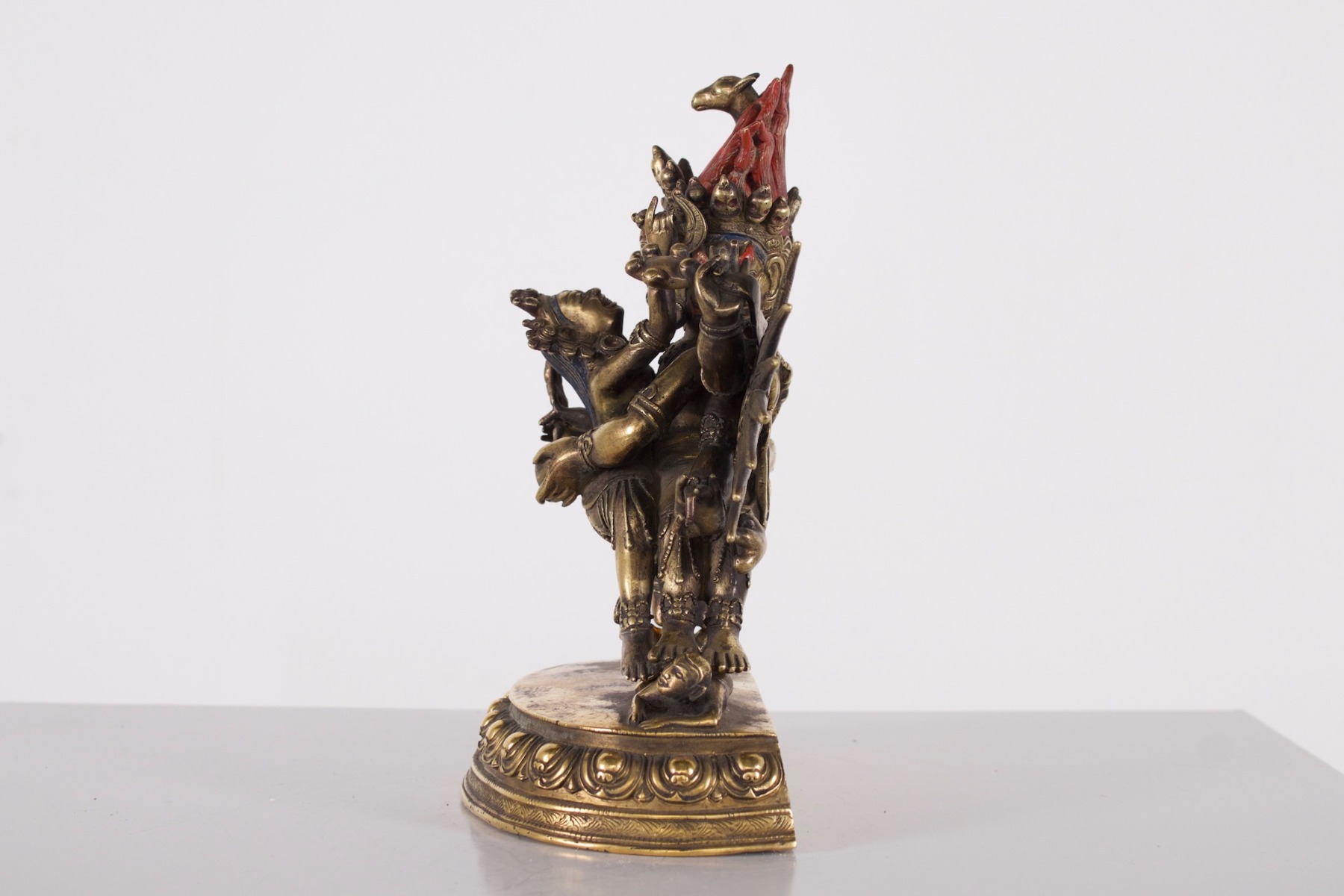
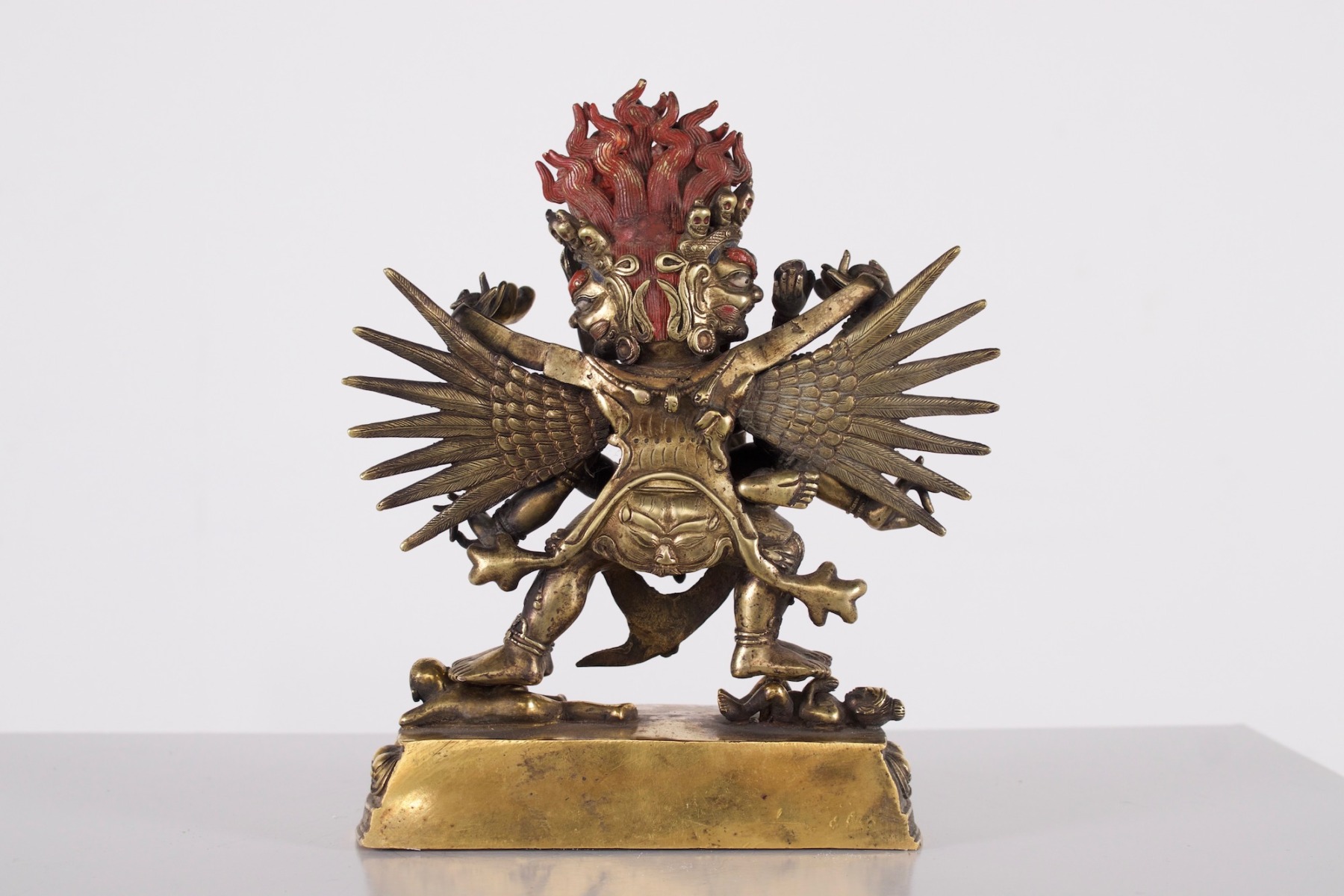
The particularly dense composition of this statuette aligns it with the forms of Red Hayagrīva known as the “Very Secret Accomplishment.” The deity possesses three wrathful heads, six arms, and four legs, while two large, widely spread wings give the ensemble a spectacular silhouette.

Fine details of Hayagriva’s wrathful face.
Hayagrīva appears in yab-yum union with his consort, embraced against him. This “father-mother” representation is characteristic of Tantric iconography: far from constituting a mere erotic scene, the union notably symbolizes the inseparability of wisdom and the means employed to attain Enlightenment.
The three faces of Hayagrīva are surmounted by a crown of skulls and framed by an imposing mane of hair raised like a blazing fire, of which significant traces of red pigment remain. The principal face presents the usual signs of wrathful deities: wide-open eyes, frontal third eye, menacing mouth and visible fangs.

The horse head in Hayagriva’s hair, a highly distinctive element of his iconography.
Above this ensemble appears the horse’s head, turned in profile. According to Tibetan tradition, the neighing of Hayagrīva possesses the power necessary to shake the different worlds and repel the forces obstructing the spiritual path. The Musée Guimet thus evokes in this regard the swiftness of the horse and the power of its cry, capable of driving away demons and ridding the mind of its defilements.
An iconography entirely devoted to protective power
Hayagrīva adopts a dynamic and martial attitude. His spread and flexed legs give the sculpture a strong tension, amplified by the symmetrical deployment of the wings and the multiplication of arms. Several hands perform wrathful gestures while the deity holds his consort against him.
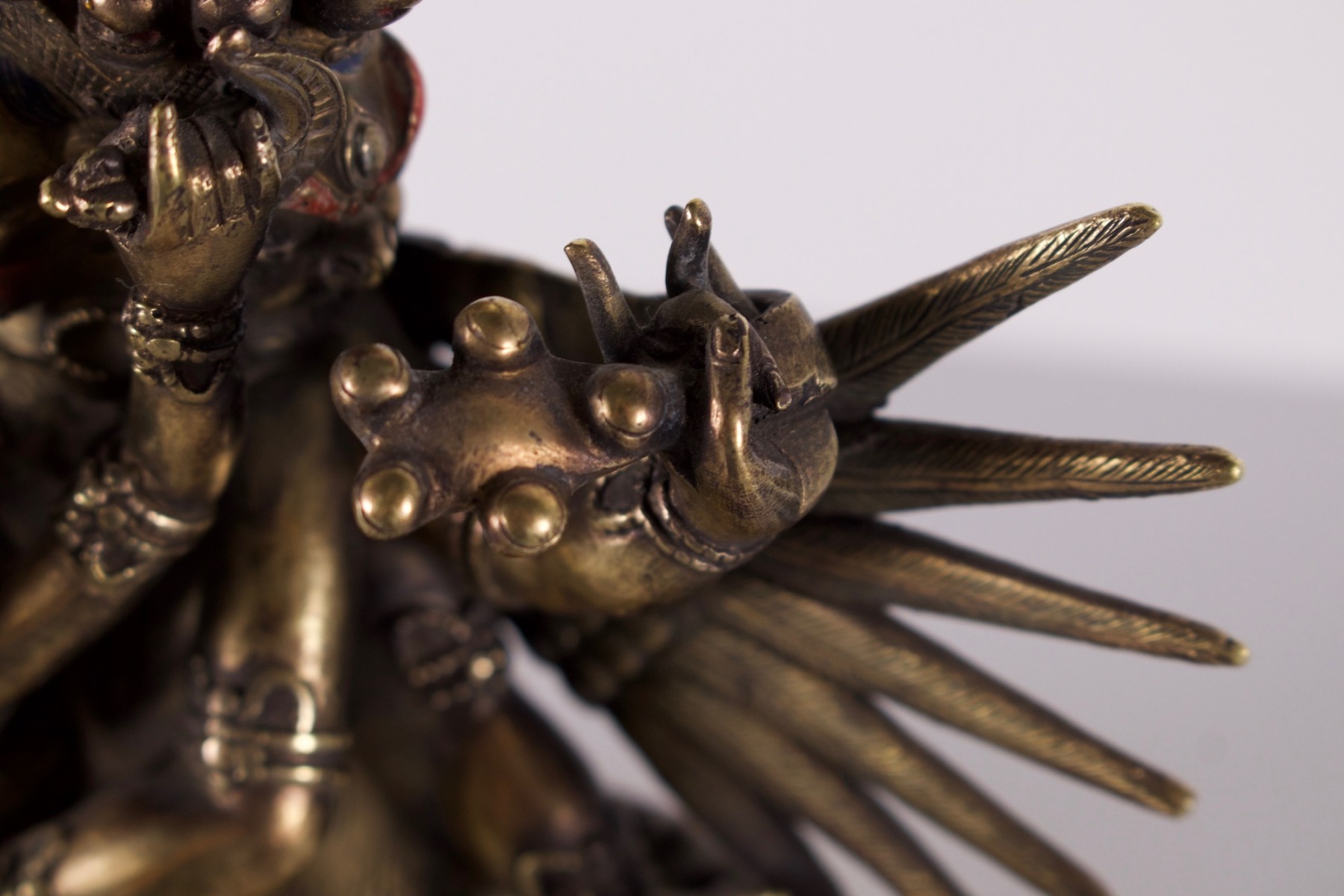
Tibetan representations of this form of Hayagrīva may include different ritual attributes: skull cup, flower, sword, goad, club, lasso or ritual staff. Their arrangement varies according to traditions and lineages, and some have frequently disappeared on ancient bronzes. Identification therefore rests less on an isolated attribute than on the highly characteristic combination of the three faces, six arms, four legs, wings, consort and above all the equine head dominating the hair.
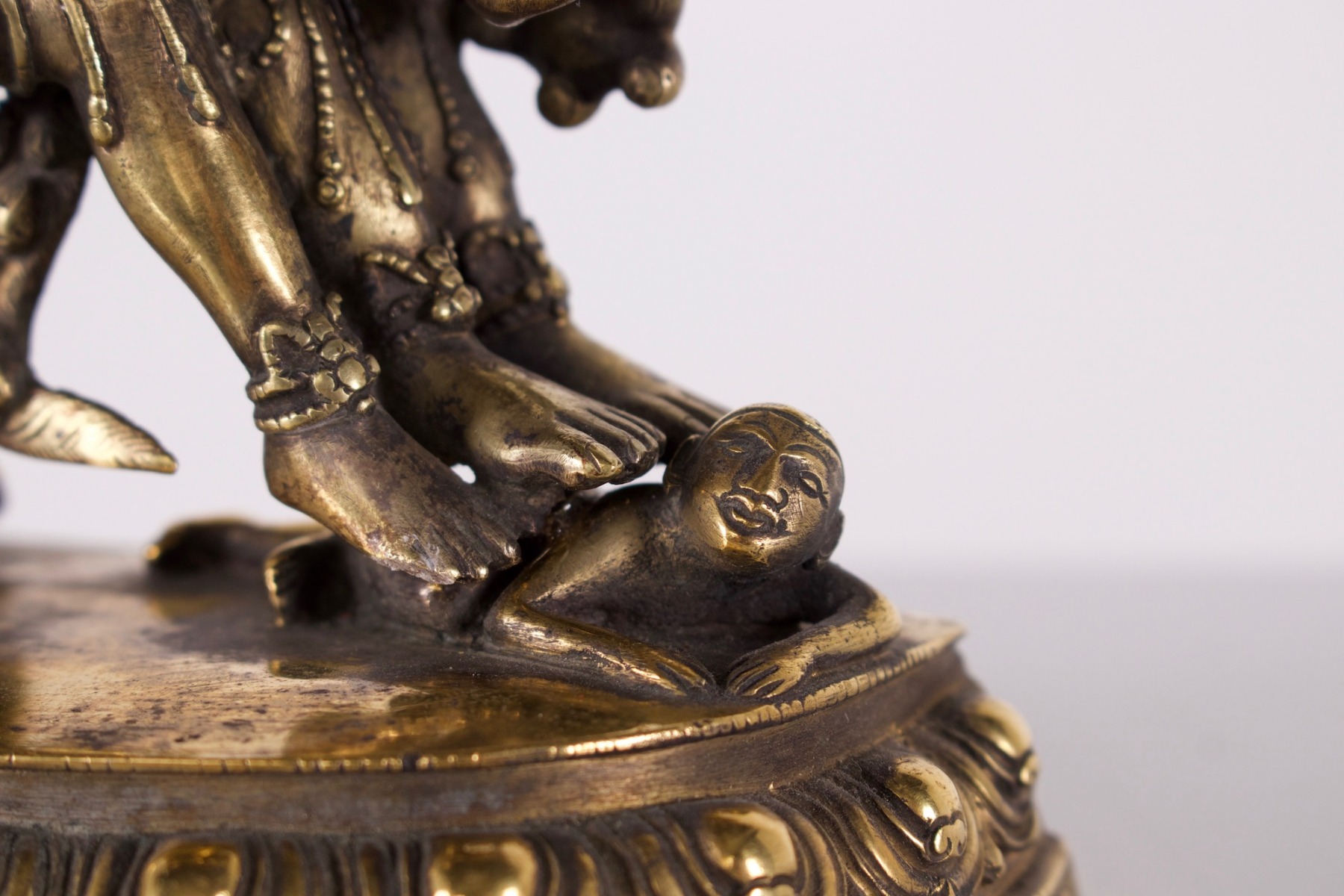
Beneath the deity’s feet are stretched two prostrate figures. As often in Tibetan tantric art, these represent the obstacles, passions or negative forces mastered by the deity. Hayagrīva therefore does not symbolically destroy beings but what obstructs knowledge and spiritual accomplishment.

The vanquished demons, the obstacles overcome by Hayagriva.
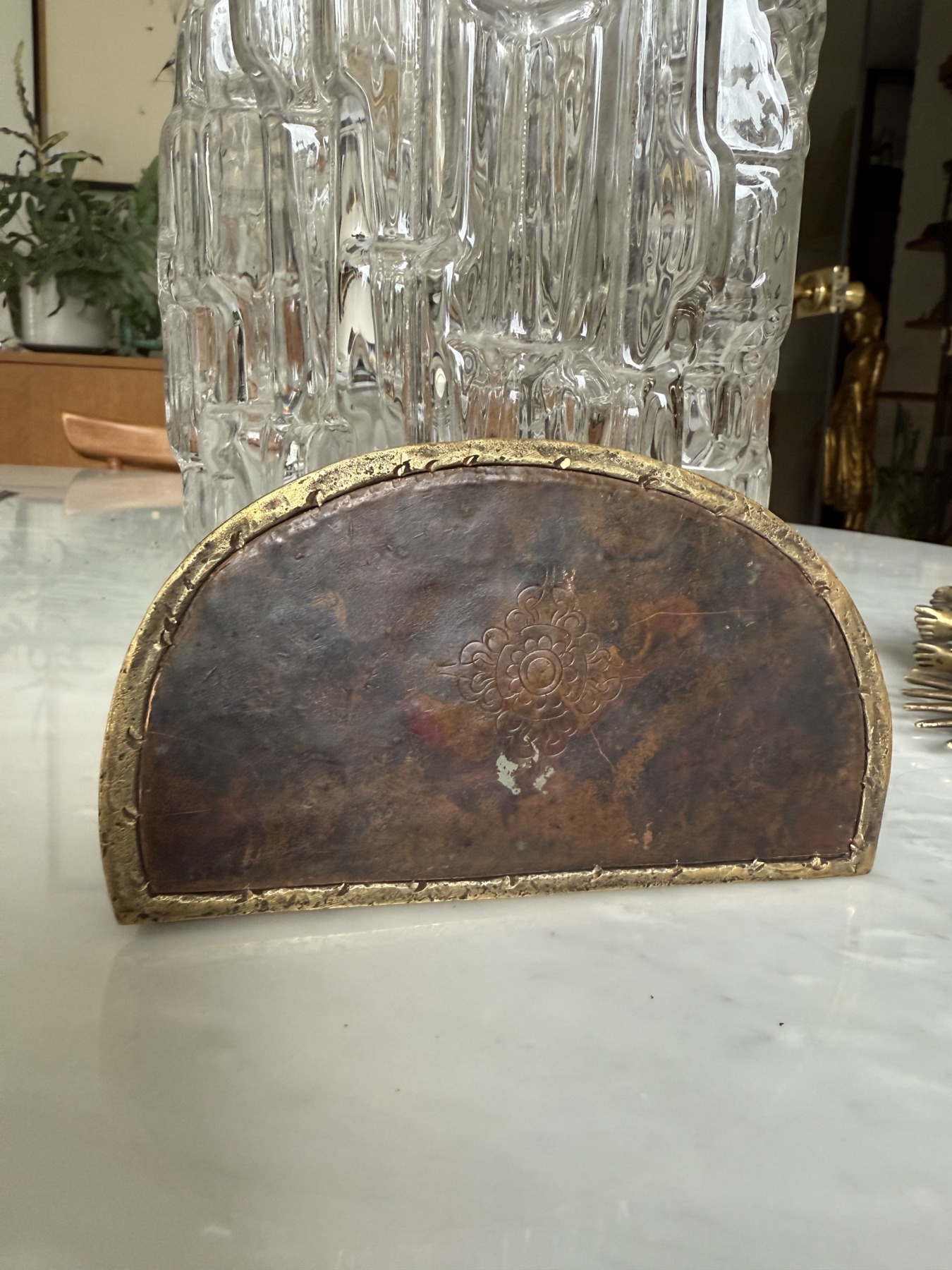
The whole rests on a gilt bronze lotus-form base, whose rounded petals bring a calmer foundation to the visual violence of the upper part.
A 19th-century Tibetan sculpture
Made in Tibet in the 19th century at the latest, this statuette presents a remarkably complex casting given its dimensions. The work plays on the accumulation of faces, limbs, ornaments, wings, secondary figures and symbolic elements without losing the overall reading of the composition.
The ancient gilding is today nuanced by wear and by the natural variations of the bronze surface. The pigments preserved in the hair, faces and beard are particularly interesting: they recall that these sculptures were not conceived as simple monochrome bronzes but could combine gilt metal and colors in order to reinforce the presence of the deity.
This representation of Hayagrīva bears powerful witness to the universe of Tibetan tantric Buddhism, where the most terrifying appearances can embody a profoundly protective action.
The sculpture comes from the estate of the collector Claude de Marteau; it is sold with certificate of authenticity.
You might also like…


Discover also...


Delivery to Belgium

Delivery to France

Delivery to Luxembourg
