





Ratha Panel – Shiva Kalarimurti – The Triumph over Death
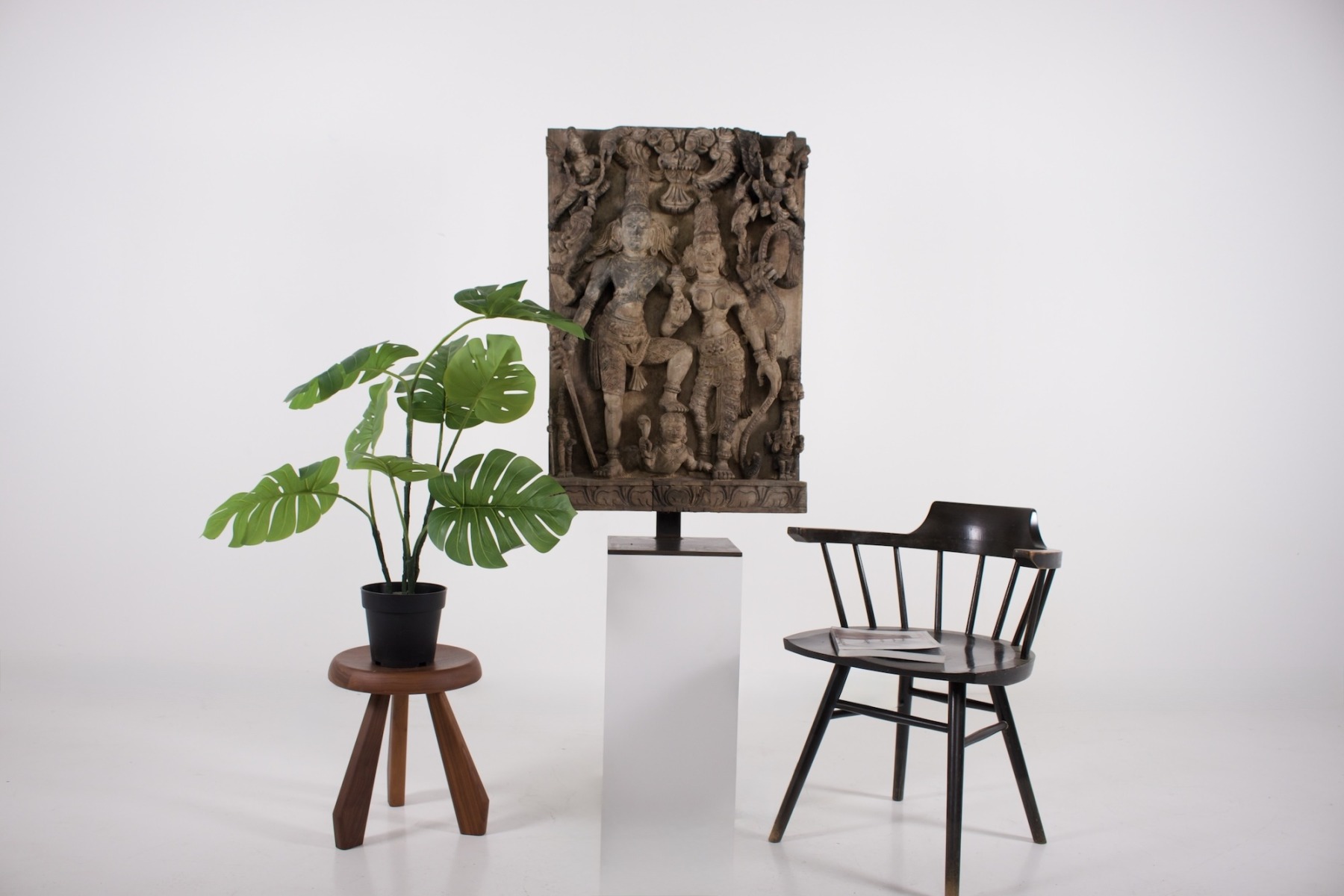
Shiva Kalarimurti (The Triumph over Death) South India, Tamil Nadu — 18th – 19th century. High-relief wooden processional chariot panel (Ratha)
This carved wooden panel likely depicts Shiva in his fierce Kalarimurti form, vanquishing Yama, the god of Death, to save his young devotee Markandeya.
In a warrior stance, Shiva strides over his adversary and diagonally brandishes a large trident (trishula). The lower shaft of the weapon, carved into a spearhead, is directed towards the ground to pin down Yama, depicted here as a royal figure, prostrate and powerless. In his other hands, Shiva holds the hourglass drum (damaru) and displays a heavy stylized garland. This dynamic work symbolizes the victory of devotion over time and death.
- Normal signs of wear and minor losses.
- Panel dimensions (overall without steel base): H 98 cm x W 47 cm x D 12 cm
- The custom-made base is included.
- Former Claude de Marteau collection
Sold

The Attributes of Shiva, Symbols of His Cosmic Power
This chariot panel depicting Shiva is distinguished by its eight arms, each holding an attribute that contributes to the symbolic interpretation of the sculpture. Far from being mere accessories, these objects convey the deity’s various manifestations, simultaneously creator, destroyer, protector, and master of the forces of the universe.

The various attributes of Shiva
.
Notably, one recognizes the trident (trishula), symbol of his supreme authority, the double drum (damaru), whose rhythm evokes the creation of the world, the axe (parashu), emblem of his destructive power, as well as the antelope (mriga), held delicately between the fingers and representing the wandering mind that Shiva keeps under his control. The other hands hold a sword or a large combat knife (khadga), a small shield (khetaka), symbol of his warrior might, as well as a ritual bell (ghanta), used in Hindu worship to punctuate ceremonies, announce the deity’s presence, and accompany purification rites.
The precision given to each of these attributes testifies to the sculptors’ care for Shaivite iconography and allows this representation of Shiva to be identified as one of his warrior forms, placing this sculpture within the great tradition of processional chariot panels from Tamil Nadu.
Processional Chariots, True Mobile Temples
In South India, large Hindu temples traditionally possess imposing processional chariots (ratha in Sanskrit or ther in Tamil), used during major religious festivals. These monumental wooden structures, sometimes several meters high, are used to transport sacred images of deities out of the sanctuary so that they can be venerated by the entire community.

Temple processional chariot in Madras circa 1850. Two carved panels are visible on its sides. (Source: Wikipedia.)
The unusual dimensions of the panels we offer attest to the importance of the monumental composition of which they were originally a part.
Far more than simple ceremonial vehicles, these chariots are true works of art. Their architecture is entirely covered with carved panels illustrating the great episodes of Hindu mythology, the various manifestations of deities, as well as a multitude of celestial figures, animals, and plant motifs. Each panel participates in a vast iconographic program designed to transmit sacred narratives throughout the procession.
An ancient processional chariot panel from Tamil Nadu, this sculpture was part of the Claude de Marteau collection, whose archives attest to his interest in South Indian religious sculptures. It illustrates the remarkable craftsmanship of Tamil sculptors’ workshops, capable of combining monumentality, expressiveness, and iconographic precision in the service of Shaivite worship.
An Iconography Close to Several Wrathful Forms of Shiva
The precise identification of this representation of Shiva remains delicate. By its weaponry, its eight arms, and the presence of a prostrate figure at its feet, it shares characteristics common to several wrathful forms (Samharamurti) of the god.
It notably evokes Andhakasuravadha, in which Shiva slays the demon Andhaka, blinded by his desire to seize Parvati. According to the mythological account, each drop of the demon’s blood giving birth to a new adversary, Shiva receives the help of the goddesses Saptamatrikas to prevent his regeneration and win the battle.
The sculpture can also be likened to Kalarimurti (or Kalasamharamurti), a representation in which Shiva punishes Yama, the god of Death, for attempting to take his young devotee Markandeya before his destined time.
In the absence of an inscription from Claude de Marteau’s inventory or an absolutely definitive attribute, it is preferable to consider this work as a representation of Shiva in one of his wrathful forms, rather than definitively favoring one or the other of these interpretations.
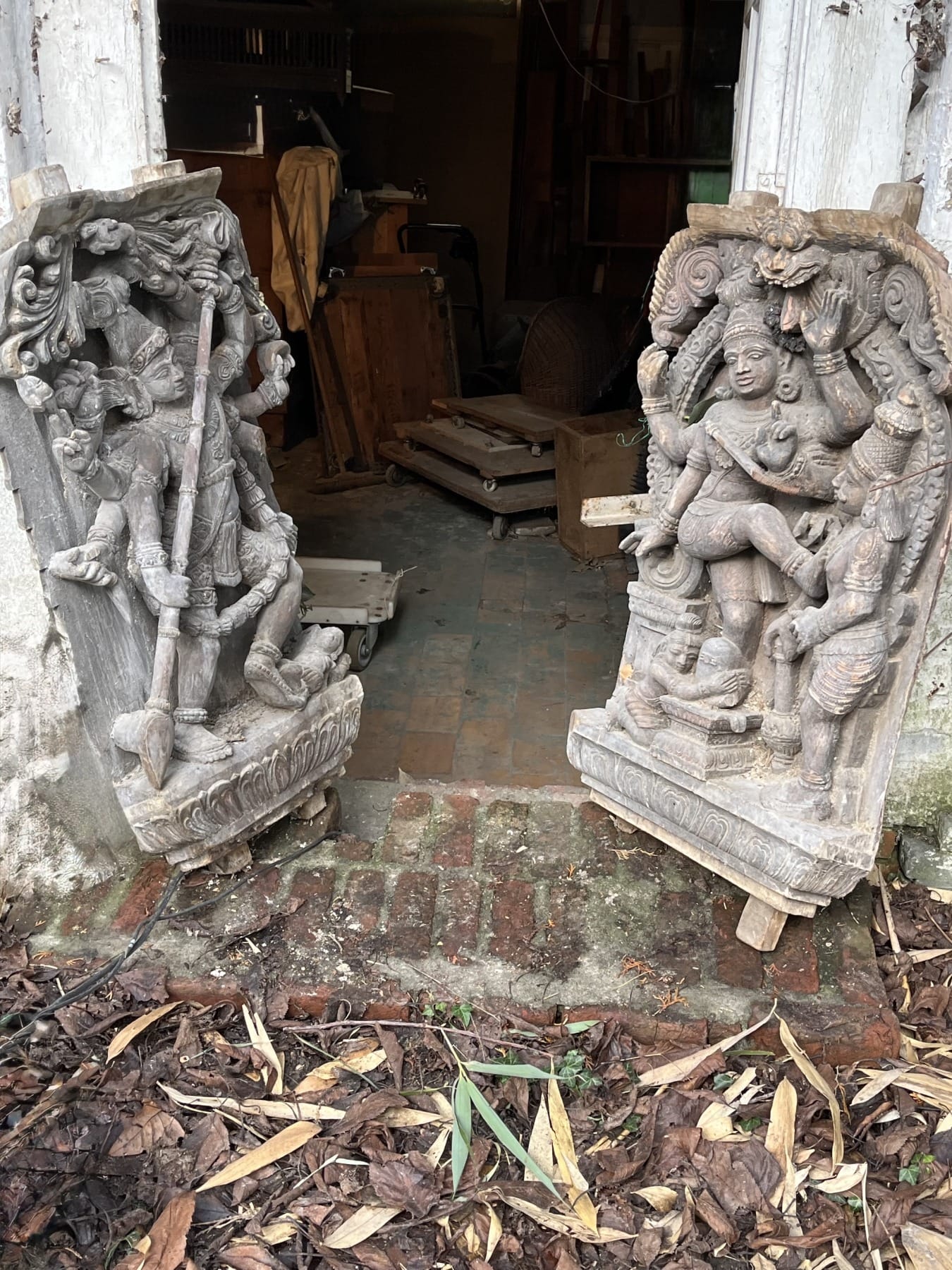
Two Indian processional chariot panels rediscovered in Claude de Marteau’s storerooms.
You might also like…


Discover also...


Delivery to Belgium

Delivery to France

Delivery to Luxembourg
