





Temple Chariot Panel – Shiva Kalantaka – India, Tamil Nadu
€3500,00
- Large processional chariot panel depicting Shiva as Kalantaka also called Shiva Kalari Murti. This form embodies the victory of the divine over time and death, the latter being personified by the god Yama
- India, Tamil Nadu, 19th century.
- Former collection of Claude de Marteau, sold with certificate of provenance.
- H (without base) 95 cm x D 11 cm x W 51 cm.
- Max H (with base) 105 cm.
- Minor damage and restorations (Small fragments were restored when found)
1 available in store

Shiva Kalantaka, Destroyer of Time and Death
This legend tells how Shiva saved the young sage Markandeya from the clutches of Yama, the god of death.
The sage Mrikanda devoted many years to devotion to gain Shiva’s favor and asked for the grace of having a son. Shiva then offered him a choice: a virtuous and deeply pious child, but destined for a very short life, or a son with a long existence, but devoid of wisdom and virtue. Mrikanda unhesitatingly chose the first destiny.
Thus was born Markandeya, a child of great piety, destined to die at the age of sixteen. Very early on, he mastered the Vedas and Shastras and dedicated his entire existence to the worship of Shiva. Shortly before his sixteenth birthday, his parents revealed to him the prophecy announcing his imminent death. Without succumbing to despair, Markandeya redoubled his fervor and continued his meditation before a lingam, the aniconic representation of Shiva.

Markandeya, son of Mrikanda, embracing the lingam from which Shiva emerges.
When the fateful hour arrived, Yama’s envoys were unable to seize his soul, so powerful was Shiva’s protection. Yama then presented himself and cast his noose around the young sage (Missing on the panel). The sage, entwined with the lingam, was seized along with the sacred emblem.

Yama, god of death, casts his lasso around Markandeya and the lingam. Shiva emerges from the lingam to vanquish Yama with his trident and thus save his faithful devotee.
At that instant, Shiva emerged from the lingam in a manifestation of divine wrath. He confronted Yama, vanquished him, and delivered his faithful devotee. At the request of the devas, Shiva then restored the god of death to life, but imposed a condition: Markandeya would remain eternally sixteen years old, thus escaping death and the passage of time.
Following this episode, Shiva received the name of Kalantaka, “the Destroyer of Time and Death,” an incarnation of his victory over destiny and his protection of his most fervent devotees.
Temple Chariots in India

A temple chariot published in “Living Wood – Sculptural traditions of Southern India”
The large processional chariots (ratha) hold an essential place in Hindu religious festivals. Pulled by devotees during major celebrations, they are richly decorated with carved panels depicting the main episodes of mythology. These reliefs had both a decorative and pedagogical function, illustrating the exploits of deities and the great narratives of the Puranas for the faithful.

A temple chariot in Madras in 1850. Two panels are visible. (Source Wikipedia)
This temple chariot panel from Tamil Nadu comes from the former collection of Claude de Marteau; it is sold with its certificate of provenance.
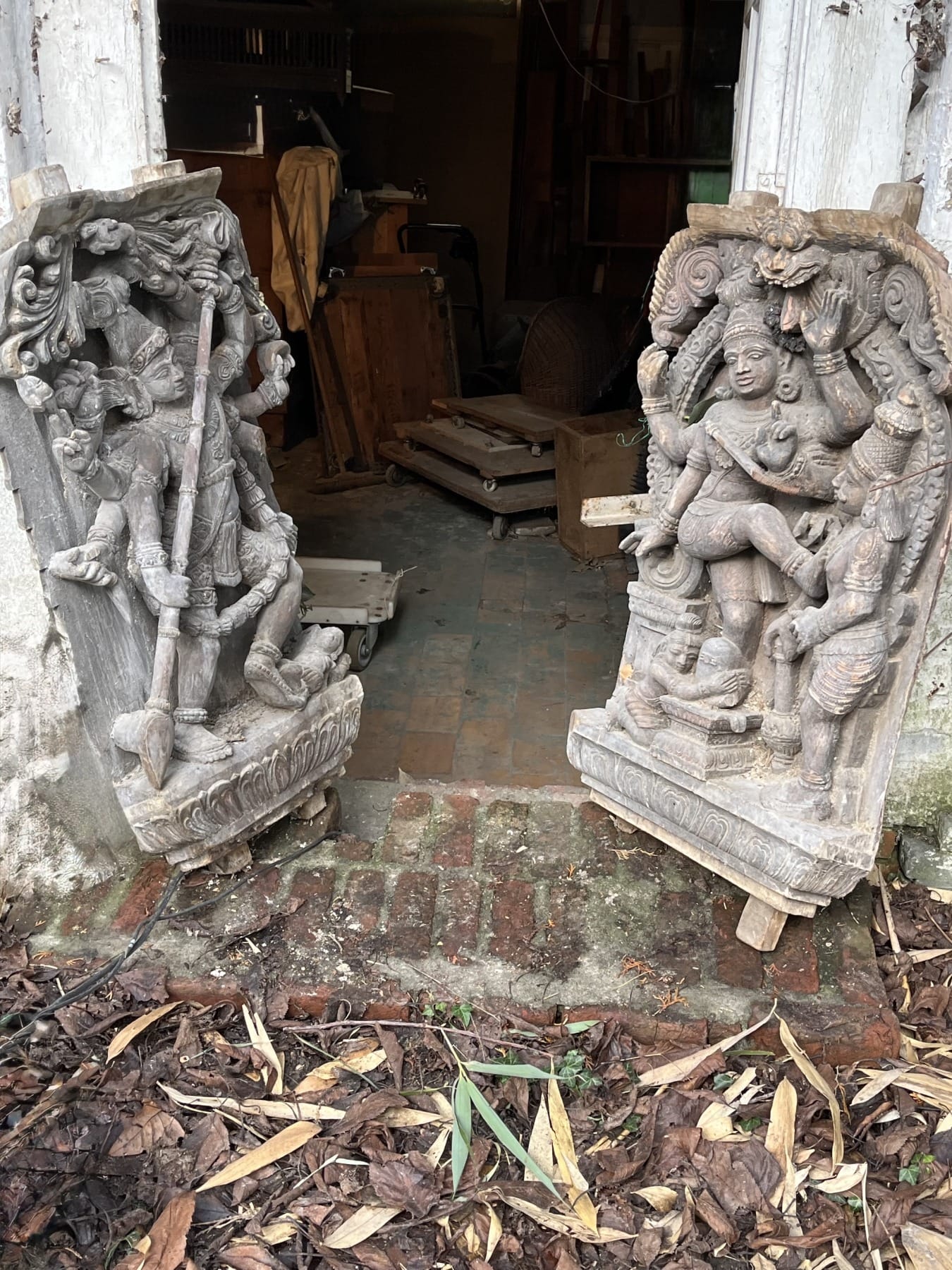
Two Indian processional chariot panels rediscovered in Claude de Marteau’s storerooms.
You might also like…


Discover also...



Delivery to Belgium

Delivery to France

Delivery to Luxembourg
