




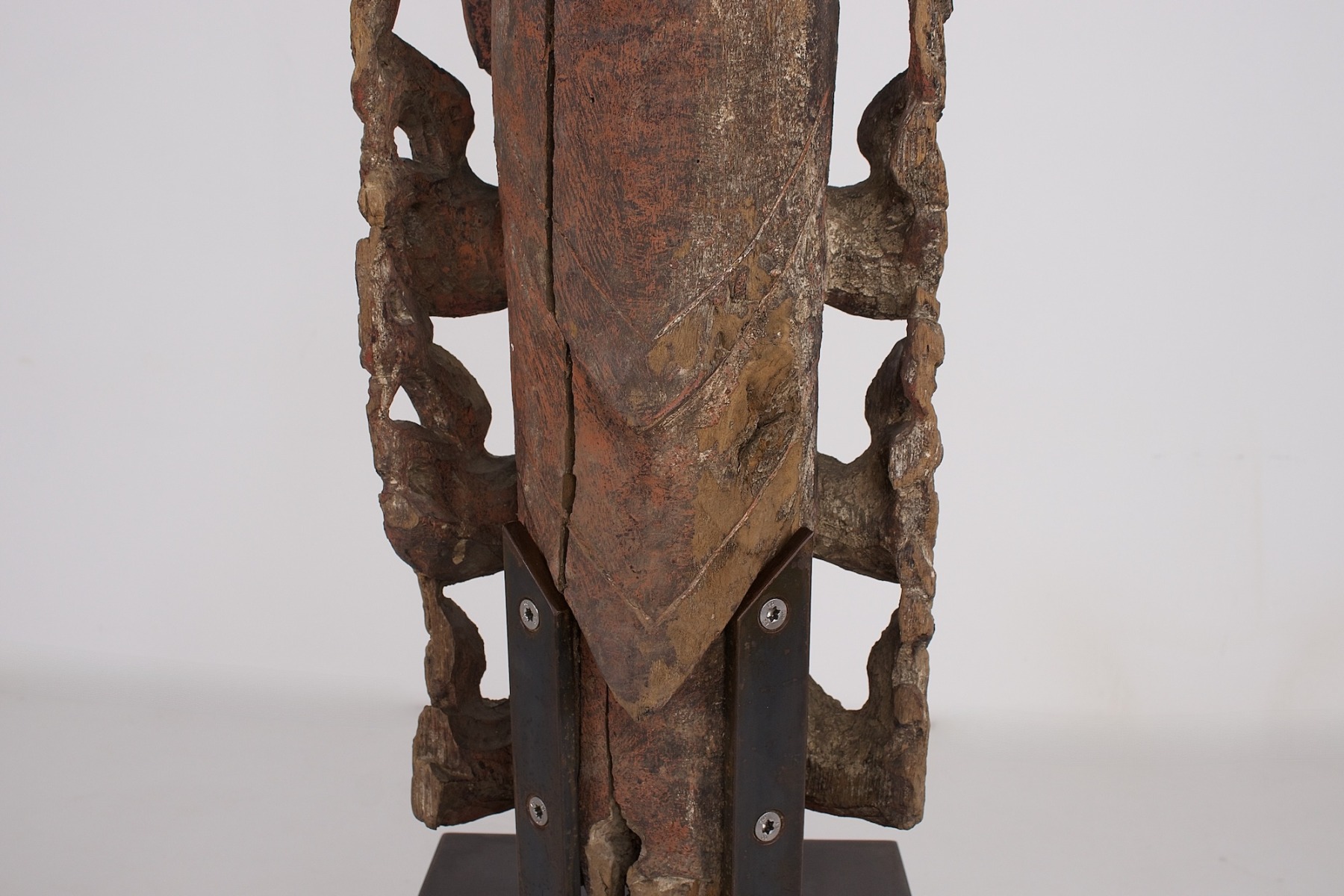
Burmese wooden sculpture of the deva Thagyamin – 18th century
€2800,00
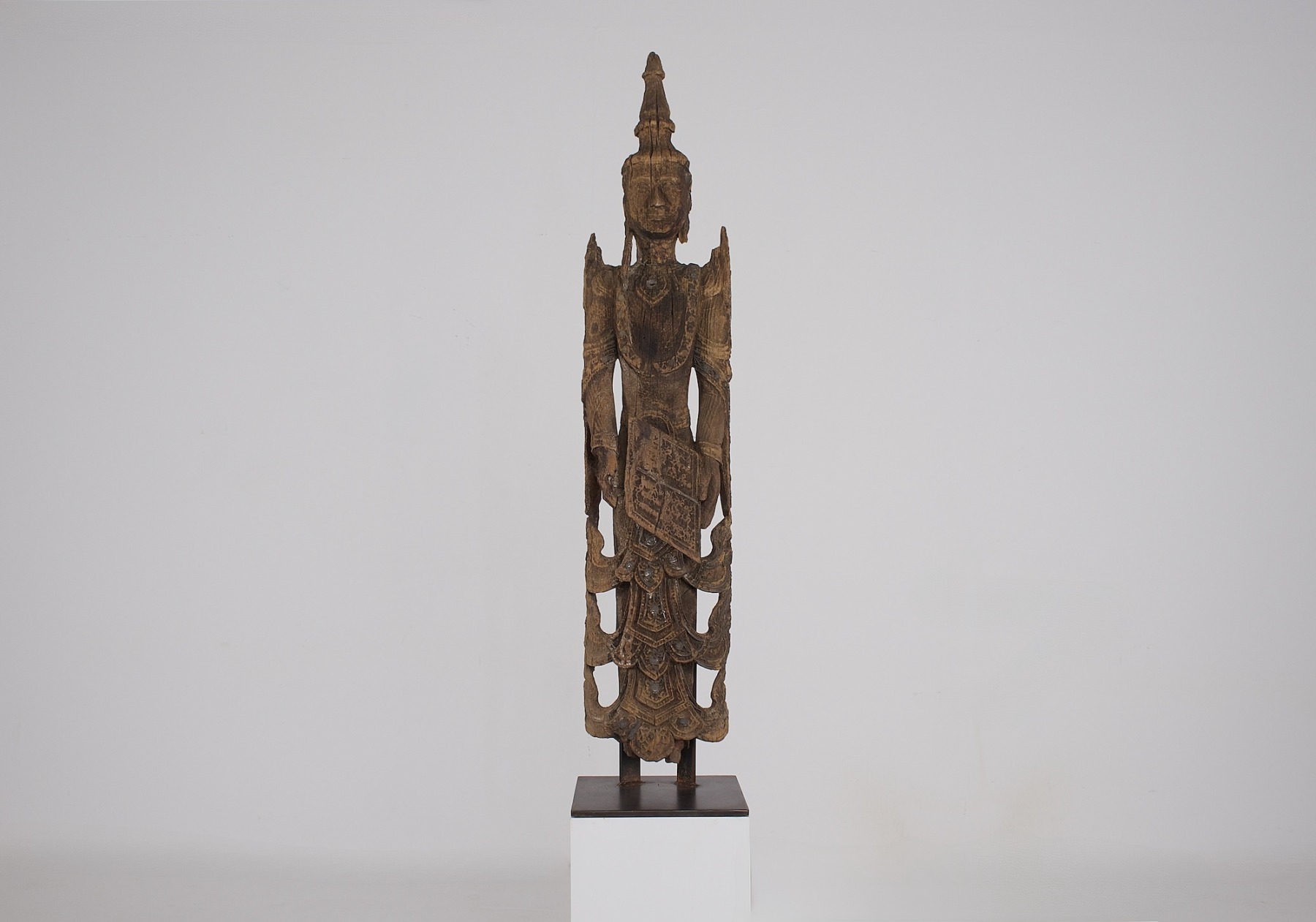
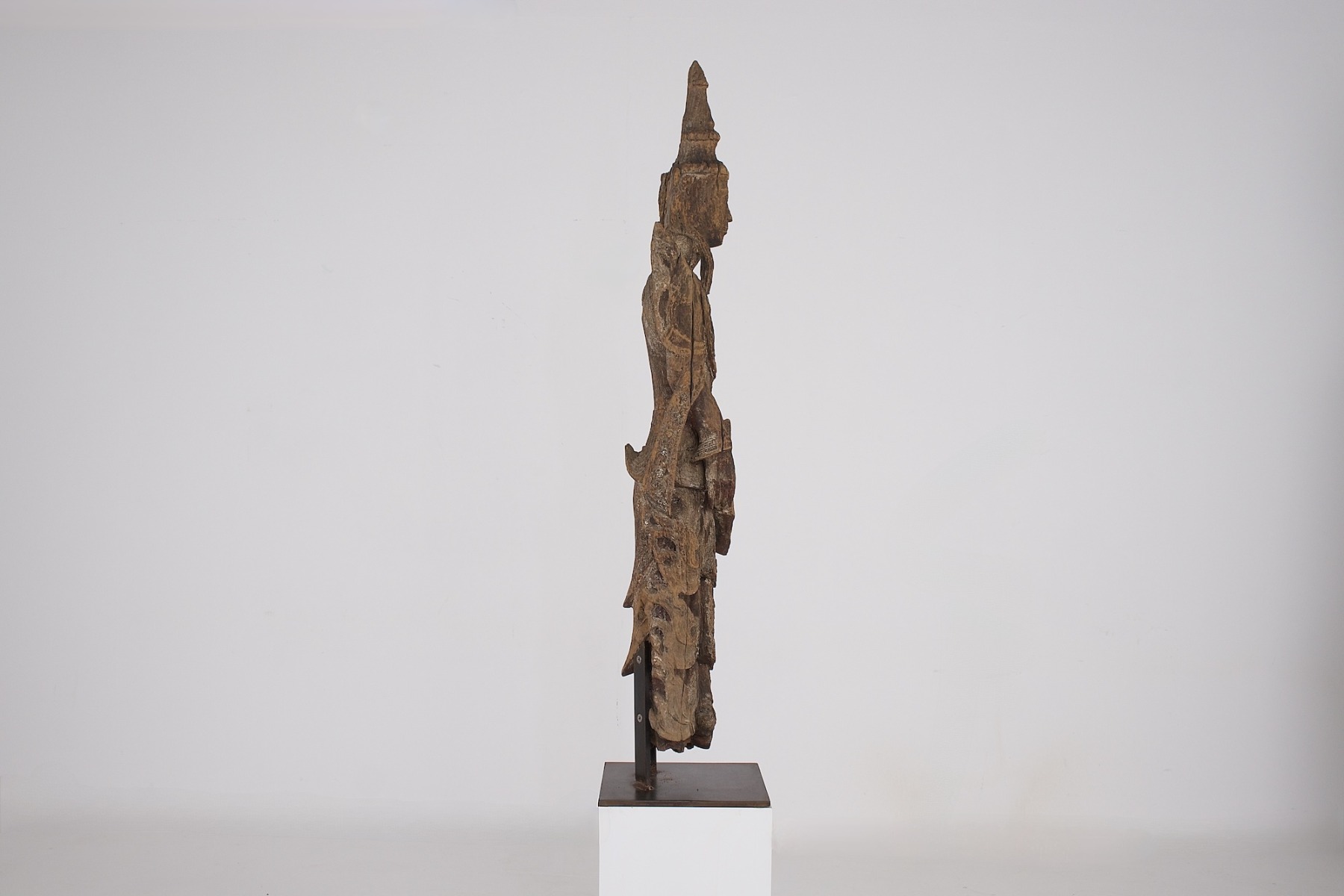
Burmese wooden sculpture likely depicting the deva Thagyamin (Thakya: Indra and Min: Lord), Burmese form of Sakka/Indra, Konbaung period, 18th century. Celestial figure in court attire, with a very slender silhouette, retaining an ancient patina and vestiges of its original decoration.
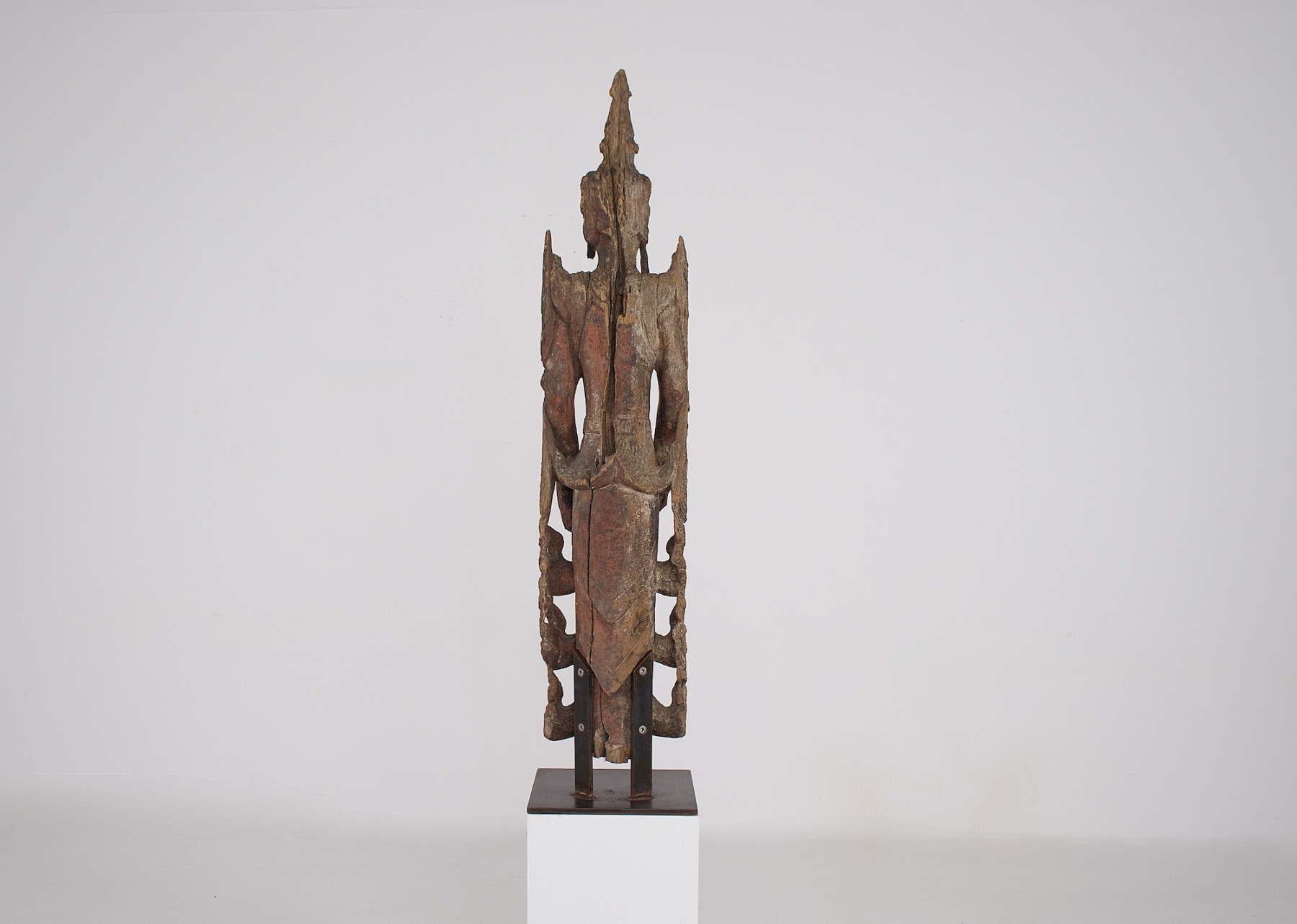
- The work is mounted on a steel stand made by our restorer; it is perfectly stable and removable if needed.
- Provenance: Former Claude de Marteau collection, sold with certificate.
- H (without base) 124 CM x D 20 CM x W 25 CM.
- Max H (With base) 134 cm.
1 available in store

Burmese sculpture depicting Thagyamin, Sakka, or Indra
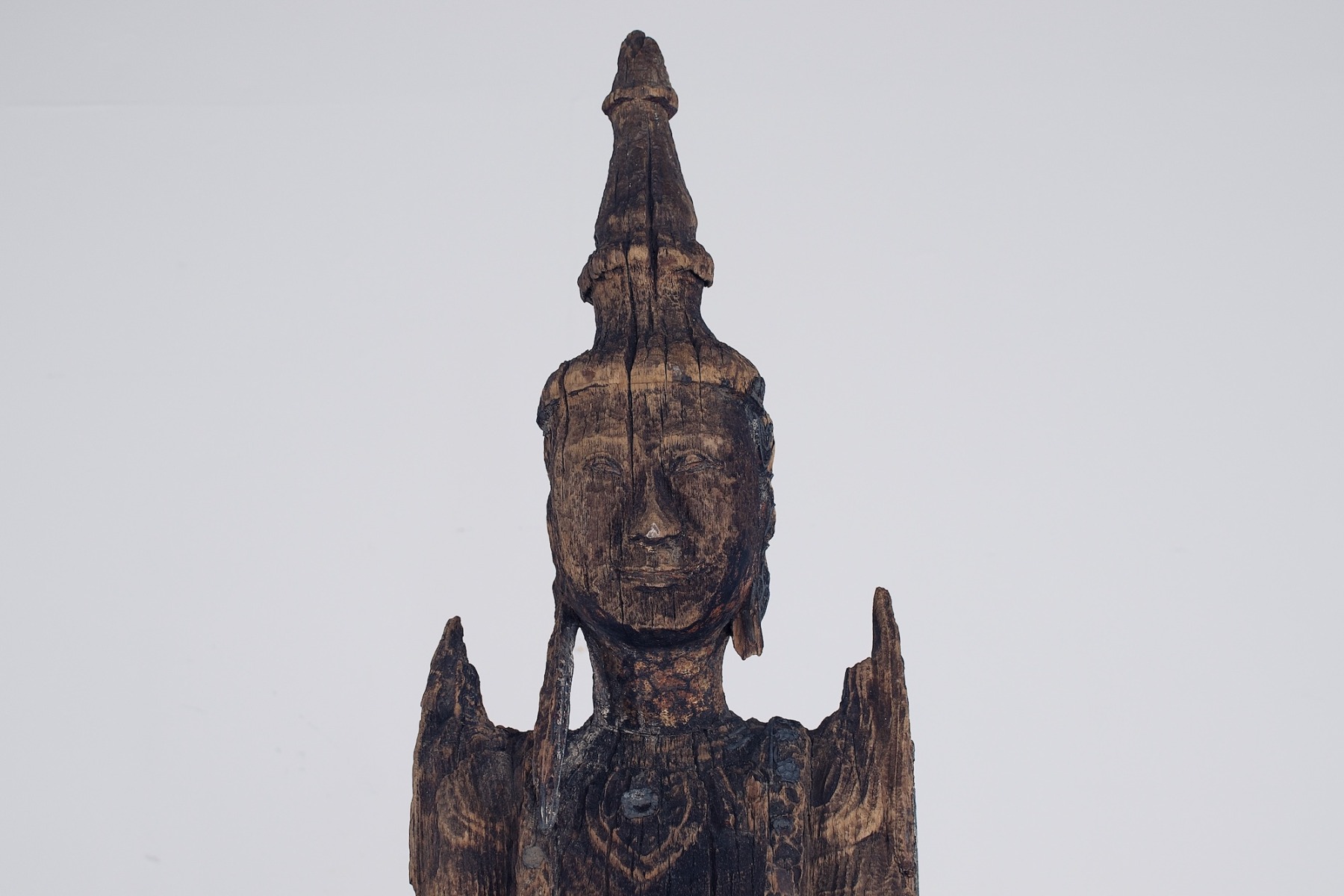
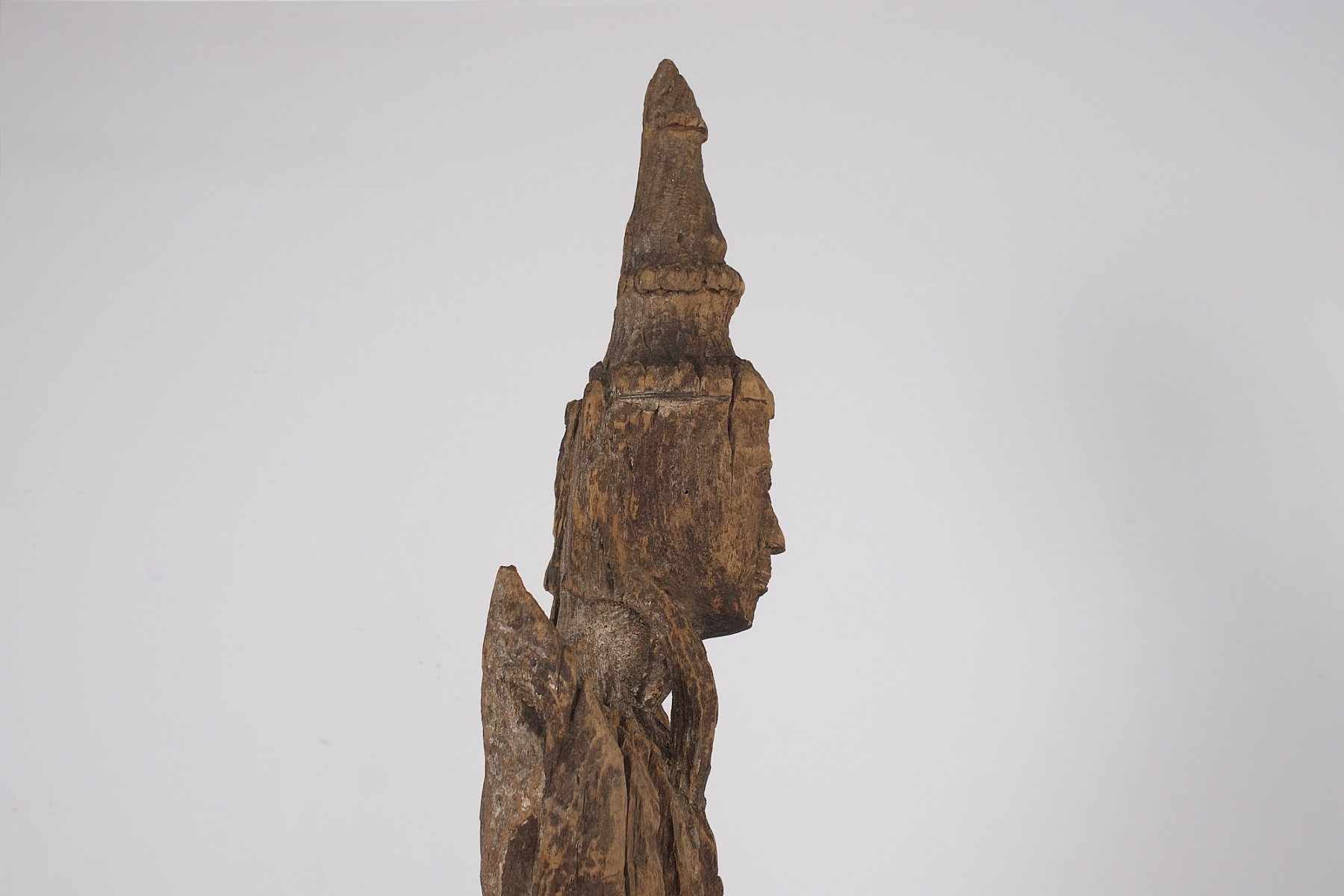
This significant Burmese wooden sculpture depicts a standing celestial deity, dressed in rich court attire. The tall, tapering headdress, raised shoulder pads, jewelry, and various superimposed garment pieces belong to the vocabulary of royal and divine figures in Burmese art.
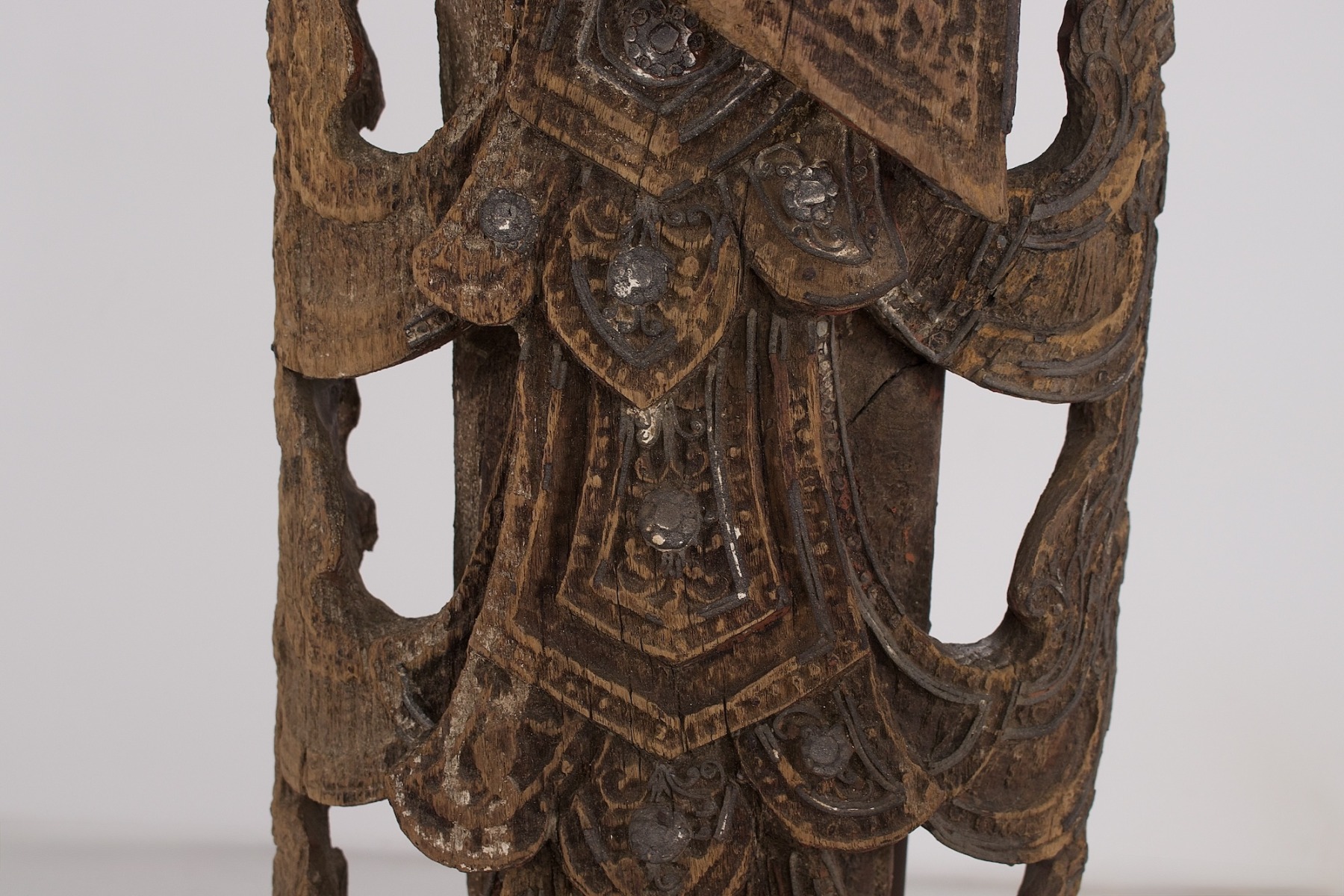
The particularly slender silhouette is structured by the long vertical lines of the costume and by the pierced sections arranged on either side of the legs. Despite the ancient wear on the surface, the ornamentation remains highly legible in the pectoral adornment, the headdress, and the meticulous decoration of the garments.
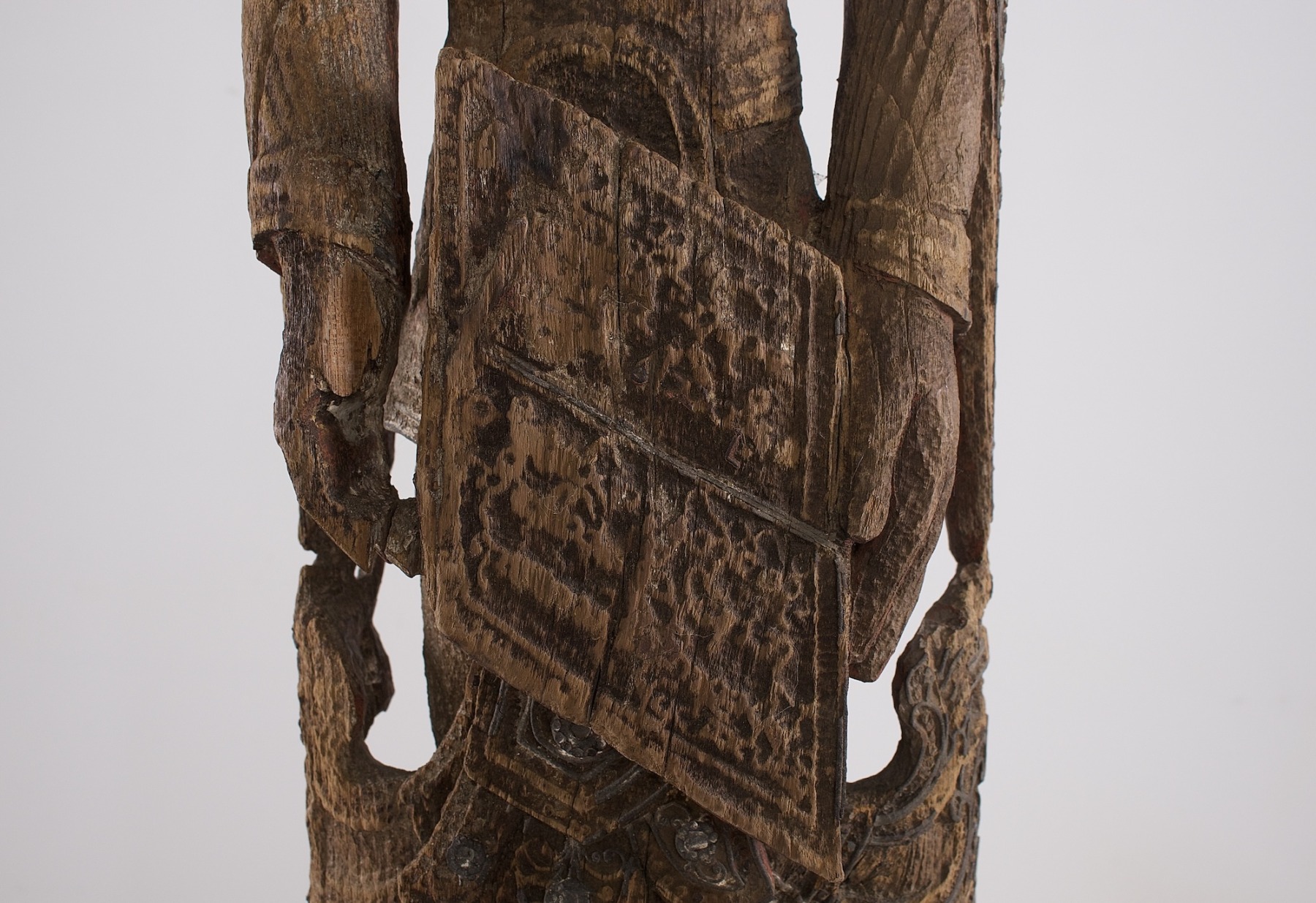
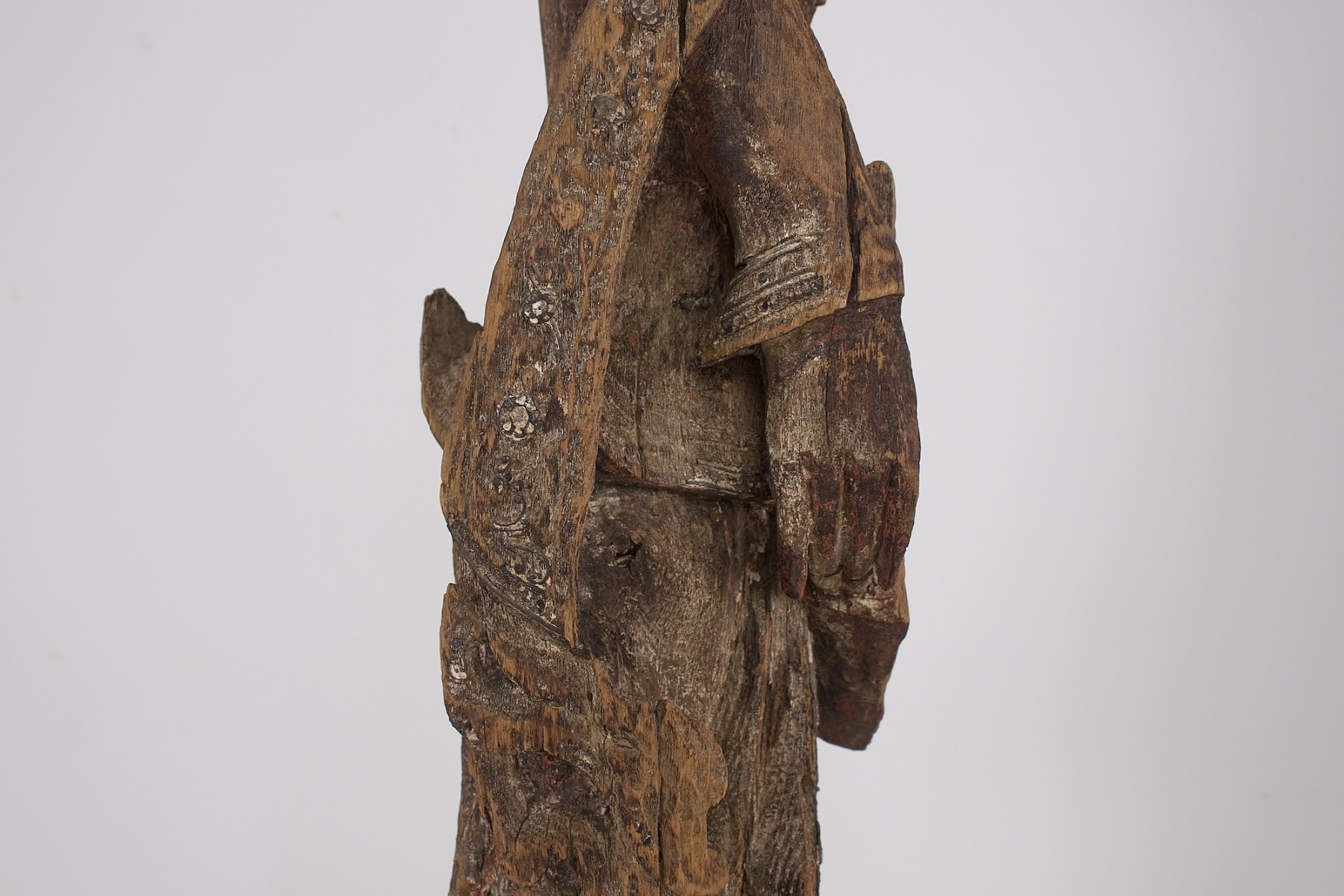
One iconographic element is particularly noteworthy: the figure holds an inscribed tablet or manuscript before him. This attribute allows for a more precise identification than the generic terms Nat or Deva.
Nat and Deva in Burmese Religious Tradition
In the Burmese context, the terms Nat and Deva sometimes overlap without being perfectly synonymous.
The term Deva, derived from Sanskrit and Pali, designates celestial beings in Hindu and Buddhist cosmology. The Burmese word Nat has a broader scope: it can refer to nature spirits, deified human figures, protectors, or certain celestial beings.
With the establishment of Theravada Buddhism in Burma, ancient local beliefs did not disappear but gradually integrated into Buddhist cosmology. This superposition explains why certain figures can be described in Western collections as Burmese Nat, Burmese Deva, or celestial deity.
Thagyamin, Sakka, and Indra
This sculpture could more precisely represent Thagyamin, the Burmese name for Sakka, who corresponds to Indra in Buddhist cosmology.
Indra initially belongs to the Vedic and Hindu pantheon. In Buddhism, he appears under the name Śakra or Sakka, ruler of the Tāvatiṃsa heaven of the Thirty-Three. In Burma, this figure becomes Thagyamin, a particularly important character in popular religious tradition and integrated into the world of Nats.
The identification is all the more interesting as Thagyamin holds a moral function in Burmese tradition: he observes human actions and takes into account good and bad deeds.

Burmese sculptures preserved in public collections thus show Sakka or Thagyamin in the guise of a royal figure holding a manuscript, a tablet, or a parabaik, sometimes accompanied by a writing implement. On the present sculpture, the long element placed obliquely on the tablet could precisely correspond to a stylus.

For comparison, the British Museum preserves a later Burmese representation of Sakka (Indra), holding a parabaik and a writing implement (inv. 1914,0812.5), whose iconography allows for a comparison of the present sculpture with Thagyamin/Sakka.
The inscribed tablet held by this sculpture therefore constitutes an important clue in favor of a representation of Thagyamin/Sakka.
The equivalence between Sakka and Indra is well established in Burmese Buddhist cosmology and iconography. The catalogue of the exhibition Buddhist Art of Myanmar by the Asia Society defines Sakka — Śakra in Sanskrit, Indra in the Indian tradition, and Thagya-min in Burmese — as the king of the gods residing in the Tāvatiṃsa heaven. The same catalogue presents several ancient representations of Sakka/Indra preserved notably at the Bagan Archaeological Museum.
This iconographic particularity, beyond the aesthetic qualities of the work, very probably constitutes one of the reasons for its acquisition by Claude de Marteau, whose collection demonstrates a marked interest in rare representations and the singularities of Buddhist iconography.
Burmese Religious Sculpture and Konbaung Tradition
Under the Konbaung dynasty, Burmese religious sculpture developed a particularly refined vocabulary, combining celestial figures, protective deities, Nats, and characters from Buddhist cosmology. Carved wood played an essential role in the decoration of sanctuaries, monasteries, and palatial complexes.
The sculpture presents an extremely elongated silhouette, almost conceived as an architectural element rather than a sculpture in the round. The back and profile show that it was primarily crafted to be viewed from the front. Its treatment differs significantly from that of many 19th-century Mandalay Nats, which are often more volumetric and more heavily ornamented.
The costume combines relief carving, engraved decoration, openwork, and small reflective inlays arranged in floral motifs, probably made of glass or possibly mica. Despite significant surface wear and the disappearance of much of its original decoration, these elements attest to the sculpture’s initial richness. The current patina, largely revealing the wood, conversely highlights the finesse of the carving work and the figure’s very graphic construction.
Sources:
- Sally Jane Bamford, Hidden in Plain Sight: The Nat Images of Myanmar, doctoral thesis, Australian National University, 2017.
- Sylvia Fraser-Lu and Donald M. Stadtner (eds.), Buddhist Art of Myanmar, Asia Society Museum / Yale University Press, 2015.
- British Museum, Sakka (Indra), Burma, inv. 1914,0812.5.
You might also like…
Discover also...


Delivery to Belgium

Delivery to France

Delivery to Luxembourg
