





Joseph André Motte Sideboard – Groupe 4 Charron – 1955
Sideboard in mahogany, ash, and ebony designed by Joseph André Motte (1925-2013) for Groupe 4 – Charron, circa 1955.
- W 180 cm x H 100 CM X D 39CM
- The solid ebony handles are a new variation on the few known models.
- There is a crack in the left side, but it does not affect the strength or stability of the furniture.
- Bibliography: “Les Décorateurs des Années 50”, Patrick Favardin, Norma. Page 250.
- This piece has been restored by our restorer.
- Last copy available (2 of 2)
Sold

Joseph-André Motte Bar Sideboard for Groupe 4 Charron – 1950s
This bar sideboard designed by Joseph-André Motte for Groupe 4 and produced by Charron belongs to the most characteristic French creations of the mid-1950s. Its façade combines mahogany with a lighter ash structure and base, while dark handles discreetly emphasize the composition.
The piece adopts a deliberately asymmetrical organization: on the left, a drop-front conceals a bar compartment, complemented by two drawers in the lower section; on the right, two large sliding doors provide access to storage spaces. This arrangement brings together several functions within a relatively compact volume, without breaking the continuity of the façade.
Motte’s sideboard offers abundant storage in an asymmetrical layout.
The design of the base constitutes one of the piece’s most interesting elements. The rectangular body appears almost suspended above the floor thanks to the steam-bent ash feet, extended beneath the case by highly controlled curves. This contrast between the horizontal rigor of the sideboard and the suppleness of the base considerably lightens the whole.
Joseph-André Motte, Pierre Guariche and the Atelier de Recherches Plastiques
Joseph-André Motte belongs to the generation of designers who profoundly renewed French furniture after the Second World War. His trajectory is closely linked to that of Pierre Guariche, with whom he shared in the early 1950s the same reflection on industrial production, functionality, and the adaptation of furniture to new ways of living.
In 1954, Motte founded the Atelier de Recherches Plastiques – ARP with Pierre Guariche and Michel Mortier. The trio then developed furniture programs intended for serial production, in which constructive simplicity, modularity, and multiplicity of uses occupied a central place.

Two Coquetiers armchairs produced by Atelier de Recherche Plastique.
This sideboard is not, however, a collective creation of the ARP: it was designed by Joseph-André Motte for Groupe 4 Charron. The chronological proximity is nevertheless important. The piece is contemporary with the research conducted within the ARP and translates the same desire to move beyond traditional furniture in favor of rational, versatile furniture adapted to modern living.
Groupe 4 Charron and French Furniture of the Reconstruction
Groupe 4 was created in 1954 around Georges Charron and brought together notably Joseph-André Motte, René-Jean Caillette, Geneviève Dangles, and Alain Richard. These designers participated in the development of modern French furniture reconciling manufacturing quality, new forms, and serial production.
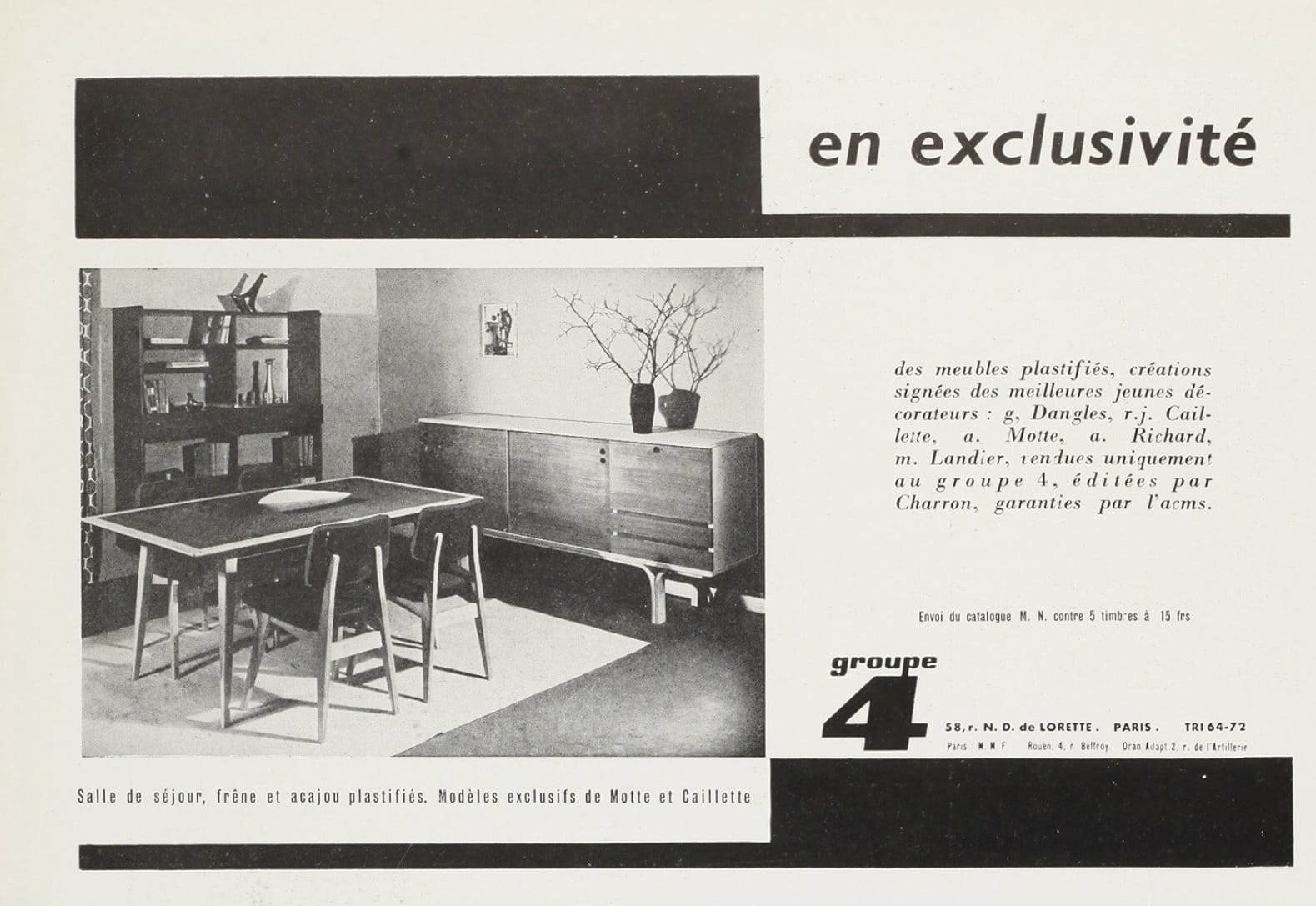
Vintage 1950s advertisement for Groupe 4 Charron, showing J-A Motte’s sideboard (variant with knobs rather than handles)
In this sideboard, this research translates through both function and proportions: sliding doors requiring no clearance in front of the piece, integrated bar compartment, immediately accessible drawers, and elevated case to preserve a light reading of the whole.
The choice of mahogany nevertheless brings a warmer and more refined presence than that of many strictly functionalist pieces from the same period. The vertical grain of the panels animates the large façade while the ash elements draw its architecture. The piece thus retains a real decorative presence without resorting to ornament.
Through its proportions, bar compartment, and storage capacity, this Joseph-André Motte sideboard can today take its place in a dining room as well as in a large living room, an office, or a modernist interior. Above all, it constitutes a particularly representative testimony to French 1950s design, at the moment when Joseph-André Motte, Pierre Guariche, and their contemporaries were profoundly redefining domestic furniture.
You might also like…


Discover also...


Delivery to Belgium

Delivery to France

Delivery to Luxembourg
