





Tripod table “Pic-Nic” Lucien De Roeck Expo 58
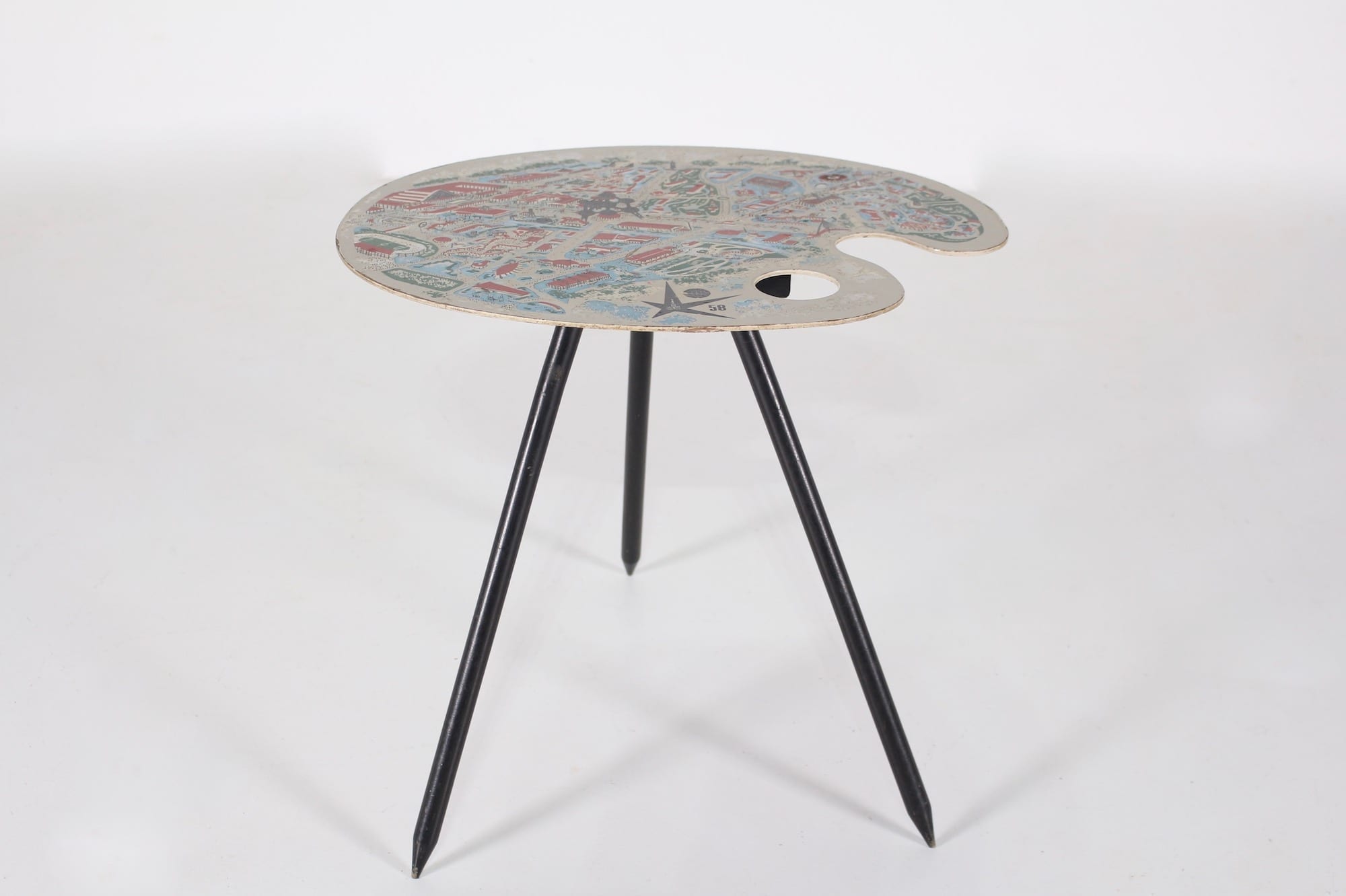
Lucien De Roeck for Bois Manu, “Pic-Nic” coffee table from the Brussels World’s Fair, 1958.
- Very good condition, normal wear.
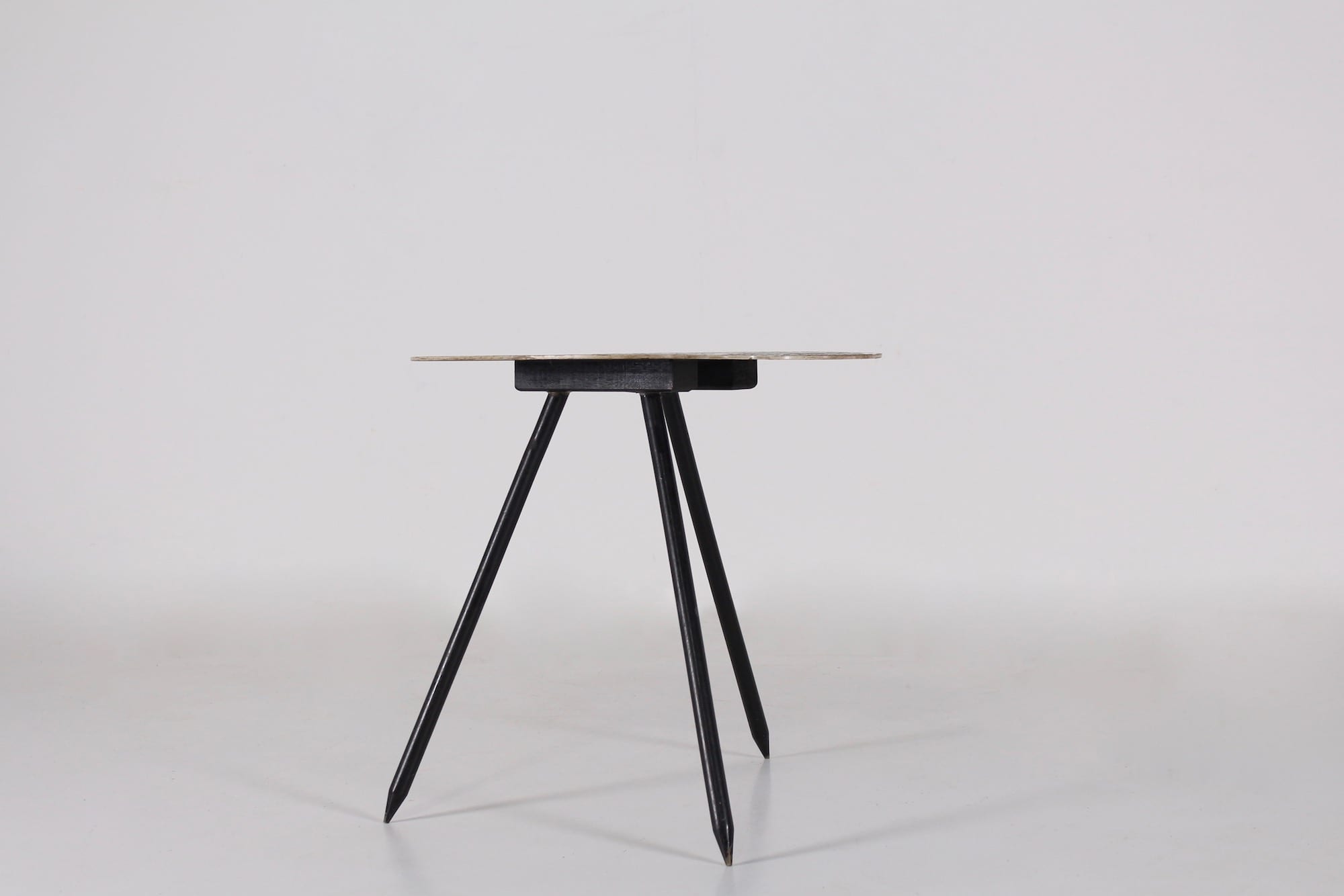
- The legs were glued by the owner of the table. Originally, they were removed to slip under the pallet.
- L 49 CM X W 39 CM x H 46 CM
Sold

“Pic-Nic” Coffee Table by Lucien De Roeck for Bois Manu – Expo 58
This tripod coffee table designed by Lucien De Roeck and produced by the Belgian manufacturer Bois Manu belongs to the creations realized in 1958 in the context of the Brussels World’s Fair. At once functional furniture, graphic object, and souvenir of Expo 58, it constitutes a singular achievement of Belgian 1950s design.
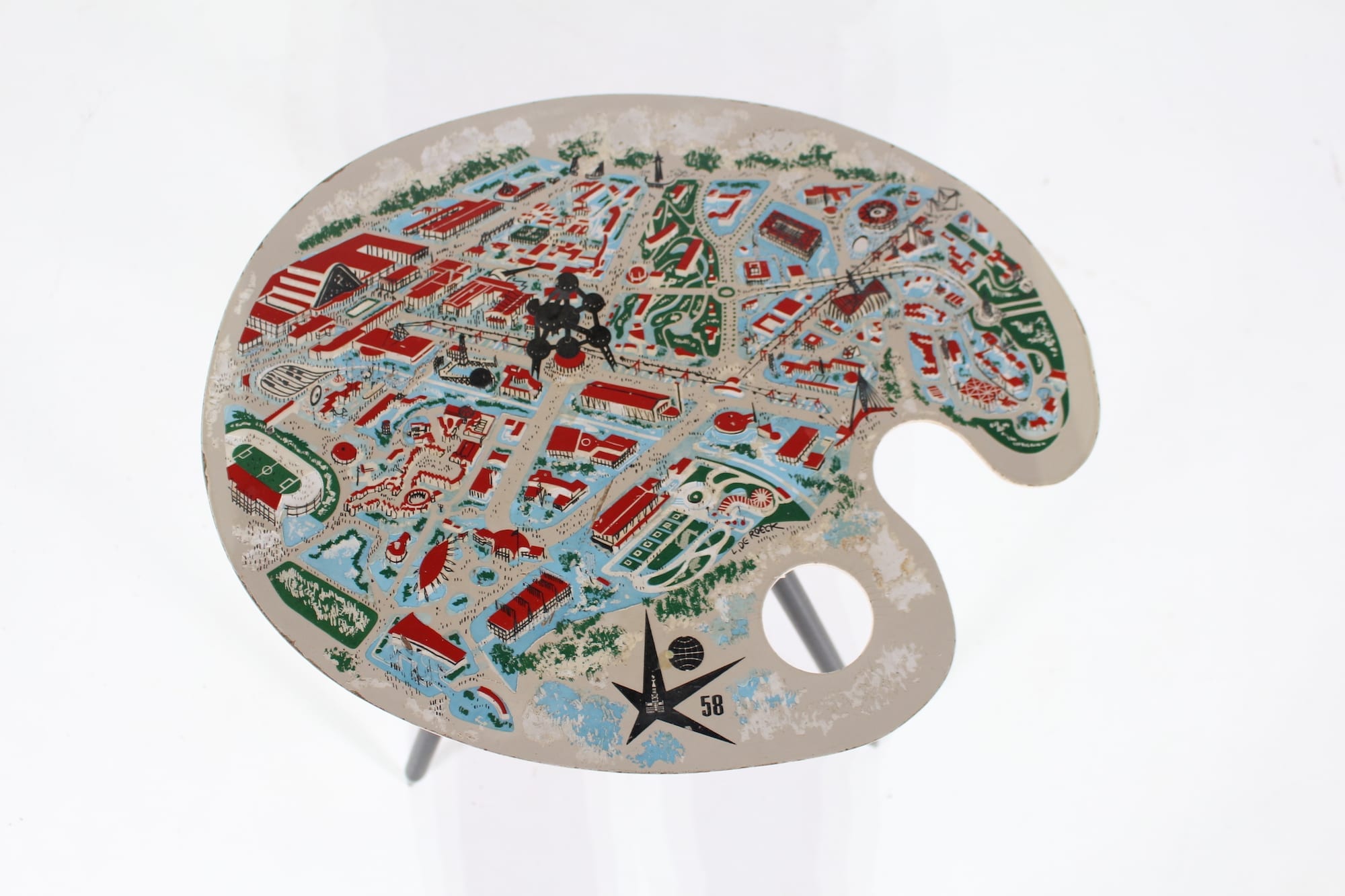
Its top adopts an immediately recognizable free form, that of a painter’s palette. It bears a bird’s-eye representation of the Heysel site, where the various emblematic pavilions and buildings of the World’s Fair are situated. This cartography thus transforms the table into a veritable miniature representation of Expo 58.
An example preserved by the Museum of the City of Brussels is precisely catalogued as a “coffee table,” created by Lucien De Roeck, manufactured by Bois Manu in Brussels and dated 1958. The museum also emphasizes the painter’s palette form, the view of the Heysel plateau, and the presence of three removable legs.
Lucien De Roeck, from Belgian graphic design to Expo 58
Born in Dendermonde in 1915, Lucien De Roeck entered the Higher Institute of Decorative Arts at La Cambre in 1932, founded a few years earlier by Henry Van de Velde. There he trained in typography, layout, poster design, and the creation of graphic identities.
His career began very early. In 1935, when he was only twenty and still a student, he won a competition for the creation of a poster devoted to the Ostend-Dover maritime link. This composition dominated by a monumental figure “3,” evoking the speed of the crossing, ranks among his most characteristic posters. He also realized graphic projects for the city of Antwerp.
After the Second World War, De Roeck intervened extensively in the field of the press. He notably designed layouts and page compositions for the journal of the Palais des Beaux-Arts in Brussels, as well as for La Lanterne, La Cité, Phare, and Le Quotidien. A prolific draftsman, he also worked for the illustrated press and developed in parallel an important production of sketches, posters, typographies, logos, and maps.
This cartographic activity is particularly interesting with regard to the present Expo 58 coffee table. De Roeck possessed a genuine practice of graphic representation of cities and territories and realized several maps of the World’s Fair park. The view of the Heysel drawn on the top thus fits naturally within a clearly identifiable part of his graphic work.
The map of Brussels Expo 58 drawn on the top of the “Pic-Nic” tripod coffee table
The Expo 58 star, major creation of Lucien De Roeck
It is above all Expo 58 that brought Lucien De Roeck international recognition. In 1954, he won the competition organized to design the emblem and poster of the Brussels World’s Fair.
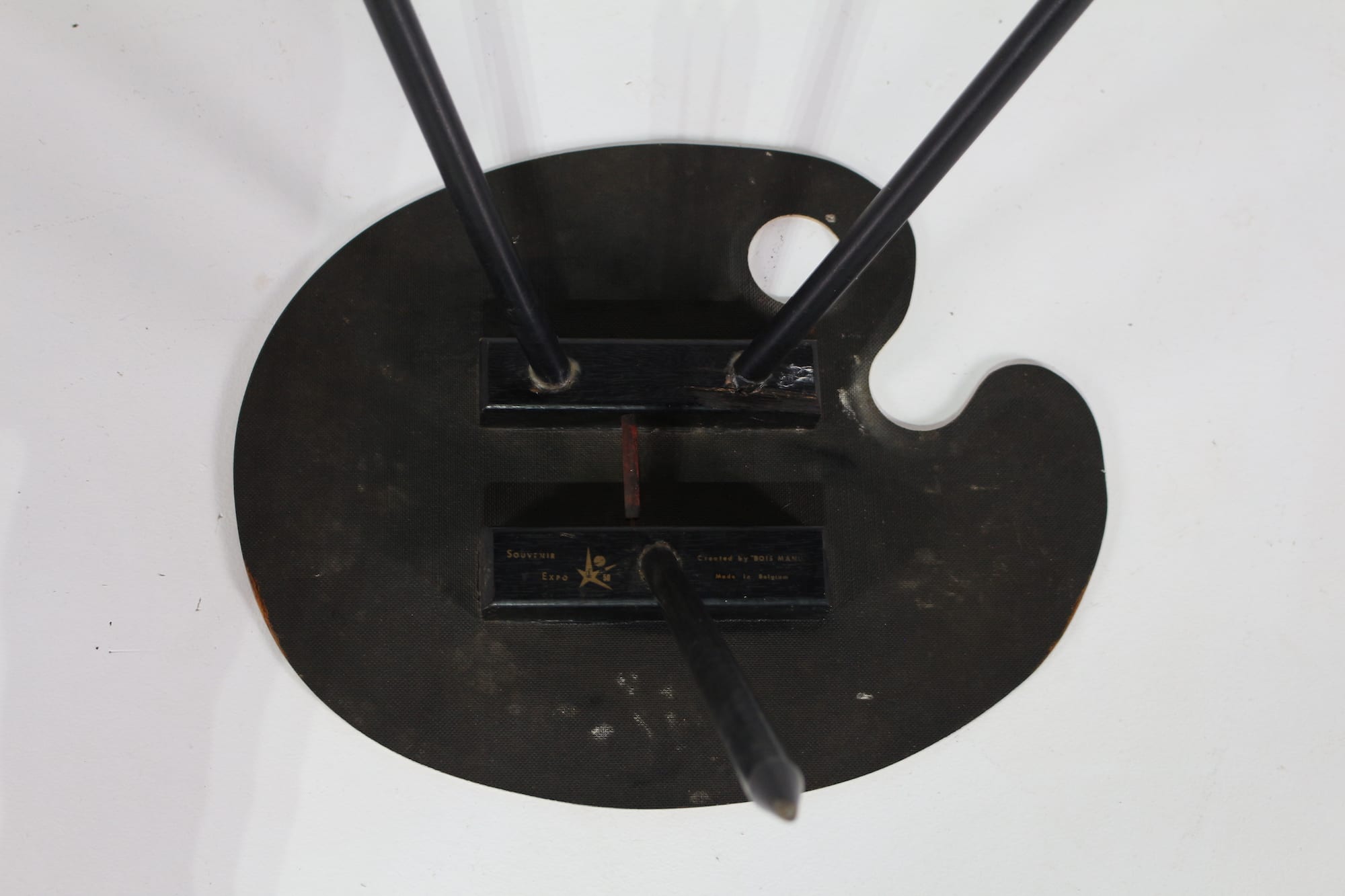
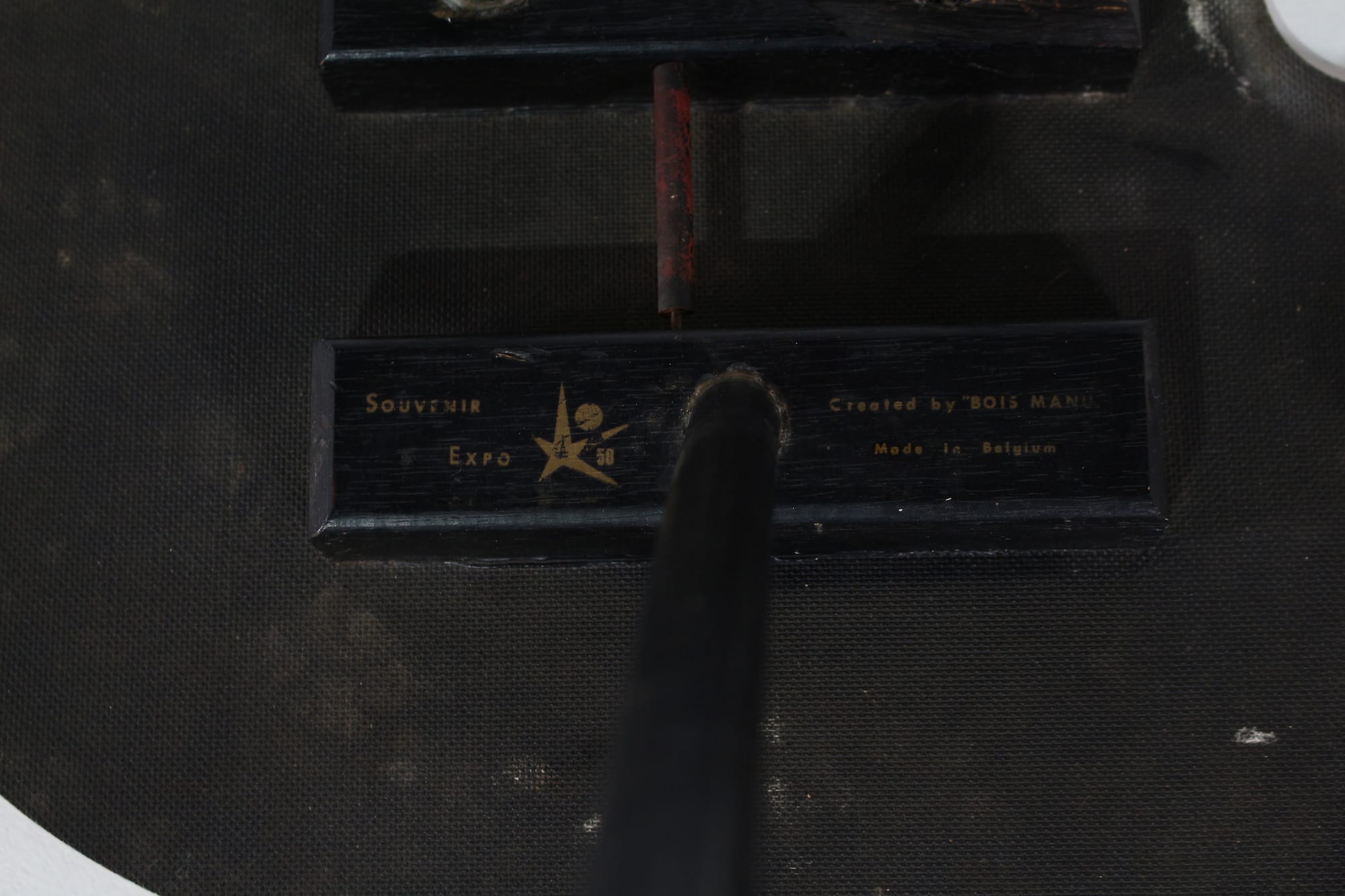
Marking under the Expo 58 coffee table, showing the asymmetrical five-pointed star and the mention “Bois Manu”
His asymmetrical five-pointed star became the visual identity of the event. The five points symbolize the five continents while Brussels appears at the center of the composition. During the Expo, this graphic was omnipresent: posters, signage, trams, hostess uniforms, and innumerable souvenir objects.
De Roeck did not limit himself to this now-famous symbol. For nearly forty years, he also directed the typography workshop at La Cambre, participating in the training of several generations of graphic designers. His teaching notably counted among his students Pierre Alechinsky and Jean-Michel Folon.
The small table produced by Bois Manu thus takes on a particular dimension: it is not simply an anonymous souvenir bearing the decoration of the Expo. It was designed by one of the principal architects of its graphic identity.
A palette-shaped table: furniture and graphic creation
The painter’s palette silhouette is expressly mentioned in the collections of the Museum of the City of Brussels. No known document, however, appears to explain why De Roeck chose precisely this form.
The connection with his activity as poster artist, draftsman, and graphic designer is naturally appealing: the piece literally associates a form linked to the artist’s work with a graphic representation of the Expo site. This relationship should, however, be considered as a reading of the object rather than as a formally documented intention of De Roeck.
The top rests on three oblique and removable legs, giving this tripod coffee table a light silhouette typical of 1950s furniture. The removable character of the base moreover facilitated the storage and transport of an object intended to be distributed as a souvenir of the Exhibition.
Héraklith, Pavatex, or fiberboard?
The available documentation is not entirely consistent regarding the exact composition of the top. The Museum of the City of Brussels describes its example as made of “wood (héraklith),” whereas other examples of the model have been described on the specialist market as made of Pavatex, that is to say a wood fiberboard much closer technically to a hardboard of the Unalit type.
In the absence of an analysis of the material of our example, we therefore prefer to retain the cautious designation of painted wood panel, rather than attributing with certainty a precise composition to the top.
This vintage 1958 coffee table thus brings together several dimensions rarely associated in a single object: furniture, graphic design, the history of Brussels, and that of the World’s Fair. Through its author, its production by Bois Manu, and its Heysel decoration, it constitutes a particularly original testimony of Belgian 1950s design furniture and the visual universe of Expo 58, in a creative context also marked by Alfred Hendrickx and Willy Van Der Meeren.
You might also like…

Discover also...


Delivery to Belgium

Delivery to France

Delivery to Luxembourg
