Danish mid-century teak desk
€1650,00



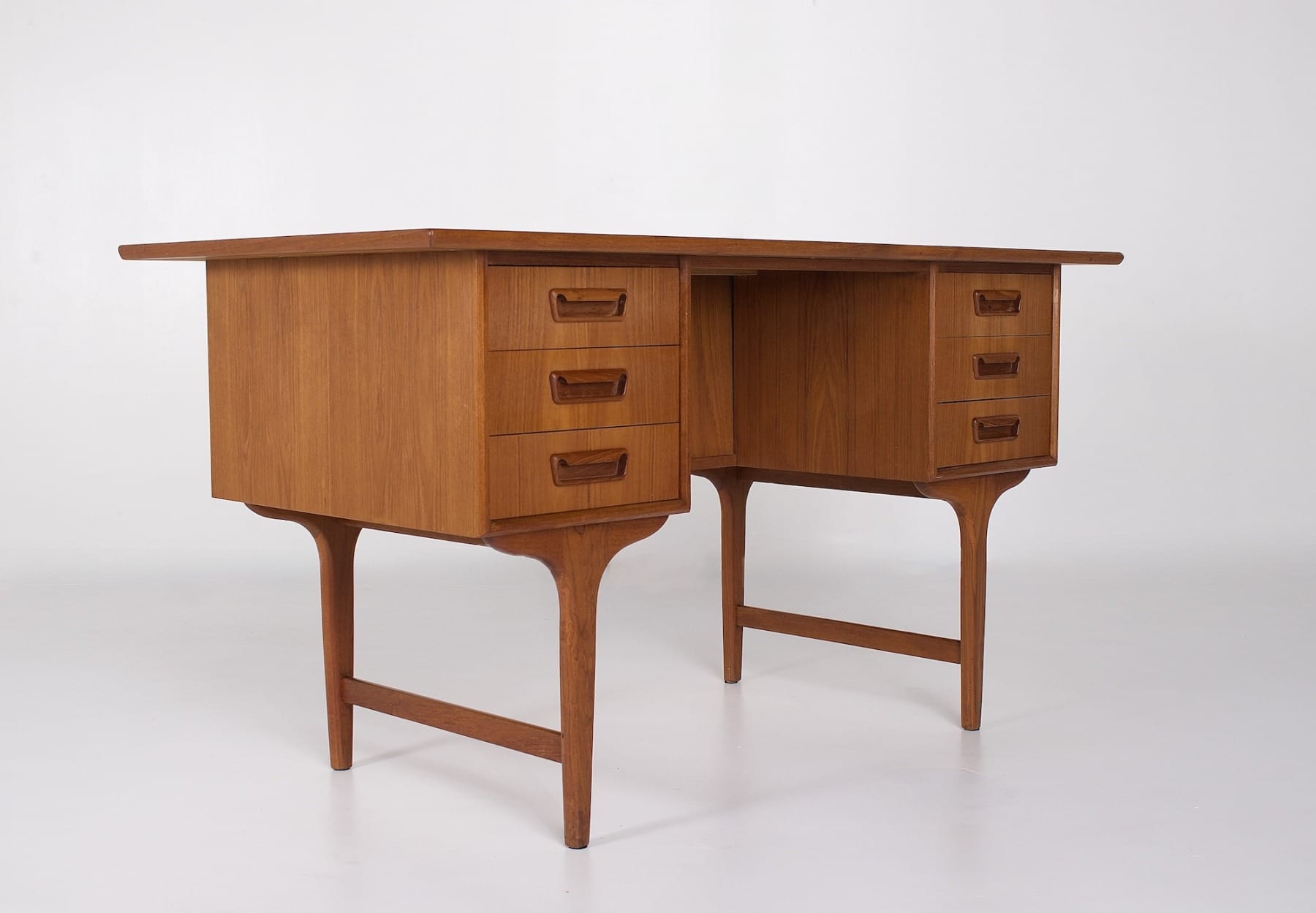
Partners desk in teak by Arne Wahl Iversen for Vinde Møbelfabrik, Denmark, 1960s
This Danish piece features three apron drawers on its front side. On the visitor-facing side, it presents a storage cabinet enclosed by a sliding door.
This desk underwent a meticulous structural inspection; its woodwork was then restored and oiled in our workshop.
Sold

Designed by Danish designer Arne Wahl Iversen for Vinde Møbelfabrik, this Scandinavian desk transcends its sole function as a workstation. Its construction was also conceived so that the piece could be viewed from both front and back, thus not requiring it to be systematically placed against a wall.
On the user’s side, three apron drawers keep documents and accessories within easy reach. However, it is primarily the opposite side, facing visitors, that distinguishes the piece: it features a genuine storage cabinet partially enclosed by a sliding door. The back of the desk thus becomes a facade in its own right, rather than a mere technical panel intended to be concealed.
This additional storage also allows the desk to serve a decorative function. Books, magazines, documents, or small objects can be placed within, while its top can accommodate a table lamp, a ceramic piece, a vase, or other selected objects.
The desk designed by Arne Wahl Iversen invites viewing from all angles.
This design is particularly advantageous when the desk is placed in a living room or a large open-plan area. Positioned perpendicularly to a wall, behind a sofa, or simply in the center of the room, it does not present an uninteresting back panel to the eye: its cabinet contributes to the decor and allows the desk to harmonize with the rest of the furniture. The organic design of the compass-shaped legs softens the desk’s presence and highlights the asymmetry of the facade’s recess. Conceived as a complete piece of furniture, rather than a mere workstation against a wall, it is designed to be admired from every side.
The visitor-facing cabinet is equipped with a sliding door
It can thus be placed near a pair of armchairs, a coffee table, or a reading nook, without giving the impression that a workstation has simply been added to the room.
This dual interpretation of the furniture piece particularly suits contemporary lifestyles, where the workspace often shares a bedroom, living room, or lounge. Once documents and accessories are tidied away, the desk maintains the appearance of a understated Danish furniture piece and can fully contribute to the room’s decoration.
The visitor-facing cabinet then reveals its full value: it provides storage while giving the piece a structured and useful exterior. The desk thus becomes as much a storage unit as it is a workspace that integrates naturally into a contemporary interior or a decor featuring 1960s Scandinavian furniture.
This desk is currently sold, but it remains a fine example of how Danish design expresses itself in this type of furniture, where ergonomics, quality of proportions, and attention to detail are as important as the overall line. Please consult our other available desks below.