



Joe Colombo – Designer
Joe Colombo (1930–1971) is one of the leading figures of Italian design in the 1960s. His futuristic creations combine organic forms, innovative materials, and a pursuit of comfort. From the Elda armchair to modular furniture and Space Age lighting, he conceived functional, mobile objects capable of transforming the way we live.



Joe Colombo: Italian design looking to the future
Cesare “Joe” Colombo was born in Milan in 1930. First drawn to painting and avant-garde art movements, he opened his design studio in 1962. In a rapidly modernizing Italy, he envisioned a freer way of living, where furniture became mobile, modular, and multifunctional.
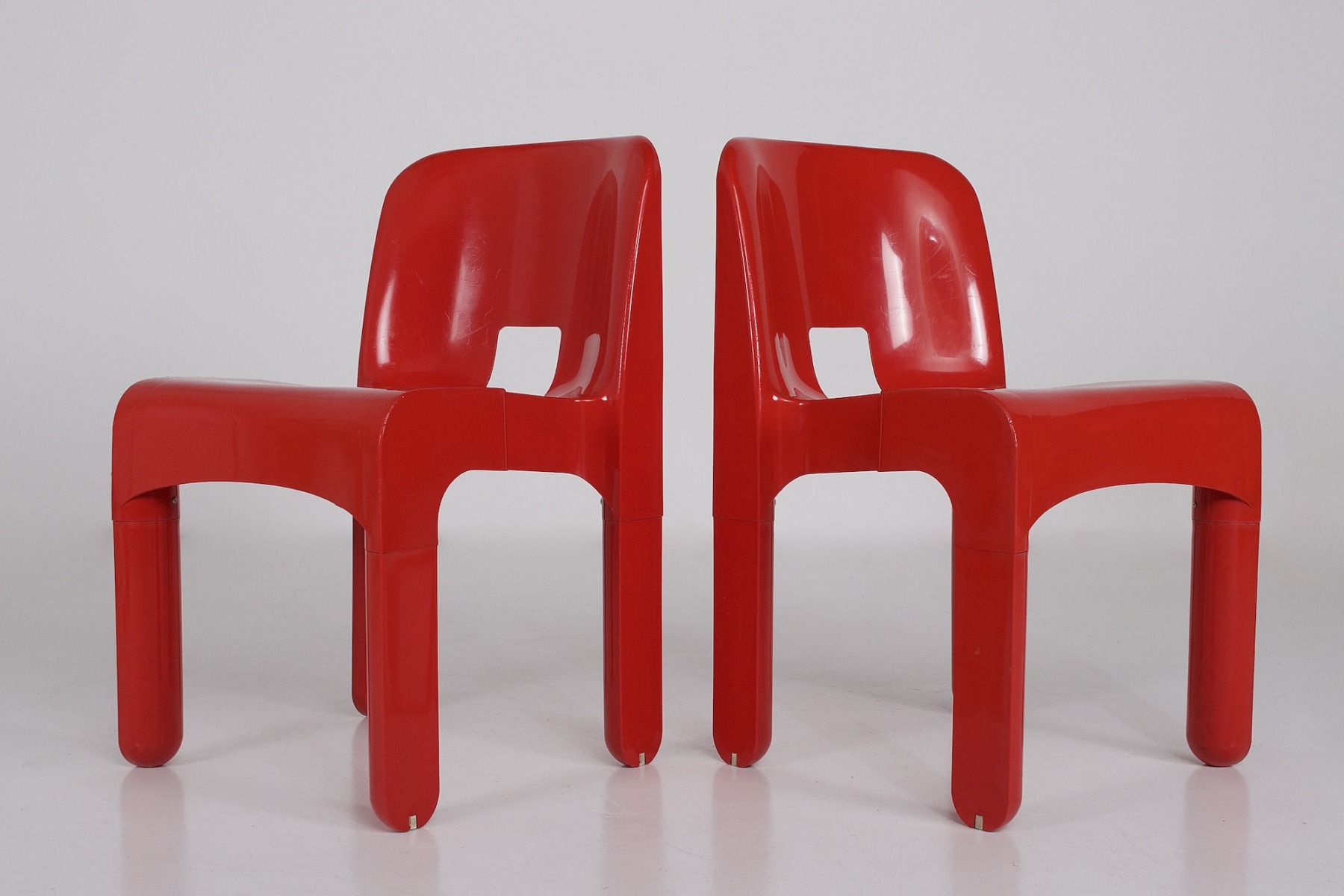
His work embodies the experimental spirit of 1960s design. For Kartell, he conceived the Universale chair, marketed in 1967, which exploits the possibilities of injected plastic. The 4801 armchair, initially made in bent plywood in 1965, reflects another approach to material and would later be reissued in plastic.
The Elda armchair: from Comfort editions to Longhi production
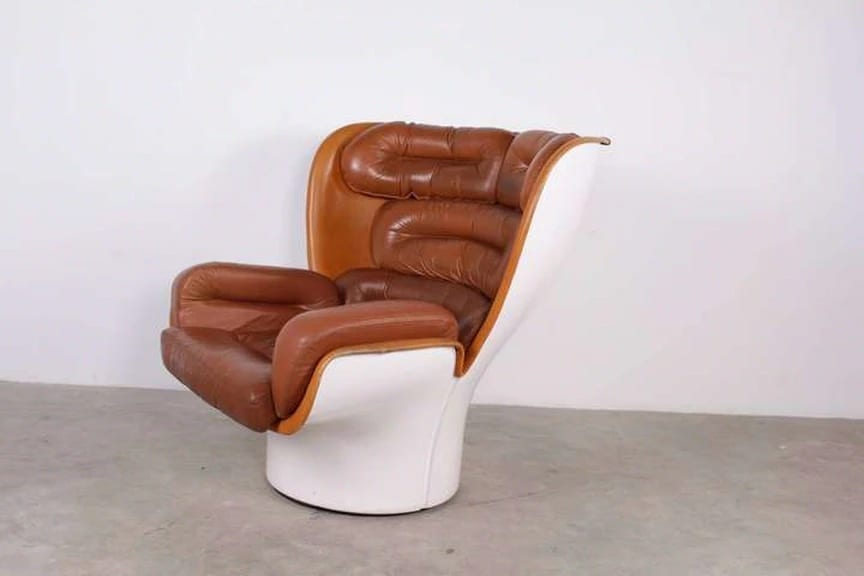
Created in 1963, the Elda armchair by Joe Colombo combines an imposing swiveling fiberglass shell with generous tufted leather cushions. The contrast between the rigidity of its structure and the suppleness of the upholstery gives rise to an enveloping, almost architectural armchair that has become emblematic of Italian design.
Put into production from 1965 by Comfort Fratelli Longhi, the Elda armchair still appears today in the Longhi catalog under reference X105. This continuity makes it essential to distinguish an early example from a contemporary manufacture. Comfort or Longhi markings, materials, construction details, and the consistency of their aging help refine the identification of the different editions.
The Boby trolley: from Bieffeplast to B-Line
Created in 1970 and initially published by Bieffeplast, the Boby trolley illustrates Joe Colombo’s pursuit of modularity. Its swiveling compartments and casters turn ordinary storage into mobile furniture, as useful in an office as in a workshop or a domestic interior.
Reissued by B-Line since 1999, the Boby remains one of the designer’s most recognizable creations. Early Bieffeplast editions and contemporary B-Line productions are distinguished in particular by their markings and their production period, two important criteria for vintage furniture enthusiasts.
Joe Colombo lamps: from Kartell to Oluce
Joe Colombo also applied his futuristic vision to lighting. For Kartell, he developed in the 1960s several lamps under the references KD24, KD27, KD28, and KD29. These models explore different possibilities of light diffusion and the use of synthetic materials: rounded reflectors, opaline diffusers, metallic finishes, and, for the KD29, an integrated tray.
The KD28, created in 1967, illustrates this research with its opaline plastic diffuser and rounded silhouette. Kartell put it back into production in 2025, adopting recycled materials, a satin diffuser, and a textile cable matched to the base. Early editions and contemporary productions must therefore be distinguished despite their resemblance. The letters KD are a Kartell catalog reference, with no expanded meaning sufficiently documented to be asserted.
For Oluce, Joe Colombo also designed several innovative design table lamps and floor lamps. The Spider (1965) and the Coupé (1967) favor adjustable reflectors, while the Acrilica, created with Gianni Colombo in 1962, exploits the optical properties of a thick piece of curved acrylic. Several of these models still appear in the Oluce catalog, extending their circulation well beyond the historic editions.
Gone too soon in 1971, Joe Colombo left a body of work that foreshadowed new ways of living in 1970s design. His creations remain sought after for their inventiveness, their functionality, and that singular way of imagining the future through everyday objects.