





Motoko Ishii Modular Prism Lamp for Staff Leuchten
€950,00
Ceiling light, wall sconce, or table lamp designed by Motoko Ishii composed of 5 clear glass octagonal prisms on a mirrored chrome-finish hard plastic base, Staff Leuchten edition, 1970s.
- H 30 x D 25 x W 25 cm.
- Single prism: H 10 x D 9 x W 13 cm.
- In very good condition. Originally built on a modular base, the elements are now permanently joined (riveted assembly – acquired as is – see photo of the base underside).
1 available in store

A versatile modular lamp from the 1970s
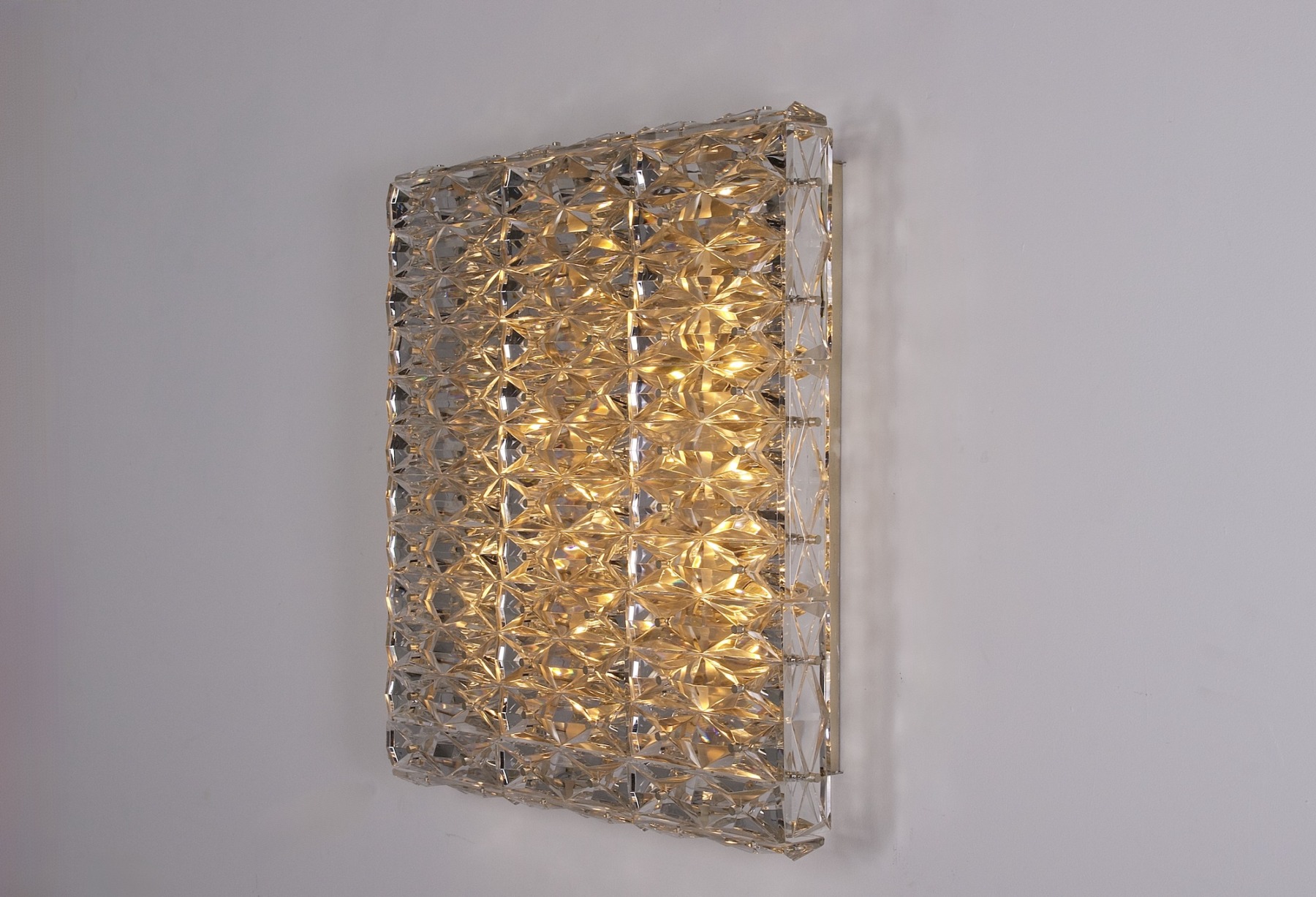
Each prism features a series of flat facets and crisp edges that capture and redistribute light. Their arrangement forms a sculptural composition of interlocking volumes with perspectives that shift depending on the viewing angle. When lit, the lamp reveals an interplay of transparency, reflections, and light contrasts that highlight each element’s contours.

Interplay of reflections and transparency between the translucent facets and mirroring prism surfaces, multiplying lighting effects.
Designed to function both as a ceiling light and a wall sconce, this lamp can also be used as a table lamp. In the latter case, we can fit a power cord with an inline switch upon request for use on a sideboard, console, or coffee table.
Motoko Ishii: A Sculptural Approach to Light
Born in Tokyo in 1938, Motoko Ishii is a Japanese lighting designer. After training and practicing in Finland and Germany, she founded her own studio in Tokyo in 1968.

Designer Motoko Ishii
Her career is distinguished by an approach to light that transcends mere illumination. Working at the scale of objects as well as architecture and urban environments, she creates projects in which light becomes an essential compositional medium. Her designs for German manufacturer Staff Leuchten reflect this philosophy: geometric forms, translucent materials, and reflective surfaces combine to produce lighting effects that shift with the viewer’s perspective.
This five-prism lamp embodies that vision: a rigorous composition whose geometry is enhanced by light, reflecting the spirit of Space Age experimentation and 1970s design.
You might also like…


Discover also...



Delivery to Belgium

Delivery to France

Delivery to Luxembourg
