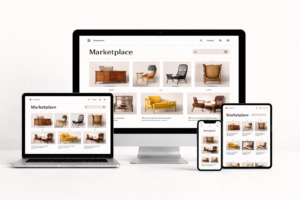
Marketplaces: a model to be examined in the medium and long term
Home ” Newspaper ” Marketplaces: a model to be examined in the medium and long term
Marketplaces offer immediate visibility. In the medium and long term, their effects on value, customer relations and the merchant’s identity need to be examined.
Marketplaces for independent merchants have established themselves as an almost indispensable step over the past fifteen years. They promise visibility, traffic, and commercial simplification. In the short term, these promises are often kept. In hindsight, however, certain limitations become clearer.
This analysis is not based on isolated experience. It is based on more than fifteen years’ experience with several European and American platforms, and very different business models. This timeframe enables us to distinguish between what works immediately and what, more slowly, weakens the balance of the business.
The point here is not to oppose platforms and dealers, but to observe, with hindsight, the real effects of a dependency that has become commonplace in the art, design and antiques trades.
Visibility is not the same as value
Selling on a marketplace sometimes offers rapid visibility, backed by an existing audience, marketing strength and referencing capacity that few independent structures can match on their own.
However, this visibility is, by nature, borrowed and diluted. Visitors primarily remember the platform’s name, then the item, rarely the source. In the continuous flow of pages, a relevant and carefully documented item can quickly find itself juxtaposed with opportunistic offerings, without any true qualitative hierarchy. The value of the merchant’s work then dissolves into a heterogeneous whole, where context and uniqueness struggle to emerge.
Over time, the question becomes: what’s left for the merchant when the platform changes its rules, algorithms or commercial priorities?
When the platform becomes the reference
One of the most discreet, yet most structuring, effects concerns how online visibility is redistributed. When the same items, with similar descriptions and images, are published simultaneously on multiple sites, an arbitration occurs. And in this arbitration, the platform, being more powerful and centralized, is often favored.
The marketplaces’ own SEO mechanisms reinforce this centralization. By aggregating pages, items, and interactions, the platform becomes the perceived reference, even when the content initially originates from the merchant. This cannibalization is rarely brutal; it is slow, cumulative, and often understood too late.
The invisible cost of simplicity
The promise of simplicity is largely based on a commission model, generally between 15 and 25%. Presented as the price of visibility, it actually acts as an invisible structural cost.
For the dealer, this commission directly reduces the value created by the work of selection, restoration and documentation. The more desirable an object is, the more noticeable the cut.
In the medium term, this mechanism leads to constrained trade-offs: higher prices, poorer sourcing or gradual erosion of margins. In all cases, it contributes little to the construction of an identity of its own, and feeds the growth of the platform above all.
Transport: when responsibility is diluted
Another point, often underestimated, concerns shipping costs. On many platforms, the price displayed to the buyer does not always correspond to the cost actually borne by the merchant. Pricing grids, logistics margins and internal adjustments create an asymmetry of information.
Added to this is a very concrete problem: in case of delay, damage, or incident, the platform and the carrier frequently shift responsibility to each other. The client becomes impatient, and the merchant spends time resolving a situation they do not fully control. This dilution weakens a central element of the art and design market: trust.
A customer relationship that erodes over time
The heart of the merchant’s business is based on relationships: dialogue, transmission, fine-tuned understanding of expectations, and long-term follow-up.
On a marketplace, this relationship is largely filtered out. The merchant sells, but exchanges less. He operates within a framework that does not belong to him.
In the short term, the system may seem efficient. In the long term, however, it tends to reduce the merchant to a logistical function, diluting what made his know-how unique.
Taking back control
These observations do not mean that marketplaces are useless or to be dismissed out of hand. They can play an occasional role: launch, temporary visibility, access to new audiences.
However, they do not constitute a sustainable horizon for a merchant who wishes to preserve the authorship of their work, control their customer relationship, and establish their activity long-term. Recentering a part of the activity around direct sales from the merchant, via their own website, allows for a clearer, more controlled, and more consistent relationship in the long run.
Today, more and more professionals are making this choice, designing their site not as a simple catalog, but as a documented, assertive editorial space.
Marketplaces are not the problem.
Exclusive dependence, however, becomes one.
In the medium and long term, the solidity of a merchant depends less on the multiplication of shop windows than on the clarity of its source. Building your own visibility takes more time, more effort and more consistency – but it’s also the only way to turn a commercial activity into real capital.
A selection of pieces resulting from this work is presented on our site, with a direct, documented, and intermediary-free approach.
Joseph-André Motte holds a unique place in the renewal of post-war French furniture. However, his career was not limited to furniture design: he was also active in interior architecture, the layout of public facilities, teaching,...
René-Jean Caillette (1919–2004) belongs to that generation of designers who, in the 1950s and 60s, profoundly transformed French furniture. At a time when furnishing still hesitated between decorative tradition and industrial production, he resolutely chose...
In the history of post-war Belgian furniture, Alfred Hendrickx holds a singular place. Today, his name is mainly associated with Belform, its sideboards and credenzas with taut lines, its tables, seating and modular storage systems....
×
1
Product selection
2
Contact information
3
Review information
error: Content is protected !!
Gérer le consentement
Pour offrir les meilleures expériences, nous utilisons des technologies telles que les cookies pour stocker et/ou accéder aux informations des appareils. Le fait de consentir à ces technologies nous permettra de traiter des données telles que le comportement de navigation ou les ID uniques sur ce site. Le fait de ne pas consentir ou de retirer son consentement peut avoir un effet négatif sur certaines caractéristiques et fonctions.
Fonctionnel
Always active
L’accès ou le stockage technique est strictement nécessaire dans la finalité d’intérêt légitime de permettre l’utilisation d’un service spécifique explicitement demandé par l’abonné ou l’utilisateur, ou dans le seul but d’effectuer la transmission d’une communication sur un réseau de communications électroniques.
Préférences
L’accès ou le stockage technique est nécessaire dans la finalité d’intérêt légitime de stocker des préférences qui ne sont pas demandées par l’abonné ou l’internaute.
Statistiques
Le stockage ou l’accès technique qui est utilisé exclusivement à des fins statistiques.Le stockage ou l’accès technique qui est utilisé exclusivement dans des finalités statistiques anonymes. En l’absence d’une assignation à comparaître, d’une conformité volontaire de la part de votre fournisseur d’accès à internet ou d’enregistrements supplémentaires provenant d’une tierce partie, les informations stockées ou extraites à cette seule fin ne peuvent généralement pas être utilisées pour vous identifier.
Marketing
L’accès ou le stockage technique est nécessaire pour créer des profils d’internautes afin d’envoyer des publicités, ou pour suivre l’utilisateur sur un site web ou sur plusieurs sites web ayant des finalités marketing similaires.