



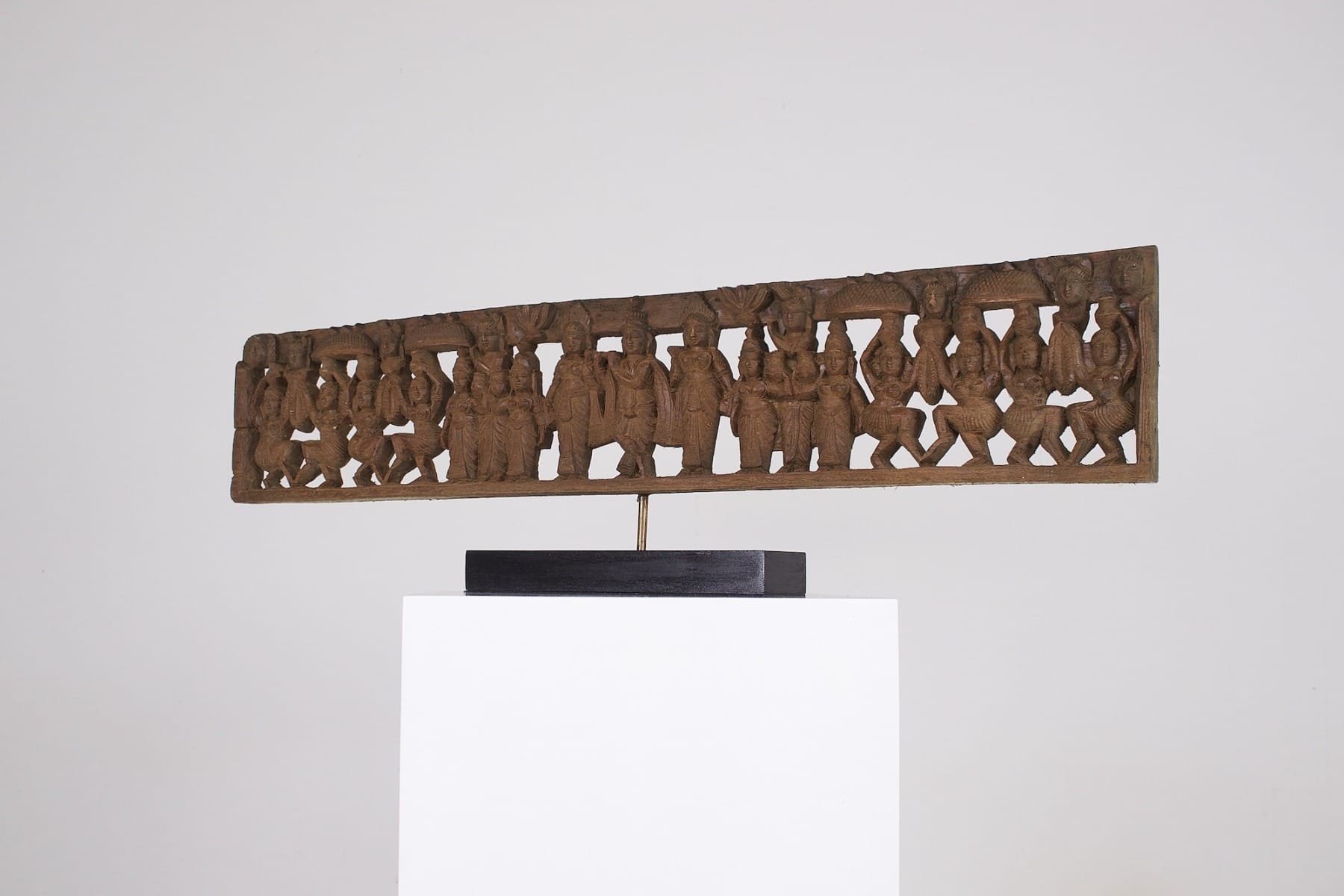


Openwork carved wooden panel – South India
Openwork carved wooden panel from South India, decorated with figures illustrating a narrative scene linked to Hindu iconography. Tamil Nadu or Karnataka, early 20th century.
- W 98 cm × D 4 cm × H 19 cm (without base).
- H with base: 28 cm.
- Base included: W 32 cm × D 9 cm × H 4 cm.
Sold

Openwork carved panel and the tradition of architectural woodwork in South India
This openwork carved wooden panel from Tamil Nadu or Karnataka illustrates the decorative traditions developed in South Indian architecture at the turn of the 20th century. Its narrative decoration linked to Hindu iconography forms part of an ornamental vocabulary combining religious symbolism, protective creatures, and architectural wood carving.
With its horizontal format and deeply carved decoration, this work can be compared to architectural elements produced for traditional homes in Tamil Nadu, notably in the Chettinad region, famed for its rich ensembles of carved woodwork adorning doors, lintels, panels, and structural elements.
The art of wood carving in India developed over the centuries through a tradition combining craftsmanship, religious symbolism, and architectural decoration. Its origins date back to India’s great ancient civilizations, notably the Maurya and Gupta periods, when carved wood already adorned temples, palaces, and aristocratic residences.
Architectural elements such as doors, pillars, lintels, or carved panels played an essential role in the ornamentation of religious and domestic buildings. Wood carving saw significant development during the medieval period, notably in regions such as Karnataka or Tamil Nadu, where artisans and sculptors created complex decorations combining deities, floral motifs, sacred birds, and fantastic creatures.
Teak and other dense woods resistant to insects and humidity were widely used, explaining the preservation of many old examples to this day. After the colonial period and up to the early 20th century, these carved traditions continued to hold an important place in the domestic and religious architecture of South India.
Provenance: Former Collection Claude de Marteau
You might also like…


Discover also...



Delivery to Belgium

Delivery to France

Delivery to Luxembourg
