





10 “Binocle” Chairs by Georges Vanrijk and Beaufort
Rare set of 10 chairs “Binocle“, designed by Georges Vanrijk for Beaufort. Belgium, 1965.
- Polished cast aluminum legs, chrome steel backrest slat, original beige fabric upholstery.
- The seats and backrests have been cleaned with a shampoo cleaner by our restorer; they are in good condition and rarely show signs of normal wear.
- H 79 CM X D 40 CM X W 43 CM.
- H sitting 42 CM.
Sold

The Binocle chairs by Georges Vanrijk for Beaufort, 1965
This rare suite of ten Binocle chairs was designed by Georges Vanrijk for Beaufort in 1965. Period documentation preserved with the model allows us to go beyond a simple attribution: the Beaufort Collection ’65 brochure directly reproduces the Binocle chairs and credits designer G. Vanrijk.
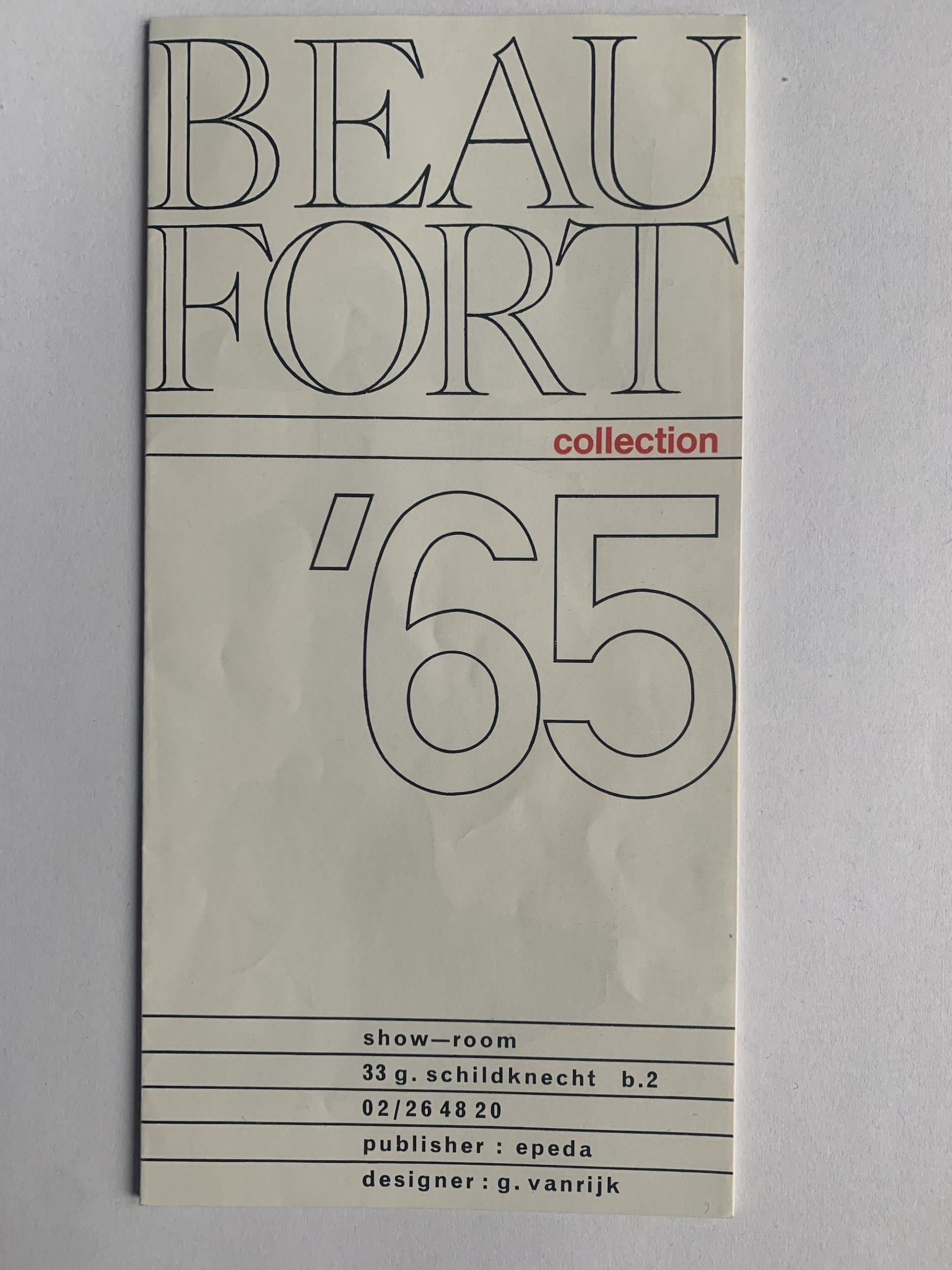
The 1965 Beaufort brochure.
The brochure photograph shows them around a table, in a typically modernist staging. Their design appears in all its simplicity: a very light central base supports a seat and a backrest, both upholstered and of similar, almost oval shapes. Viewed from the front, these two superimposed volumes immediately explain the name “Binocle,” like two lenses separated by the backrest’s thin metal blade.
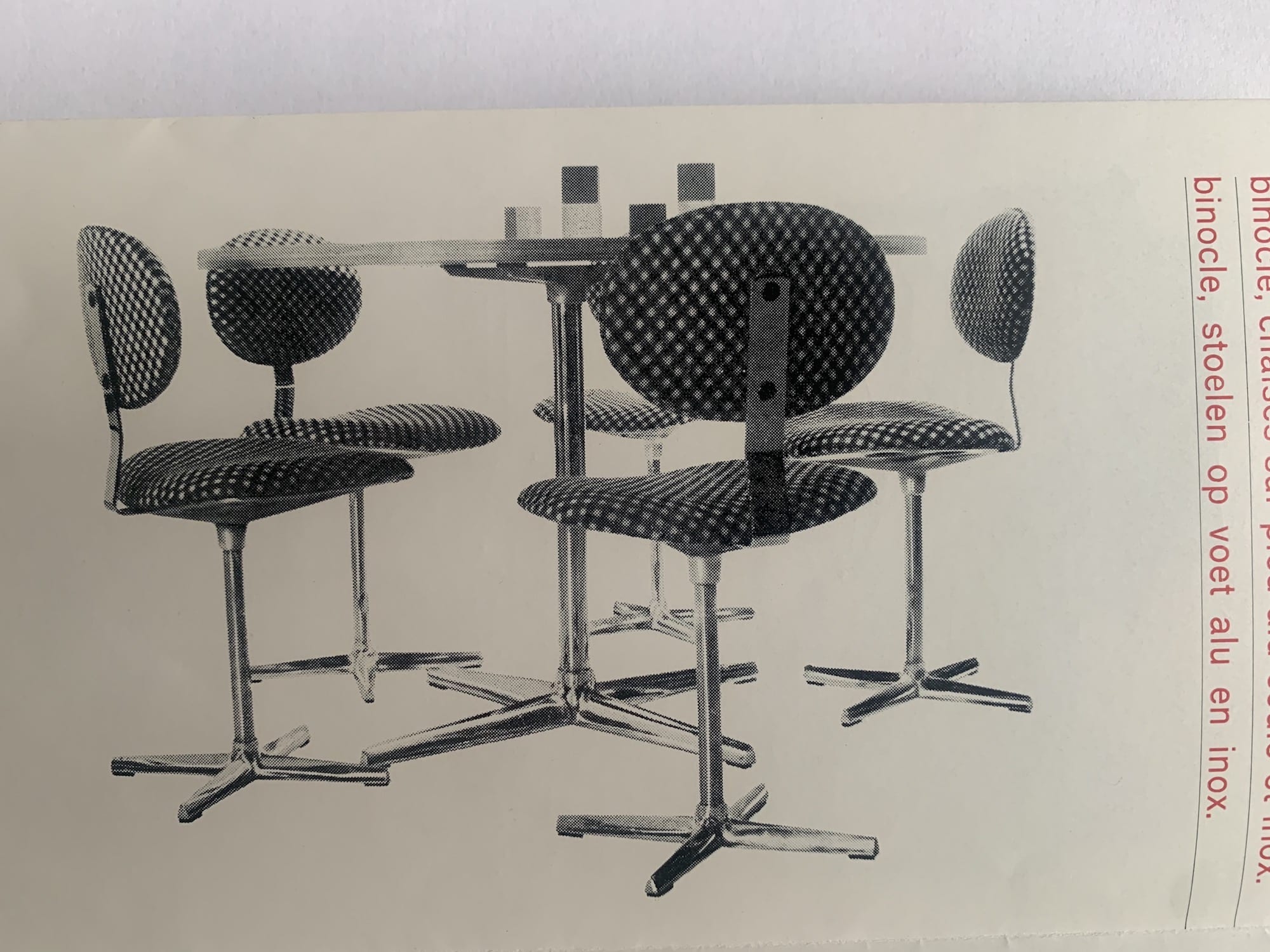
The Binocle chairs by Georges Vanrijk in a 1965 Beaufort leaflet.
This construction gives the chairs a particularly graphic silhouette. The polished cast aluminum base, ending in four branches, visually lightens the ensemble, while the vertical chromed steel blade leaves a clean space between the seat and the backrest. The shiny metal contrasts with the softness of the upholstery and emphasizes the model’s taut lines without ever weighing it down.
In this suite, the ten chairs have retained their original beige fabric upholstery, a particularly valuable element for a set dating from 1965. Together, they form a remarkably homogeneous group and allow for the recreation of the effect sought in the Beaufort catalogue photograph: the repetition of the same design creates almost an architecture around the table.
The Binocle chairs testify to a Belgian design of the 1960s that is both rational and playful. Vanrijk reduces the chair to a few highly legible elements—a central base, two upholstered surfaces, and a metal connection—but imbues them with enough character to make the model immediately recognizable.
The presence of the 1965 Beaufort brochure constitutes a particularly interesting document for this suite: it places the chairs within their creation context and allows for a direct comparison of the preserved examples with the model presented at the time of their commercialization.
You might also like…


Discover also...

Delivery to Belgium

Delivery to France

Delivery to Luxembourg
