



Gaetano Sciolari
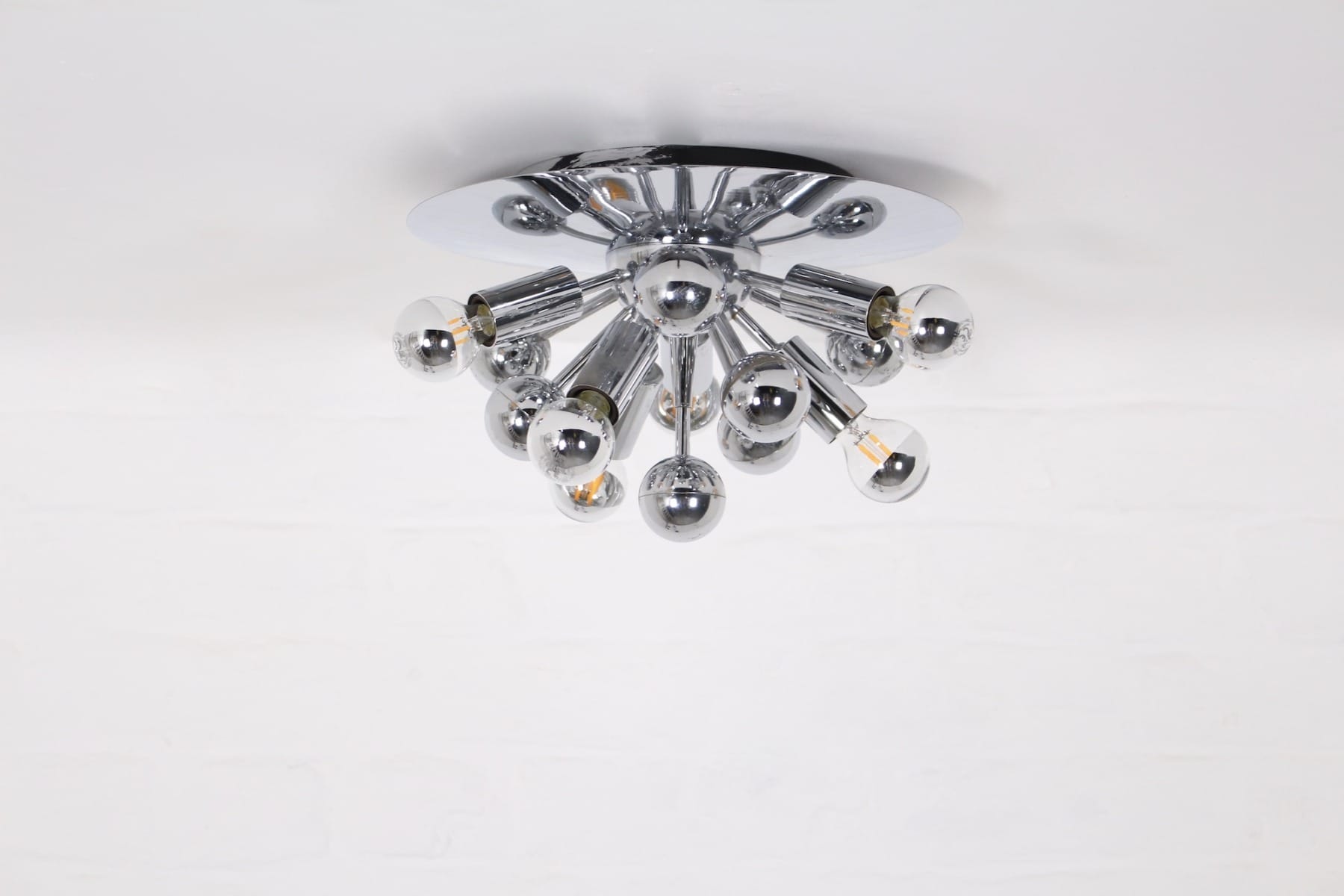
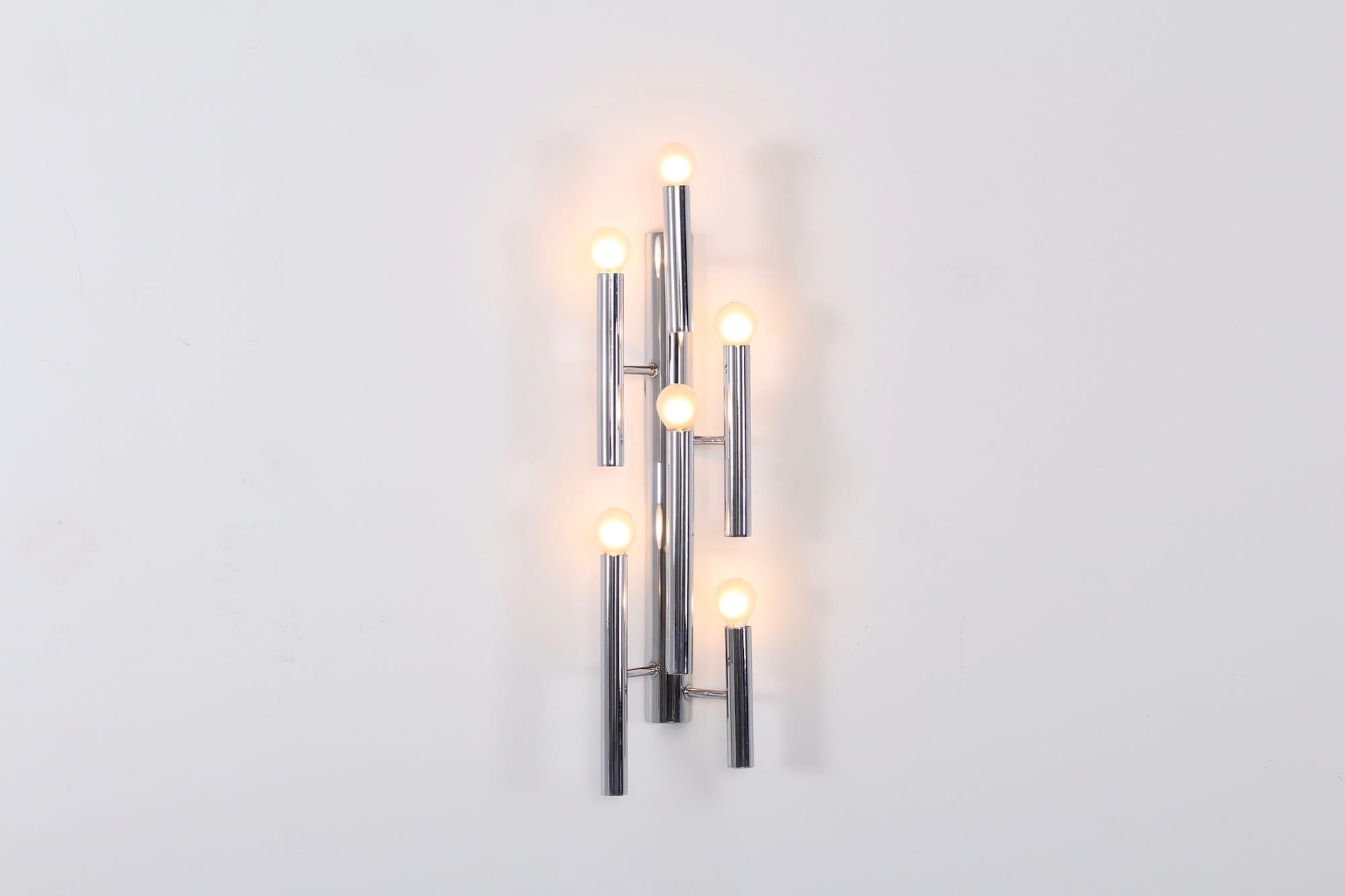
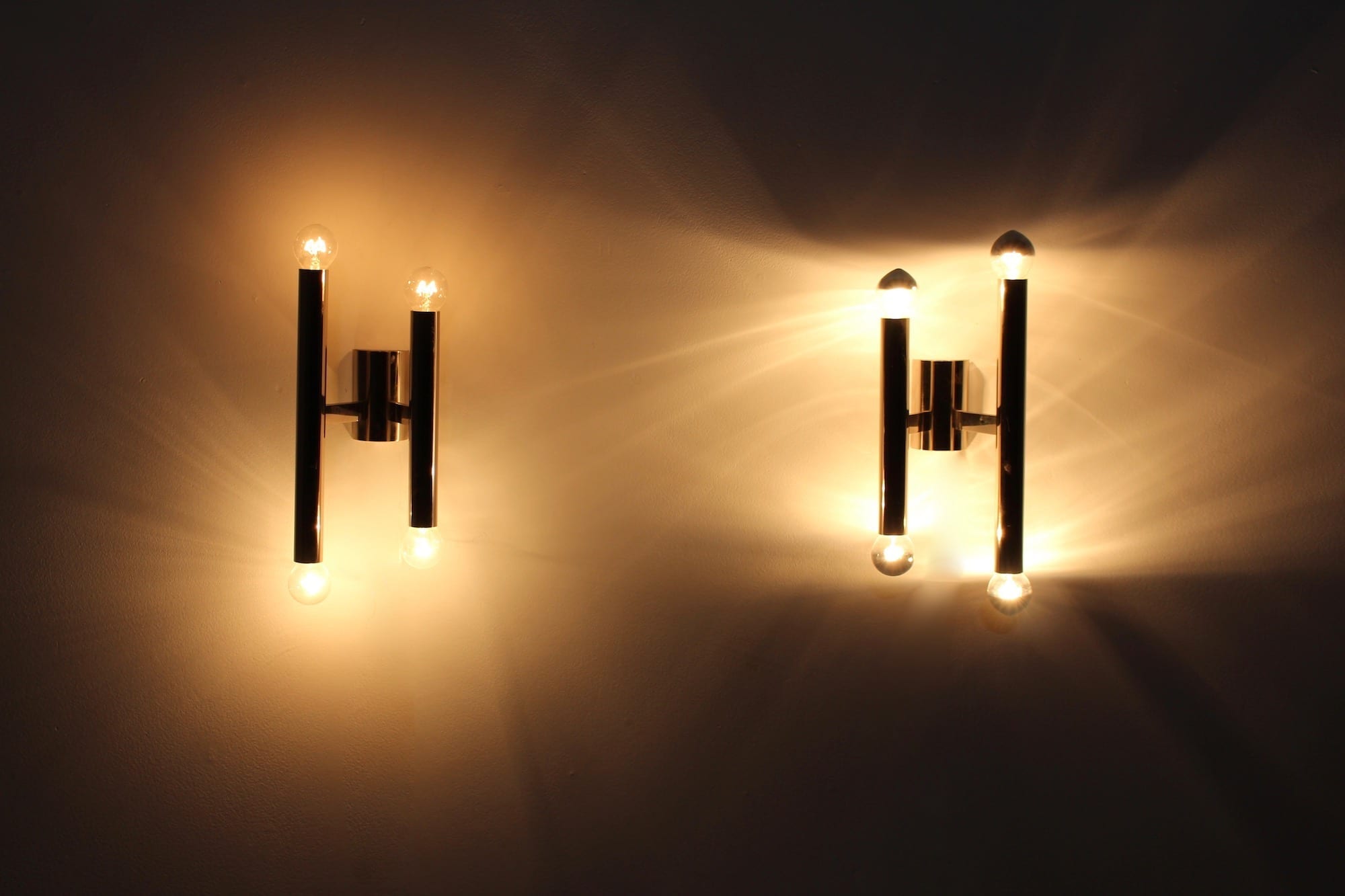
The chandeliers and lighting fixtures of Gaetano Sciolari are among the most recognizable expressions of Italian design from the 60s and 70s. Geometric structures, brass, chrome, polished steel, and occasionally crystal compose fixtures whose presence far exceeds their lighting function. This selection brings together creations by Sciolari and Sciolari Illuminazione, including chandeliers, pendants, ceiling lights, and wall sconces, as well as period lighting influenced by his aesthetic language.


Gaetano Sciolari: lighting as architecture
In 1949, Gaetano Sciolari (1927-1994) took over the family lighting business founded in Rome in 1892. Initially drawn to architecture and cinema, he developed a vision of lighting in which structure, proportions, and geometric composition played a central role.
His collaborations with Stilnovo in the 1950s accompanied the renewal of post-war Italian design. Traditional chandelier forms gradually gave way to more linear constructions, based on the assembly and repetition of metallic elements.
It was mainly during the 1960s and 70s that Sciolari established his aesthetic language and achieved international success, particularly among enthusiasts of American interior design.
Sciolari chandeliers: brass, chrome, and geometric compositions
Gaetano Sciolari’s chandeliers stand out for their architectural, sometimes complex, structures built from relatively simple forms: tubes, cylinders, cubes, rectangles, and orthogonal arms.
The designer exploited contrasts between metals. Gilded brass sits alongside chrome and polished steel, while reflective surfaces multiply the play of light. Some models also incorporate glass or crystal elements.
The repetition of geometric shapes gives these fixtures a sculptural presence. Suspended in the center of a room, they form compositions whose appearance changes depending on the vantage point, whether lit or unlit.
This aesthetic sometimes aligns with the Hollywood Regency style, especially popular in the United States, where glossy metallic finishes and spectacular compositions play a prominent role in interior design.
Sciolari Illuminazione and international distributors
Gaetano Sciolari’s success quickly crossed Italian borders. In addition to Sciolari Illuminazione, his creations are associated with several European and American manufacturers and distributors, notably Stilnovo, Stilkronen, Lightolier, and Progress Lighting.
Other names appear in the documentation and lighting market of this period, including S.A. Boulanger in Belgium, Helestra and Leola in Germany, Lyfa in Denmark, as well as Metalarte, Valenti, and Ecolight. However, the exact nature of these collaborations must be examined according to specific models and period catalogs.
This international circulation helped make Sciolari’s creations known well beyond Italy, while also spreading his aesthetic among numerous lighting manufacturers.
Sciolari’s influence on 1970s lighting
Gaetano Sciolari left such a deep mark on interior lighting that many European manufacturers borrowed his aesthetic language, sometimes with real flair.
Geometric compositions, repeated metallic elements, and the interplay of reflections between brass and chrome became hallmarks of an entire generation of vintage chandeliers and pendant lights.
The Belgian manufacturer Massive is among the companies that marketed lighting close to this aesthetic, although no direct collaboration with Sciolari has been established.
These pieces are sometimes labeled as “copies,” either because they bear no signature or because they use more economical materials, such as brass-plated or lacquered metal rather than solid brass.
However, this assessment deserves nuance. Not all these fixtures offer the same manufacturing quality, but some possess genuine aesthetic and decorative qualities.
Distinguishing the real from the fake becomes almost a rearguard action when considering these fixtures for what they are: witnesses to an era when interior lighting was envisioned as a sculpture in its own right. While the signature, material quality, and manufacturing techniques remain important, they alone cannot determine the aesthetic interest of a fixture.
Many of these models have now become rare. Their interest also lies in their proportions, their construction, and their ability to occupy space.
A Sciolari chandelier in a living room, dining room, or entrance hall
The diversity of formats allows Sciolari’s creations to be integrated into very different interiors. A large multi-arm chandelier naturally finds its place above a dining table or in a spacious living room. Its structure stands out in the space and remains decorative even when turned off.
In an entrance hall or a stairwell, vertically developed models complement the ceiling height and can be observed from multiple levels. Their geometric composition then takes on an almost architectural dimension.
More compact models, notably certain vintage ceiling lights, are suitable for rooms where a strong decorative presence is desired without cluttering the volume. Wall sconces allow this aesthetic to be extended into a hallway, a bedroom, or on either side of a mirror.
The contrast between the metallic structures of the 1970s and contemporary materials also explains their appeal in interiors not exclusively furnished with vintage pieces.
Hotels, restaurants, bars, and shops: lighting that catches the eye
Sciolari’s creations also find their place in interior architecture projects for hotels, restaurants, and commercial spaces.
Their sculptural character creates an immediate focal point in a hotel lobby, above a reception desk, or in a restaurant. A large-scale chandelier can alone contribute to defining the visual identity of a space.
We also find that many of our clients choose these fixtures for their boutiques and bars. Their spectacular, almost theatrical side makes them true eye-catchers, capable of drawing the eye even before their lighting function is noticed.
In these projects, the fixture is no longer chosen just to provide light: it participates in the decor, the atmosphere, and the identity of the place. Brass and chrome models are particularly well-suited for this use, thanks to the reflections they produce in both natural light and when lit.
Buy a Gaetano Sciolari chandelier at Vintage Addict
Vintage Addict offers a selection of chandeliers, pendant lights, ceiling lights, and wall lights by Gaetano Sciolari and Sciolari Illuminazione, as well as other 20th-century vintage lighting.
Pieces requiring intervention go through our restoration workshop in Liège. Metallic structures, assemblies, sockets, and electrical components are examined and, when necessary, refurbished or replaced.
Our catalog also maintains records of sold models, allowing you to find various creations, variants, and finishes of Sciolari’s production. We assist individuals, collectors, interior architects, and decorators in their search, in Belgium, France, and internationally.